
Bounce House Materials Explained (2026): Nylon vs PVC vs Hybrid
Deep dive into bounce house materials including nylon, PVC, and hybrid builds. Learn durability, safety, failure points, and which material lasts longest.
Frank “Frosty” Adminei
5/13/20265 min read
Bounce House Materials Explained (2026): Nylon vs PVC vs Hybrid
Frank “Frosty” Adminei
Intro
Bounce house material is the single most important factor in long-term performance.
Not design. Not shape. Not even size.
Two identical bounce houses can behave completely differently depending on whether they are made from nylon, PVC, or hybrid construction.
This guide goes deeper than surface comparisons and breaks down:
how each material is engineered
how it fails under stress
how it performs in real backyard conditions
and which one actually makes sense for your use case
For setup interaction, see Bounce House Yard Prep Guide (2026): Slope, Clearance & Surface Types, since surface conditions directly impact material wear.
Who This Guide Is For
This guide is for:
Buyers confused by price differences
Parents choosing between “cheap vs durable” models
Homeowners planning repeated seasonal use
Renters needing lightweight portability
Anyone comparing nylon vs PVC long-term value
For age-based matching, Best Bounce Houses by Age Group (2026 Guide) helps align material strength with usage intensity.
Why This Topic Matters
Material determines:
Structural integrity under load
Resistance to tearing and abrasion
Air retention consistency
UV and weather degradation rate
Long-term cost of ownership
Most product dissatisfaction comes from mismatched expectations about material performance—not design flaws.
For safety implications, see Are Bounce Houses Safe? (2026 Parent Guide).
Age Group Segmentation
Toddlers (2–4)
Low force impact
Nylon sufficient
Comfort > durability
Young Kids (5–8)
Moderate bounce force
Hybrid recommended
Stability becomes important
Older Kids (9–12)
High stress loading
PVC strongly preferred
Seam integrity critical
For operational safety, see Bounce House Safety for Parents (2026): Age, Weight & Weather Rules.
Material Science Breakdown (Deep Dive)
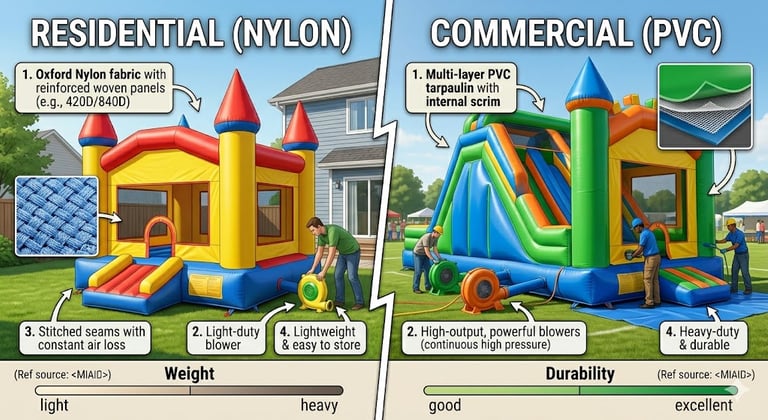
1. Nylon (Woven Fabric System)
Nylon bounce houses are built using tightly woven synthetic fibers.
Structure:
Interlaced fiber matrix (fabric-like behavior)
Coated for air retention
Flexible under pressure
Key performance traits:
Low weight-to-strength ratio
High flexibility under dynamic movement
Moderate tear resistance
Strength behavior:
Nylon absorbs force by stretching slightly rather than resisting rigidly.
This makes it:
Comfortable for light bouncing
Easier to transport
Less stable under heavy repetitive force
Weak points:
Abrasion wear from rough surfaces
UV degradation over time
Seam stress under high load
👉 Nylon behaves more like textile engineering than structural containment.
2. PVC (Vinyl Pressure Shell System)
PVC bounce houses use thermoplastic vinyl sheets fused into airtight chambers.
Structure:
Layered vinyl sheets
Heat-welded seams
High internal air pressure retention
Key performance traits:
High rigidity under inflation
Excellent tear resistance
Strong shape memory
Strength behavior:
PVC resists deformation by distributing force across a rigid air chamber.
This makes it:
Highly stable under heavy use
Resistant to repetitive impact cycles
More durable over long-term exposure
Weak points:
Heavier material increases setup difficulty
Higher cost
Can crack under extreme cold if low-grade PVC is used
👉 PVC behaves closer to a pressurized structural shell than fabric.
If the durability advantages of PVC make commercial construction the better fit for your situation, Best Commercial Bounce Houses (2026): Heavy-Duty PVC and Pro-Level Units compares actual heavy-duty models using the material, blower and structural characteristics explained here.
3. Hybrid (Reinforced Composite System)
Hybrid bounce houses combine PVC outer layers with fabric reinforcement.
Structure:
PVC-coated exterior
Reinforced internal fabric mesh
Multi-layer seam systems
Key performance traits:
Balanced flexibility and rigidity
Moderate weight
Improved tear distribution
Strength behavior:
Hybrid systems distribute force across multiple material layers, reducing localized stress points.
This makes it:
More stable than nylon
Lighter than full PVC
Adaptable for mixed usage environments
Weak points:
Performance varies by manufacturer
Not as durable as full PVC
Mid-range lifespan ceiling
👉 Hybrid is best described as a compromise engineering system.
Material choice also has a major effect on price. How Much Does a Bounce House Cost? (2026 Pricing Guide) shows how moving from residential nylon into reinforced hybrid and commercial PVC construction changes both purchase cost and what you get for the money.
Failure Modes (What Actually Breaks First)
Understanding failure patterns matters more than marketing claims.
Nylon failure points:
Base abrasion wear (most common)
Seam stitching fatigue
UV weakening of fibers
Edge tearing at anchor stress points
PVC failure points:
Seam weld separation under extreme misuse
Cold-weather stiffness cracking (low-quality units)
Overpressure stress if blower is oversized
Hybrid failure points:
Layer delamination (rare but critical)
Coating wear exposing fabric core
Mixed-material seam fatigue
Product Modules
![ACTION AIR [Updated Version] Bounce House, Inflatable Bouncer with Air Blower, Jumping Castle with S](https://assets.zyrosite.com/cdn-cgi/image/format=auto,w=768,h=498,fit=crop/mP4QzgGOwxS6r9vq/action-air-updated-version-bounce-house-inflatable-bouncer-with-air-blower-jumping-castle-with-slide-family-backyard-bouncy-castle-durable-sewn-with-extra-thick-material-idea-for-kids-F2WwA6ou6XSozvh6.jpg)
![ACTION AIR [Updated Version] Bounce House, Inflatable Bouncer with Air Blower, Jumping Castle with S](https://assets.zyrosite.com/cdn-cgi/image/format=auto,w=375,h=366,fit=crop/mP4QzgGOwxS6r9vq/action-air-updated-version-bounce-house-inflatable-bouncer-with-air-blower-jumping-castle-with-slide-family-backyard-bouncy-castle-durable-sewn-with-extra-thick-material-idea-for-kids-F2WwA6ou6XSozvh6.jpg)
Action Air Bounce House (Nylon – Amazon Bestseller)
Search phrase: Action Air bounce house inflatable
Lightweight nylon construction
Best for occasional residential use
Easy setup and storage
Lower abrasion resistance
Ideal for younger children
Budget-friendly entry point
Requires careful ground prep
A simple, low-maintenance option for casual backyard use.
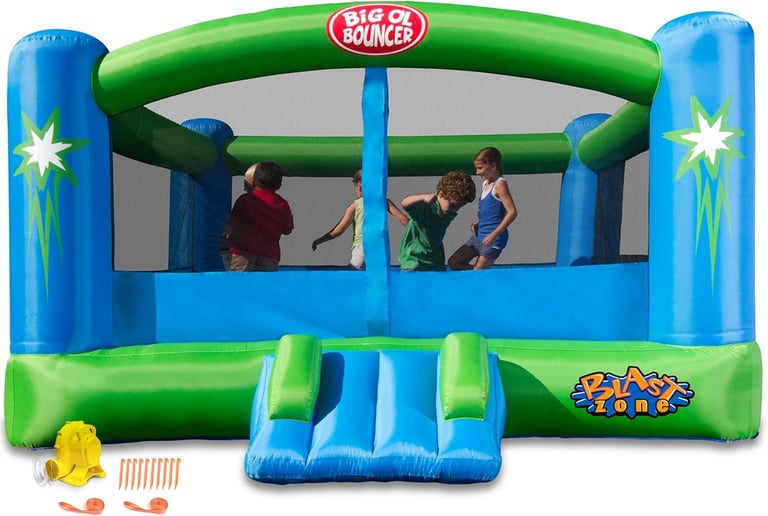
Blast Zone Big Ol Bouncer (PVC – Amazon Bestseller)
Search phrase: Blast Zone Big Ol Bouncer bounce house
Heavy-duty PVC vinyl construction
High structural rigidity under load
Designed for repeated seasonal use
Strong seam welding system
Higher weight and durability
Best for older kids or frequent use
Requires stronger anchoring system
A long-term durability choice for serious backyard setups.


Intex Jump-O-Lene Castle (Hybrid – Amazon Bestseller)
Search phrase: Intex Jump-O-Lene inflatable bounce house
Hybrid reinforced vinyl system
Lightweight but more stable than nylon
Moderate durability profile
Easy indoor/outdoor use
Best for light recreational use
Lower capacity than PVC models
Highly portable and easy to store
A flexible option for mixed indoor and outdoor setups.
Safety Notes
Nylon = flexible but wear-prone
PVC = strongest structural integrity
Hybrid = balanced but variable
Material choice directly impacts:
anchoring needs
wind sensitivity
lifespan expectations
See Bounce House Weather Guide (2026): Wind, Rain & Temperature Rules for environmental limits.
Buying Considerations
Key decision factors:
Usage frequency
User age intensity
Storage capacity
Budget vs lifespan expectations
PVC offers lowest long-term cost per use.
Nylon offers lowest upfront cost.
Hybrid sits between both.
Material Decision Matrix
Occasional use → Nylon
Weekly/seasonal use → Hybrid
Heavy/frequent use → PVC
Small storage space → Nylon or hybrid
Long-term investment → PVC
Yard Size / Fit Considerations
Material affects behavior:
Nylon = more movement during use
PVC = stable footprint
Hybrid = moderate movement
Heavier materials require more stable yard prep.
See Bounce House Size Calculator (2026): Yard Fit & Space Requirements.
Setup
Nylon shifts more during inflation
PVC holds structure immediately
Hybrid stabilizes mid-inflation
See How to Set Up a Bounce House Safely (2026 Step By Step Guide).
Maintenance
Nylon: frequent inspection required
PVC: easy cleaning, long lifespan
Hybrid: moderate maintenance
Storage
Nylon: compact storage
PVC: bulky but durable
Hybrid: mid-range footprint
See Bounce House Storage Guide (2026): Folding, Drying & Long Term Care.
Key Takeaways
Material is the core performance driver
Nylon = lightweight convenience
PVC = maximum durability
Hybrid = balanced flexibility
Failure modes differ by construction type
Mini Conclusion
Bounce house material determines how the inflatable behaves under real stress—not just how it looks or inflates.
Understanding nylon, PVC, and hybrid systems helps you avoid underbuying or overpaying and ensures your setup matches real-world usage expectations.
Related Articles
Are Bounce Houses Safe? (2026 Parent Guide)
Bounce House Safety for Parents (2026): Age, Weight & Weather Rules
Bounce House Yard Prep Guide (2026): Slope, Clearance & Surface Types
Bounce House Setup Mistakes to Avoid (2026)
Bounce House Weather Guide (2026): Wind, Rain & Temperature Rules
Best Bounce Houses by Age Group (2026 Guide)