
Bounce House Storage Guide (2026): Folding, Drying and Long‑Term Care
Learn how to properly dry, fold, and store a bounce house to prevent mold, cracking, and seam damage. Nylon vs PVC storage rules, blower care, seasonal storage, and Frosty’s pro tips.
By Frank “Frosty” Adminei
5/21/20262 min read
Bounce House Storage Guide (2026): Folding, Drying and Long‑Term Care
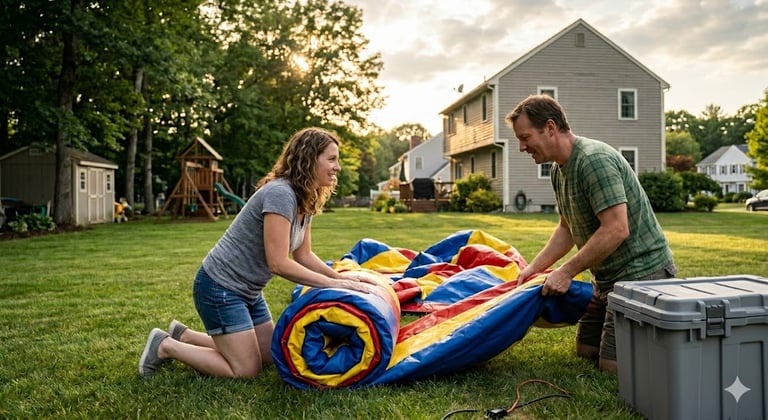

WHO THIS GUIDE IS FOR
This guide is designed for:
Parents storing residential nylon bounce houses
Owners of commercial PVC inflatables
Rental operators preparing for seasonal downtime
Homeowners wanting to prevent mold and cracking
Anyone who wants their inflatable to last 5–10+ years
If you haven’t cleaned your unit yet, start with:
How to Clean a Bounce House (2026 Step‑By‑Step Guide).
WHY PROPER STORAGE MATTERS
A bounce house is a fabric‑based pressure vessel. When stored incorrectly, three things happen:
Moisture becomes mold
Seams weaken from compression
PVC cracks in cold temperatures
Nylon becomes brittle if UV‑damaged
Material Behavior:
Nylon dries fast but absorbs moisture.
PVC dries slow but resists abrasion.
Frosty’s note: “Almost dry is still wet — and wet is mold.”
PRE‑STORAGE CHECKLIST
HOW TO DRY A BOUNCE HOUSE PROPERLY
Drying is the most important step in long‑term care.
Nylon and PVC behave differently — and Frosty’s rules reflect that.
⭐ Drying Nylon (Residential)
Run blower 10–15 minutes
Sun‑dry 20–30 minutes
Flip corners
Use box fan for shaded areas
Avoid >1 hour direct sun (UV brittles nylon)
Behavior:
Nylon dries fast but absorbs moisture → must check seams and underside.
⭐ Drying PVC (Commercial)
Run blower 20–30 minutes
Towel‑blot puddles
Lift corners to drain pockets
Add airflow assist
Sun‑dry 45–60 minutes
Dry underside
Frosty’s trick:
“Dry PVC twice — inflated and deflated.”
PVC dries slow and traps water in pockets → double‑drying prevents mold.
FOLDING A BOUNCE HOUSE
Nylon and PVC fold differently because of weight, stiffness, and seam behavior.
⭐ Folding Nylon (Residential)
Deflate
Walk air out
Fold sides inward
Fold in half/thirds
Roll toward blower tube
Strap
Behavior:
Light, flexible, easy to roll.
⭐ Folding PVC (Commercial)
Deflate
Walk air out slowly
Fold into long strip
Fold strip into thirds
Roll tightly
Strap twice
Lift with legs
Frosty’s trick:
“Leave 5–10% air inside to shape the roll.”
PVC rolls cleaner with a little internal structure.

SHORT‑TERM STORAGE (DAILY/WEEKLY)
Store in garage/shed
Keep off concrete
Avoid rodents
Keep humidity low
Store blower separately
Avoid chemicals/fertilizers nearby
Why:
Concrete wicks moisture → mold.
Rodents chew nylon → catastrophic damage.
LONG‑TERM STORAGE (SEASONAL)
⭐ Temperature Rules
PVC becomes brittle below 40°F
Nylon becomes brittle below 20°F
Avoid unheated sheds
Avoid attics
⭐ Storage Containers
Use:
Heavy‑duty bins
Industrial bags
Contractor totes
Avoid:
Cardboard
Thin plastic bags
⭐ Mold Prevention
Add desiccants
Leave air gap
Inspect monthly
Tarp under + over unit
Frosty’s winterization:
“Unroll PVC once mid‑season.”
BLOWER STORAGE GUIDE
Wipe dust
Wrap cord loosely
Store in dry bin
Keep off concrete
Avoid freezing
Never store with moisture inside
Why:
Moisture inside blower housings → rust + electrical failure.
ACCESSORIES TO STORE SEPARATELY
Stakes
Sandbags
Tarps
Repair kits
Cords
Desiccants
Why:
Sharp edges + metal + moisture = punctures + rust + mold.
COMMON STORAGE MISTAKES
❌ Storing damp
❌ Folding too tight
❌ Storing on concrete
❌ Wrong bag
❌ Debris inside
❌ Extreme temperatures
❌ Ignoring blower care
FROSTY’S PRO TIPS FOR 5–10 YEAR LIFESPAN
⭐ Rotate storage position
⭐ Inspect seams twice yearly
⭐ Clean before long‑term storage
⭐ Keep humidity low
⭐ Use desiccants
⭐ Store blowers separately
⭐ Avoid UV before storage
RECOMMENDED STORAGE ACCESSORIES
Heavy‑duty tarps
Industrial bags
Desiccants
Heavy‑duty totes
Blower covers
