
Bounce House Setup Mistakes to Avoid (2026)
Learn the most common bounce house setup mistakes parents make and how to avoid them. Includes safety rules, blower guidance, anchoring errors, yard placement issues, and weather considerations.
By Frank “Frosty” Adminei
5/10/20263 min read
Bounce House Setup Mistakes to Avoid (2026)
By Frank “Frosty” Adminei
WHY SETUP MISTAKES MATTER
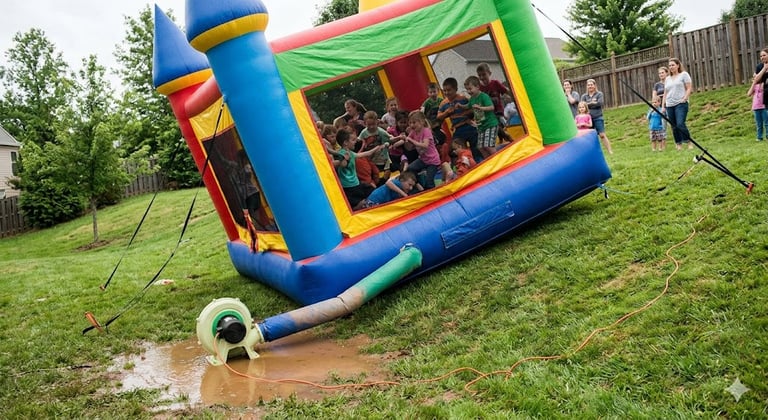
Improper setup is the leading cause of bounce house injuries. Even a high‑quality unit becomes unsafe if it’s placed on the wrong surface, anchored incorrectly, or inflated in poor weather conditions. Understanding these mistakes helps parents prevent collapses, shifting, tipping, and other hazards.
MISTAKE #1 — USING THE WRONG SURFACE
Bounce houses must be placed on flat, level grass. Hard surfaces like concrete, asphalt, patios, or driveways increase injury risk and reduce anchoring effectiveness. Gravel, mulch, and uneven dirt create instability and can damage the material. Grass provides the safest combination of friction, cushioning, and stake penetration.
MISTAKE #2 — NOT USING ENOUGH STAKES
Most residential bounce houses require 6–12 stakes depending on size. Many parents only secure the four corners, leaving the unit under‑anchored. Every anchor point must be used. Missing even one stake increases the risk of shifting, tipping, or lifting in wind.
MISTAKE #3 — USING THE WRONG STAKE ANGLE
Stakes must be driven at a 45‑degree angle away from the bounce house. Driving stakes straight down or toward the unit reduces holding strength. A proper 45‑degree angle increases resistance and prevents pullout during play or wind gusts.
MISTAKE #4 — USING SANDBAGS INCORRECTLY
Sandbags only work when placed directly over anchor points or tied to D‑rings. Placing sandbags on the skirt or random corners does nothing. Most parents also use bags that are too light. Residential units typically require 50–100 pounds per anchor point when sandbags are used.
MISTAKE #5 — BLOCKING THE BLOWER
The blower must have clear airflow on all sides. Blocking the intake with leaves, toys, walls, or fences reduces air pressure and can cause the bounce house to sag or collapse. The blower should sit on a flat, dry surface with at least two feet of clearance around the intake.
MISTAKE #6 — USING THE WRONG EXTENSION CORD
Bounce house blowers require heavy‑duty outdoor extension cords. Thin indoor cords cause voltage drop, overheating, and blower failure. The cord must be 12‑gauge or thicker and rated for outdoor use. Cords longer than 50 feet reduce blower performance and should be avoided.
MISTAKE #7 — NOT DRYING THE UNIT BEFORE SETUP
Moisture inside the bounce house increases weight, weakens seams, and creates slippery surfaces. Setting up a wet bounce house also increases mold risk. The unit must be fully dry before inflation, especially around seams, slides, and interior corners.
MISTAKE #8 — OVERLOADING WEIGHT LIMITS
Every bounce house has a maximum weight per user and a maximum total weight. Exceeding these limits stresses seams, reduces bounce quality, and increases the risk of collapse. Parents often underestimate combined weight when multiple kids enter at once.
MISTAKE #9 — MIXING AGE GROUPS
Toddlers, young kids, older kids, and teens should never bounce together. Larger kids generate more force and can easily knock over smaller children. Mixed‑age play is one of the leading causes of bounce house injuries.
MISTAKE #10 — IGNORING WIND RULES
Wind is the most dangerous factor in bounce house safety. Even moderate gusts can lift a poorly anchored unit. Residential bounce houses should not be used in winds above 15 mph. Gusts matter more than sustained wind. If the unit shifts, lifts, or the walls ripple excessively, shut it down immediately.
MISTAKE #11 — POOR YARD PLACEMENT
Bounce houses must be placed away from fences, decks, sheds, trees, and overhead branches. A minimum of six feet of clearance on all sides is required. Placing the unit too close to obstacles increases collision risk and restricts airflow.
MISTAKE #12 — NOT CHECKING SEAMS AND AIRFLOW
Before kids enter, parents must inspect seams, anchor points, and airflow. Soft spots, sagging walls, or uneven inflation indicate a leak or blower issue. A quick walk‑around can prevent mid‑play collapses.
MISTAKE #13 — INFLATING ON A SLOPE
Even a slight slope can cause kids to slide or roll unexpectedly. Slopes also increase stress on seams and anchor points. The bounce house must be placed on a level surface. If the yard slopes, rotate the unit or choose the flattest area.
MISTAKE #14 — LETTING KIDS ENTER BEFORE FULL INFLATION
Kids should never enter while the bounce house is inflating. Partially inflated walls cannot support weight and can collapse inward. The unit must be fully inflated, firm, and stable before anyone enters.
MISTAKE #15 — NOT SUPERVISING EXITS AND SLIDES
Most injuries occur at the entrance or slide landing zone. Kids collide, fall sideways, or land on each other. An adult must supervise the exit area at all times to ensure spacing and safe landings.
FAQ
CONCLUSION
RELATED ARTICLES
Bounce House Safety for Parents (2026): Age, Weight & Weather Rules
Bounce House Size Calculator (2026): Yard Fit & Space Requirements
Bounce House Weather Guide (2026): Wind, Rain & Temperature Rules
Bounce House Anchoring Guide (2026): Stakes, Sandbags & Stability Physics
How to Set Up a Bounce House Safely (2026 Step‑By‑Step Guide)