
Bounce House Weather Guide (2026): Wind, Rain and Temperature Rules
Learn the 2026 weather rules for safe bounce house use. Frosty explains wind limits, rain shutdown rules, temperature safety, blower protection, anchoring adjustments, and climate specific risks for nylon, hybrid, and PVC inflatables.
By Frank “Frosty” Adminei
5/14/20265 min read
Bounce House Weather Guide (2026): Wind, Rain & Temperature Rules
By Frank “Frosty” Adminei
INTRO
Weather is the most unpredictable safety factor in bounce house operation — and the one most people underestimate. Anchoring, blower power, and supervision all matter, but weather can override every other safety measure if you don’t know the limits.
I’ve tested bounce houses in hot sun, coastal humidity, sudden gusts, light rain, and cold mornings where PVC stiffens like a board. I’ve seen nylon units collapse from a single gust and PVC units become unsafe because the slide surface turned slick from dew.
This guide gives you the exact weather rules I use in the field — the same rules I teach parents, homeowners, and small rental operators. These rules apply to:
Nylon bounce houses
Hybrid bounce houses
PVC commercial inflatables
Throughout this guide, you’ll find internal links to deeper resources like the Bounce House Anchoring Guide (2026) and Bounce House Safety Checklist (2026) so you can reinforce every weather‑related decision with proper setup and anchoring.
WHO THIS GUIDE IS FOR
This weather guide is designed for:
Parents supervising backyard bounce houses
Homeowners unsure about wind limits
Anyone setting up on grass, patio, turf, or concrete
Owners of nylon, hybrid, or PVC units
Anyone who wants clear, non‑technical weather rules
If you haven’t set up your bounce house yet, start with:
How to Set Up a Bounce House Safely (2026 Step‑By‑Step Guide).
WHY WEATHER MATTERS (THE REAL REASON)
Weather affects:
Wall stability
Slide friction
Blower performance
Anchoring load
Material behavior
Center‑of‑mass shifts
Collapse risk
Most weather‑related accidents happen because:
Wind limits were ignored
Rain made surfaces slippery
PVC stiffened in cold temperatures
Nylon overheated in direct sun
Blower intakes clogged with wet grass
Anchors loosened after soil saturation
This guide eliminates those risks.
MATERIAL‑SPECIFIC WEATHER BEHAVIOR
Different materials react differently to weather.
⭐ Nylon (Residential)
Lightest material
Most affected by wind
Dries quickly
Can overheat in direct sun
⭐ Hybrid (Nylon + PVC)
Moderate wind resistance
Better slide performance
More stable walls
⭐ PVC (Commercial)
Heaviest and most stable
Stiffens in cold weather
Becomes slick when wet
Requires full anchoring
For material comparisons, see Bounce House Materials Explained (2026): Nylon vs PVC vs Hybrid.
WIND RULES (2026 STANDARD)
Wind is the #1 weather‑related cause of bounce house accidents.
These are the industry‑standard thresholds I enforce in the field.
⭐ 0–10 mph — Safe
Normal operation
Standard anchoring
No special adjustments
⭐ 10–15 mph — Caution Zone
This is where most parents underestimate risk.
Rules:
Add secondary sandbags
Recheck stakes every 20–30 minutes
Keep blower intake clear
No tall PVC slides
No toddlers in nylon units
If gusts exceed 15 mph, shut down immediately.
⭐ 15+ mph — Shut Down Immediately
This is a hard stop.
Why:
Wind load increases exponentially
Walls bow inward
Mesh distorts
Anchors loosen
Slides become unstable
See Bounce House Anchoring Guide (2026) for reinforcement methods.
GUST BEHAVIOR (THE REAL DANGER)
Steady wind is predictable.
Gusts are not.
A 10 mph steady wind with 18 mph gusts is more dangerous than a steady 15 mph wind.
Signs gusts are coming:
Leaves flick upward
Sudden temperature drop
Flags snap instead of wave
Blower sound changes pitch
If gusts exceed 15 mph, shut down immediately.
RAIN RULES (MANDATORY)
Rain changes everything — even light rain.
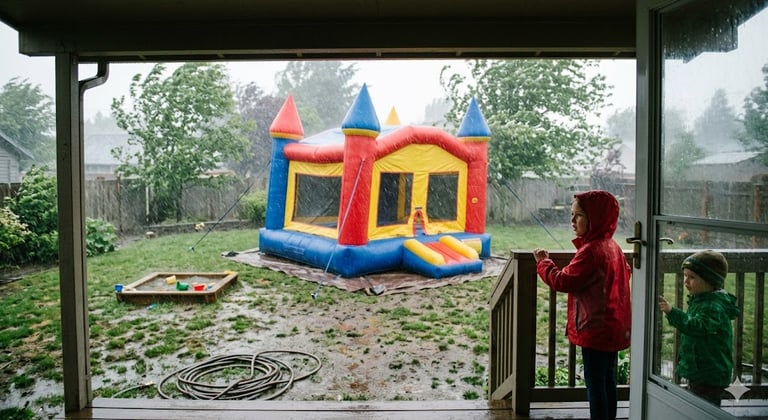
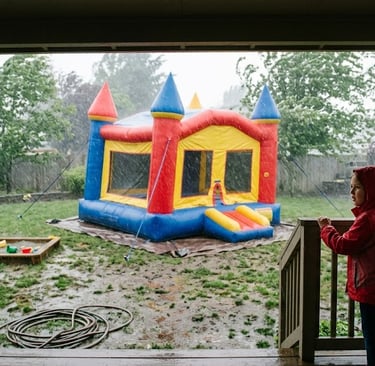
⭐ Light Rain / Drizzle — Shut Down
Why:
Slide surfaces become slick
Entry ramps become slippery
Blower intakes can clog
Nylon absorbs moisture
PVC becomes dangerously slick
⭐ Moderate or Heavy Rain — Immediate Shutdown
Rules:
Evacuate kids
Turn off blower
Let unit collapse
Cover blower
Dry unit before reinflating
See Bounce House Repair, Cleaning & Mold Prevention (2026 Master Guide) for drying instructions.
TEMPERATURE RULES (2026)
Temperature affects material behavior, blower performance, and slide friction.
⭐ Cold Weather (Below 45°F)
PVC becomes stiff and loses flexibility.
Effects:
Harder walls
Reduced bounce
Increased seam stress
Slide friction increases
Rules:
Use nylon or hybrid units
Avoid tall PVC slides
Allow extra inflation time
⭐ Hot Weather (Above 90–95°F)
Nylon absorbs heat quickly.
Effects:
Hot surfaces
Increased friction burns
Blower motors run hotter
Kids fatigue faster
Rules:
Shade the unit
Check blower temperature
Reduce session length
Keep water nearby
HUMIDITY EFFECTS
Humidity affects:
Slide friction
Material temperature
Blower intake performance
⭐ High Humidity (70%+)
Slides become faster
PVC becomes slick
Nylon stays damp longer
⭐ Low Humidity (Dry Climates)
Static increases
Nylon dries quickly
PVC stays firm
SOIL SATURATION EFFECTS (AFTER RAIN)
Wet soil reduces stake holding power by 30–50%.
Rules:
Use longer stakes (15–18")
Add sandbags (hybrid anchoring)
Avoid tall PVC slides
Recheck anchors every 15 minutes
See Bounce House Anchoring Guide (2026) for soil behavior.
BLOWER WEATHER PROTECTION
Blowers must stay dry at all times.
Rules:
Keep blower under a weather cover
Keep intake clear of wet grass
Keep blower on a dry surface
Never operate in rain
Never place blower in mud or puddles
If the blower gets wet, shut down immediately.
See Power, Extension Cords & Blower Guide (2026).
CLIMATE‑SPECIFIC GUIDANCE
Different climates create different risks.
⭐ Hot & Sunny Climates (Southwest, Southeast)
Shade nylon units
Check blower temperature
Reduce session length
Avoid dark‑colored units
⭐ Humid Coastal Climates
Expect faster slides
Expect slick PVC
Add extra anchoring
Monitor gusts closely
⭐ Dry, High‑Wind Regions (Plains, Midwest)
Use hybrid anchoring
Avoid tall PVC slides
Monitor gusts constantly
⭐ Cold Northern Climates
Avoid PVC in cold weather
Use nylon or hybrid
Allow extra inflation time
FROSTY’S WEATHER SCENARIOS (REAL‑WORLD GUIDANCE)
These scenarios reflect the most common weather‑related situations I see in backyards and during field testing.
⭐ Scenario 1 — “Wind is only 12 mph, but the bounce house walls are bowing.”
Diagnosis: Gusts are exceeding 15 mph.
Action:
Evacuate kids
Shut down immediately
Recheck anchoring
Add secondary sandbags
See Bounce House Anchoring Guide (2026).
⭐ Scenario 2 — “It’s sunny, but the slide is getting too hot.”
Diagnosis: Nylon or dark PVC absorbing heat.
Action:
Add shade
Cool slide with a towel
Shorten play sessions
⭐ Scenario 3 — “Light drizzle starts during play.”
Diagnosis: Surfaces are about to become slick.
Action:
Evacuate kids
Shut down
Dry unit fully before reinflating
See Bounce House Repair, Cleaning & Mold Prevention (2026 Master Guide).
⭐ Scenario 4 — “The blower suddenly sounds louder.”
Diagnosis: Wind is pushing against the unit, increasing backpressure.
Action:
Check wind speed
Recheck blower intake
Prepare for shutdown
⭐ Scenario 5 — “The ground is soft after last night’s rain.”
Diagnosis: Soil saturation reduces stake holding power.
Action:
Switch to 15–18" stakes
Add sandbags
Avoid tall PVC slides
⭐ Scenario 6 — “Cold morning, PVC walls feel stiff.”
Diagnosis: PVC rigidity increases below 45°F.
Action:
Allow extra inflation time
Avoid high‑energy play
Consider nylon or hybrid units
HIGH‑RISK WEATHER SITUATIONS (STOP USE IMMEDIATELY)
These conditions require instant shutdown — no exceptions.
Wind over 15 mph
Gusts over 15 mph
Any rain (light, moderate, or heavy)
Thunder or lightning
Soil saturation causing stake movement
Blower intake clogged with wet grass
PVC slide surface becoming slick
Nylon surfaces overheating
Blower overheating in hot weather
If any of these occur, shut down and reassess.
COMMON WEATHER MISTAKES (AND HOW TO AVOID THEM)
These are the mistakes I see most often during weather‑related inspections.
❌ Checking only steady wind, not gusts
Fix: Monitor gusts — they’re the real danger.
❌ Letting kids play during light rain
Fix: Shut down at the first sign of moisture.
❌ Ignoring soil saturation after rain
Fix: Use longer stakes and add sandbags.
❌ Using PVC units in cold weather
Fix: Switch to nylon or hybrid below 45°F.
❌ Not shading nylon units in hot sun
Fix: Add shade and shorten sessions.
❌ Running blower in wet conditions
Fix: Keep blower dry at all times.
❌ Assuming patios are safer in wind
Fix: Patios require heavier sandbags, not less anchoring.
KEY TAKEAWAYS (MANDATORY)
Wind over 15 mph = immediate shutdown
Gusts matter more than steady wind
Any rain makes bounce houses unsafe
PVC stiffens in cold weather
Nylon overheats in direct sun
Soil saturation reduces stake strength
Blowers must stay dry
Shade improves safety in hot climates
Hybrid anchoring improves wind resistance
Weather overrides all other safety measures
MINI CONCLUSION (MANDATORY)
Weather is the most unpredictable safety factor in bounce house operation — and the one most likely to cause accidents when ignored. Follow these wind, rain, and temperature rules every time you set up a bounce house, and you’ll eliminate the most dangerous environmental risks. Combine these rules with proper anchoring and supervision, and your bounce house will stay safe, stable, and fun in any season.
FAQ
RELATED ARTICLES
Before making weather‑based decisions, you may want to explore these related guides to ensure your setup, anchoring, and blower safety are fully optimized: