
How to Clean a Bounce House (2026 Guide)
Learn how to safely clean a bounce house in 2026 using material aware methods for nylon, hybrid, and PVC inflatables. Frosty explains dirt removal, disinfecting, slide cleaning, mold prevention, drying protocols, and safe cleaning chemicals.
By Frank “Frosty” Adminei
5/20/20264 min read
How to Clean a Bounce House (2026 Step‑By‑Step Guide)
By Frank “Frosty” Adminei
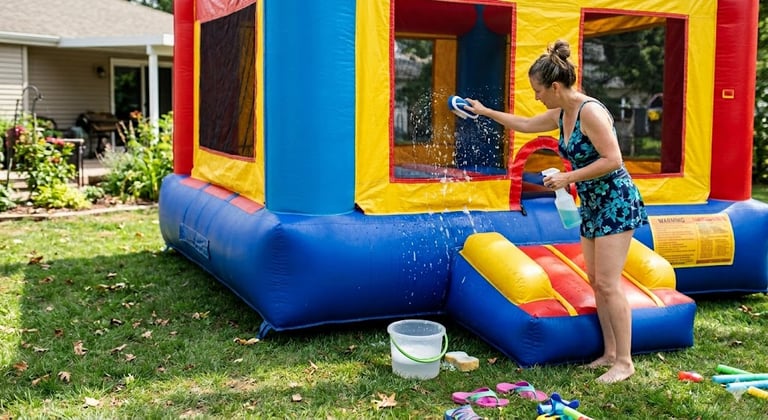
INTRO
Cleaning a bounce house isn’t just about making it look good — it’s about safety, material health, and mold prevention. Dirt weakens seams. Moisture breeds mold. The wrong cleaner can fade nylon or harden PVC. And improper drying is the #1 cause of long‑term damage.
I’ve cleaned hundreds of inflatables in the field — from backyard nylon units to full PVC commercial slides. I’ve restored units covered in mud, algae, mildew, and even mold blooms caused by damp storage. This guide gives you the exact cleaning workflow I use professionally, including:
Dirt removal
Disinfecting
Slide cleaning
Mold prevention
Drying protocols
Material‑specific cleaning rules
Safe cleaning chemicals
Climate‑specific drying strategies
Throughout this guide, you’ll find internal links to deeper resources like the Bounce House Repair, Cleaning & Mold Prevention (2026 Master Guide) and Bounce House Weather Guide (2026) so you can reinforce cleaning with proper maintenance and environmental safety.
WHO THIS GUIDE IS FOR
This cleaning guide is designed for:
Parents cleaning backyard bounce houses
Homeowners dealing with dirt, mud, or mildew
Owners of nylon, hybrid, or PVC units
Small rental operators maintaining their fleet
Anyone who wants mold‑free, long‑lasting inflatables
If your bounce house already has mold, go to:
Bounce House Repair, Cleaning & Mold Prevention (2026 Master Guide).
WHY CLEANING MATTERS (THE REAL REASON)
Cleaning affects:
Material lifespan
Mold resistance
Slide performance
Wall firmness
Safety during play
Repair success
Most cleaning‑related failures happen because:
Wrong chemicals were used
Units were stored damp
Slides weren’t cleaned properly
Mold wasn’t removed early
Nylon was scrubbed too aggressively
PVC was cleaned with alcohol or bleach
This guide eliminates those mistakes.
MATERIAL‑SPECIFIC CLEANING BEHAVIOR
Different materials require different cleaning methods.
⭐ Nylon (Residential)
Most sensitive to chemicals
Avoid alcohol and bleach
Dries quickly
Mold grows fast if stored damp
⭐ Hybrid (Nylon + PVC)
Use nylon rules for walls
Use PVC rules for slides and bases
Stronger disinfectants allowed on PVC sections
⭐ PVC (Commercial)
Most durable
Can handle stronger cleaners
Slowest to dry
Most resistant to mold
For material comparisons, see Bounce House Materials Explained (2026): Nylon vs PVC vs Hybrid.
TOOLS & SUPPLIES YOU NEED (2026 STANDARD)
These tools are safe for nylon, hybrid, and PVC inflatables.
Soft‑bristle brush
Microfiber cloths
Bucket + warm water
Mild dish soap
Vinegar (for mold prevention)
Non‑bleach disinfectant
Spray bottles
Towels
Leaf blower (optional for drying)
Bounce house blower (mandatory for drying)
STEP‑BY‑STEP CLEANING WORKFLOW (FROSTY METHOD)
This is the exact cleaning sequence I use in the field.
⭐ STEP 1 — Remove Loose Dirt & Debris
Before using any liquid cleaner:
Sweep out leaves, grass, sand, and crumbs
Use a handheld vacuum for corners
Wipe down walls with a dry microfiber cloth
Why: Dirt + moisture = mud → stains → mold.
⭐ STEP 2 — Mix a Safe Cleaning Solution
Nylon‑Safe Solution
1 gallon warm water
1–2 teaspoons mild dish soap
PVC‑Safe Solution
1 gallon warm water
1–2 teaspoons mild dish soap
Optional: small amount of non‑bleach disinfectant
Avoid:
Bleach
Alcohol (damages PVC)
Harsh degreasers
Pressure washers
⭐ STEP 3 — Clean the Walls & Floor
How to Clean Nylon Walls:
Dip cloth in soapy water
Wring out thoroughly
Wipe gently
Rinse with clean water
Dry with towels
How to Clean PVC Walls:
Use slightly stronger solution
Wipe in circular motions
Rinse thoroughly
⭐ STEP 4 — Clean the Slide Surface (PVC Only)
Slides require special care.
Steps:
Use mild soap + warm water
Wipe with microfiber cloth
Rinse thoroughly
Dry completely
Apply a small amount of slide polish (optional, PVC‑safe only)
Never:
Use abrasive brushes
Use alcohol
Use bleach
⭐ STEP 5 — Disinfect High‑Touch Areas
Focus on:
Entrance
Exit
Walls
Slide lanes
Floor
Handholds
Safe Disinfectants:
Non‑bleach household disinfectants
Vinegar + water (natural option)
Avoid:
Bleach (damages nylon)
Alcohol (damages PVC)
⭐ STEP 6 — Mold‑Prevention Cleaning
Even if you don’t see mold, this step prevents future growth.
Solution:
1 part vinegar
3 parts water
Steps:
Lightly mist interior surfaces
Wipe with microfiber cloth
Do NOT rinse
Begin drying immediately
Why: Vinegar kills mold spores without damaging nylon or PVC.
⭐ STEP 7 — Rinse (If Needed)
If soap residue remains:
Use clean water
Wipe with damp cloth
Dry with towels
Why: Soap residue attracts dirt → faster staining.
⭐ STEP 8 — Dry the Bounce House Completely
Drying is the most important step.
Drying Method (Frosty Standard):
Turn on the blower
Let the unit inflate
Open windows/doors for airflow
Use towels to remove standing water
Use fans or leaf blower for stubborn areas
Flip unit halfway through drying
Continue until 100% dry
Drying Time by Material:
Nylon: 30–90 minutes
Hybrid: 60–120 minutes
PVC: 2–4 hours
Never:
Fold while damp
Store in humid areas
Skip drying corners or seams
⭐ STEP 9 — Final Inspection Before Storage
Check:
Seams
Corners
Slide lanes
Blower tube
Interior pockets
Underside
If ANY moisture remains → continue drying.

FROSTY’S REAL‑WORLD CLEANING SCENARIOS
⭐ Scenario 1 — “The bounce house smells musty after storage.”
Diagnosis: Early‑stage mold or mildew.
Fix:
Wipe with vinegar + water (1:3)
Dry fully with blower + fans
Inspect seams and corners
Why: Musty smell = moisture trapped in fabric.
⭐ Scenario 2 — “There are dark spots on the interior walls.”
Diagnosis: Mold bloom.
Fix:
Clean with vinegar solution
Rinse lightly
Dry aggressively
Inspect for weakened material
If spots return: The unit was stored damp — repeat cleaning and extend drying time.
⭐ Scenario 3 — “The slide feels sticky after cleaning.”
Diagnosis: Soap residue.
Fix:
Rinse with clean water
Wipe with microfiber cloth
Dry completely
Why: Soap residue attracts dirt and increases friction.
⭐ Scenario 4 — “The walls feel slimy.”
Diagnosis: Algae or mildew.
Fix:
Use warm water + mild soap
Wipe thoroughly
Rinse
Dry fully
Never: Use bleach — it damages nylon.
⭐ Scenario 5 — “There’s mud ground into the seams.”
Diagnosis: Dirt + moisture → embedded debris.
Fix:
Use soft‑bristle brush
Work gently along seam
Rinse
Dry with blower
Why: Seams trap moisture → mold risk.
HIGH‑RISK CLEANING MISTAKES (AVOID THESE)
❌ Using bleach
Bleach weakens nylon and discolors PVC.
❌ Using alcohol on PVC
Causes drying, cracking, and long‑term brittleness.
❌ Using abrasive brushes
Scratches slide surfaces and removes protective coatings.
❌ Pressure washing
Forces water into seams → mold + structural weakening.
❌ Folding while damp
The #1 cause of mold blooms.
❌ Storing in humid basements or sheds
Moisture + warmth = mold growth within 48 hours.
MOLD‑SPECIFIC TROUBLESHOOTING
⭐ Early Mold (light spots)
Clean with vinegar solution
Dry fully
Inspect seams
⭐ Moderate Mold (visible patches)
Clean twice
Increase drying time
Use fans + blower
Inspect for material weakening
⭐ Severe Mold (large areas, strong smell)
Clean thoroughly
Dry aggressively
Inspect for structural damage
Consider retiring nylon units with deep mold penetration
⭐ When Mold Returns After Cleaning
Storage area is too humid
Unit wasn’t fully dry
Seams retained moisture
Interior pockets weren’t opened
CLIMATE‑SPECIFIC DRYING (FROSTY’S FIELD RULES)
⭐ Hot & Dry Climates (Ideal)
Inflate outdoors
Flip halfway
Use blower only
Dry time: 30–90 minutes
⭐ Humid Climates (High Mold Risk)
Inflate indoors or in shade
Use fans + blower
Towel‑dry seams
Dry time: 1.5–3 hours
⭐ Cold Climates (Slow Drying)
Inflate in garage/basement
Use blower + space heater (safe distance)
Avoid outdoor drying
Dry time: 2–4 hours

KEY TAKEAWAYS (CLEANING EDITION)
Cleaning protects material strength, not just appearance.
Vinegar is the safest mold‑prevention cleaner for all materials.
Nylon is chemical‑sensitive — avoid bleach and alcohol.
PVC is durable but dries slowly — monitor seams.
Drying is the most important step in the entire process.
Mold grows in 24–48 hours on damp nylon.
Always inspect corners, seams, and blower tubes before storage.
RELATED ARTICLES
Before cleaning your bounce house, you may want to explore these related guides to ensure your repair, drying, and safety workflows are fully optimized: