
Bounce House Safety for Parents (2026): Age, Weight and Weather Rules
Learn the essential bounce house safety rules for parents, including age limits, weight limits, supervision guidelines, weather rules, and Frosty’s engineering grade safety framework for 2026.
By Frank “Frosty” Adminei
5/7/20262 min read
Home › Bounce Houses › Safety › Bounce House Safety for Parents (2026)
Bounce House Safety for Parents (2026): Age, Weight and Weather Rules)
By Frank “Frosty” Adminei
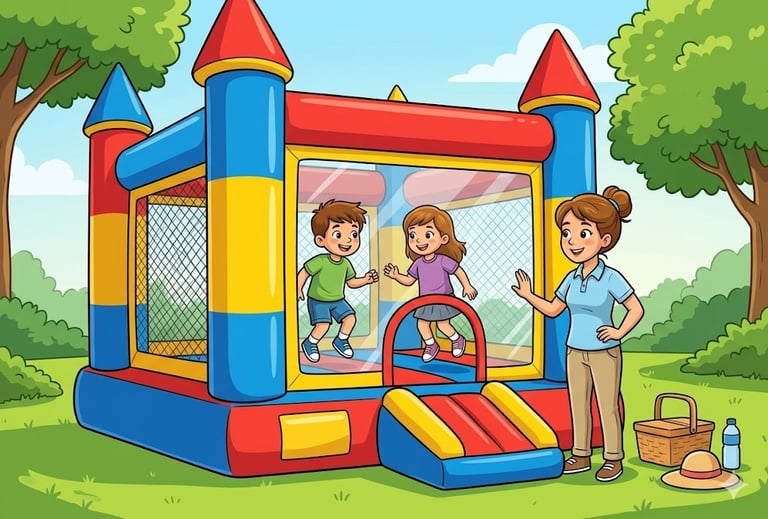
WHY PARENTS NEED THIS GUIDE
Most bounce house injuries happen because parents were never given clear rules.
The biggest risks come from:
Mixed ages
Overloading
High winds
Wet surfaces
Poor anchoring
Lack of supervision
This guide gives parents the simple, non‑negotiable rules that eliminate nearly all risk.
THE 3 PARENT SAFETY PILLARS
Age Rules
Weight Rules
Weather Rules
If parents follow these three pillars, bounce houses become one of the safest backyard activities.
AGE RULES (NON‑NEGOTIABLE)
Age separation is the #1 factor in preventing injuries.
Parents should treat these rules as absolute.
⭐ Toddlers (1–3 years)
Must use toddler‑specific units
No older kids allowed
Low walls + soft slides only
Adult must be within arm’s reach
Toddlers are the most vulnerable group — they cannot self‑correct during falls.
⭐ Kids 3–7 years
Use 10'–12' units
No older kids
No flips
No rough play
This age group is energetic but lacks collision awareness.
⭐ Kids 8–12 years
Use 12'–13' units
No toddlers
Enforce turn‑taking
Watch for collisions
This group generates more force → supervision becomes more important.
⭐ Teens
Use 13'–15' units
No toddlers or young kids
Must follow weight limits strictly
Teens can overpower younger kids even with light contact.
⭐ Adults
Only commercial PVC units
Residential nylon units are not adult‑safe
Adult weight + impact force can collapse residential walls.
Once you know which size and weight range is appropriate for your children, Best Bounce Houses by Age Group (2026 Guide) can help narrow the choices to models designed for that stage.
WEIGHT LIMITS (PARENT‑FRIENDLY RULES)
Every bounce house has:
A per‑child weight limit
A total weight limit
A maximum occupancy
General guidelines:
Toddlers: 40–60 lbs
Kids 3–7: 60–90 lbs
Kids 8–12: 80–120 lbs
Teens: 100–150 lbs
Adults: commercial units only
Never mix weight classes.
A 120‑lb child can easily injure a 40‑lb toddler.
MAX OCCUPANCY RULES (2026)
8'–10' units: 2–3 kids
10'–12' units: 3–4 kids
12'–13' units: 4–6 kids
13'–15' units: 6–8 kids
Combo units: 4–6 kids
Water slide combos: 3–4 kids
Parents should always reduce occupancy if kids are highly active.
WEATHER RULES (PARENT VERSION)
Weather is the most dangerous variable — and the easiest to control.
⭐ Wind Rules
Stop at 15–20 mph
Gusts are more dangerous than steady wind
If walls ripple → stop play
If blower tube shakes → stop play
Wind is responsible for the most severe bounce house accidents.
⭐ Rain Rules
No rain
No wet slides
No wet entrances
No wet blower cords
Wet vinyl becomes dangerously slick and increases collision risk.
⭐ Temperature Rules
PVC becomes brittle below 40°F
Nylon becomes brittle below 20°F
Avoid extreme heat (vinyl softens)
Temperature affects material strength and bounce quality.
ANCHORING RULES FOR PARENTS
Parents don’t need the full engineering breakdown — just the essentials:
Use all anchor points
Stakes must be 45° into the ground
Sandbags must be 50–75 lbs each
Recheck anchors every 20–30 minutes
Never skip anchoring indoors
Anchoring prevents tip‑overs, wall collapse, and slide instability.
SUPERVISION RULES (PARENT VERSION)
1 adult per 4–6 kids
No flips
No wrestling
No climbing walls
No sliding head‑first
Stop play if kids collide
Stop play if kids get too excited
Supervision eliminates 80% of injury scenarios.
SURFACE RULES (PARENT VERSION)
Best:
Grass
Turf
Acceptable with padding:
Concrete
Asphalt
Avoid:
Gravel
Dirt
Mulch
Slopes
Surface choice affects friction, stability, and fall risk.
WHEN TO STOP PLAY IMMEDIATELY
Wind gusts
Rain starts
Blower slows
Unit leans
Kids collide
Slide becomes slick
Stakes pull out
Kids get too wild
Stopping early prevents nearly all serious injuries.
PARENT CHECKLIST (QUICK VERSION)
Right age group
Right size unit
Anchored correctly
Weather safe
Dry surfaces
Clear entrance
No mixed ages
Active supervision