
Best Bounce Houses Under $300 (2026 Budget Guide)
Discover the best bounce houses under $300 in 2026. Compare budget-friendly inflatables, features, safety tips, and what to expect at this price point.
By Frank “Frosty” Adminei
5/16/20269 min read
Best Bounce Houses Under $300 (2026 Budget Guide)
By Frank “Frosty” Adminei
![ACTION AIR [Updated Version] Bounce House, Inflatable Bouncer with Air Blower, Jumping Castle with S](https://assets.zyrosite.com/cdn-cgi/image/format=auto,w=768,h=960,fit=crop/mP4QzgGOwxS6r9vq/action-air-updated-version-bounce-house-inflatable-bouncer-with-air-blower-jumping-castle-with-slide-o99xY2qC2bLfT72t.jpg)
![ACTION AIR [Updated Version] Bounce House, Inflatable Bouncer with Air Blower, Jumping Castle with S](https://assets.zyrosite.com/cdn-cgi/image/format=auto,w=375,h=366,fit=crop/mP4QzgGOwxS6r9vq/action-air-updated-version-bounce-house-inflatable-bouncer-with-air-blower-jumping-castle-with-slide-o99xY2qC2bLfT72t.jpg)
Intro
Let’s clear something up right away—budget doesn’t mean boring.
In fact, the under-$300 range is where most families start, and for good reason:
Affordable entry point
Easy setup
Plenty of backyard fun
But here’s the Frosty truth…
Not all budget bounce houses are created equal.
Some are weekend warriors. Others are one-party wonders.
This guide helps you spot the difference.
If you want to understand how price impacts durability, take a look at How Much Does a Bounce House Cost? (2026 Pricing Guide).
Who This Guide Is For
This guide is built for:
Parents planning backyard parties
Homeowners looking for casual weekend use
First-time buyers testing the waters
Anyone who wants solid value without overspending
If you’re debating features and sizing, check How to Choose the Right Bounce House (2026 Buyer Guide).
Why This Topic Matters
Budget bounce houses live in a very specific lane.
They are:
Lightweight
Portable
Designed for moderate use
But they are NOT:
Commercial-grade
Built for teens or adults
Designed for heavy weekly use
Understanding this prevents disappointment later.
For a deeper material breakdown, see Bounce House Materials Explained (2026): Nylon vs PVC vs Hybrid.
Age is only one part of the buying decision, because larger and more durable inflatables can cost considerably more. How Much Does a Bounce House Cost? (2026 Pricing Guide) can help you match those age and durability requirements to a realistic spending range.
Age Group Segmentation
This is where most buyers make mistakes—so let’s keep it simple.
Ages 3–6 (Ideal Range)
Perfect fit for under-$300 units
Lightweight jumpers
Lower stress on seams and material
These units shine here.
Ages 7–10 (Still Good with Limits)
Works well with supervision
Limit occupancy
Avoid rough play
At this stage, durability starts to matter more.
For sizing and capacity, see Bounce House Size Calculator (2026): Yard Fit & Space Requirements.
Ages 11+ (Not Recommended)
Here’s the honest call:
Heavier users = more stress
Increased risk of seam wear
Reduced lifespan
If older kids are involved, you’ll want to explore
Mixed Age Groups
If you’ve got a mix of younger and older kids:
Separate play sessions
Limit total users at once
Prioritize supervision
For safety rules, see Bounce House Safety for Parents (2026): Age, Weight & Weather Rules.
Product Modules
Below are some of the best-selling bounce houses under $300 that consistently deliver solid performance for backyard use.
Remember—these are budget-friendly units, so expectations should match the category: fun, light use, and easy setup.
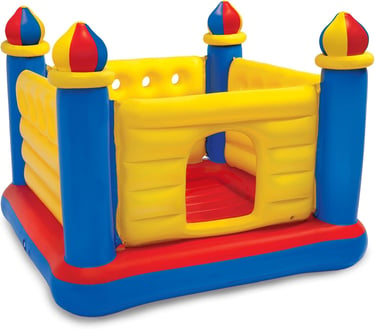
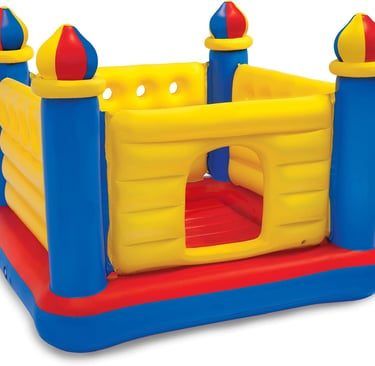
Intex Jump-O-Lene Inflatable Bounce House
Search Phrase: Intex Jump-O-Lene Bounce House
What it is
A compact, enclosed inflatable bounce house designed primarily for younger kids and indoor/outdoor use.Why it works
Its low height and soft walls create a controlled, safe bouncing environment—great for beginners.Size / footprint
Approx. 6.5 ft x 6.5 ft footprint; fits easily in small yards or indoor spaces.Material & durability
Made from reinforced vinyl; lighter than nylon/PVC but suitable for low-impact play.Best user / age range
Ages 3–6; ideal for toddlers and younger children.Why buyers like it
Extremely affordable
Easy to inflate and store
Great starter option
Safety or usage notes
Limited to light use and small kids only, but for a first bounce house, it’s a simple way to test the waters without overcommitting.
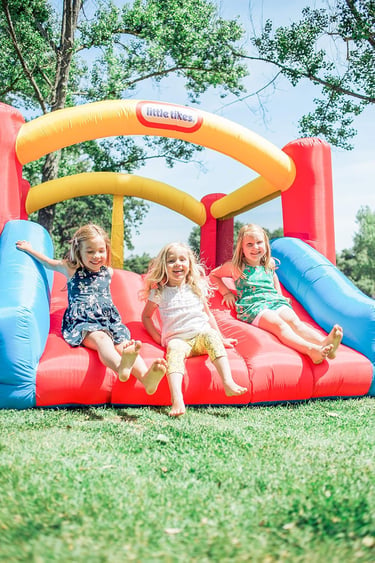
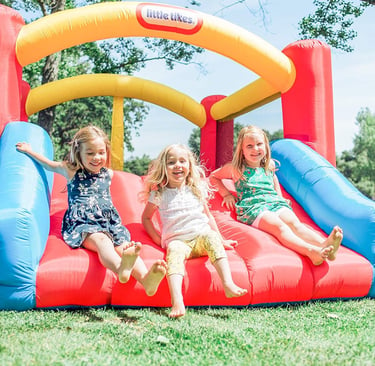
Little Tikes Jump ‘n Slide Bouncer
Search Phrase: Little Tikes Jump n Slide Bounce House
What it is
A backyard bounce house with an attached mini slide and mesh safety walls.Why it works
Combines bouncing and sliding, which keeps kids engaged longer than standard flat jumpers.Size / footprint
Approx. 12 ft x 9 ft footprint; requires moderate yard space.Material & durability
Constructed from polyester fabric with reinforced stitching; typical residential-grade durability.Best user / age range
Ages 3–8; best for small groups of younger kids.Why buyers like it
Built-in slide adds variety
Trusted brand reliability
Easy setup with included blower
Safety or usage notes
Weight limits matter here, but for younger kids who want more than just bouncing, it adds a little extra fun without jumping into higher price tiers.
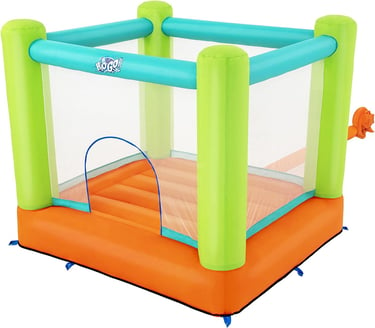
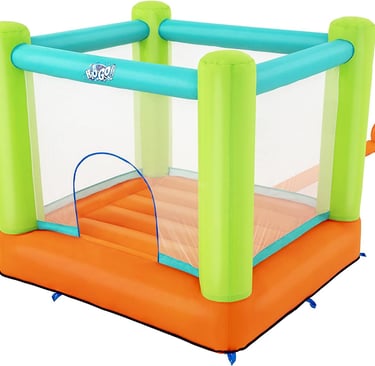
Bestway H2OGO! Jump and Soar Bounce House
Search Phrase: Bestway Jump and Soar Bounce House
What it is
A simple, open-top bounce house designed for quick setup and casual backyard play.Why it works
Minimal design means faster inflation and fewer failure points.Size / footprint
Approx. 7 ft x 6 ft footprint; great for tighter spaces.Material & durability
PVC-coated polyester; standard for budget inflatables.Best user / age range
Ages 3–7; light to moderate use.Why buyers like it
Quick setup
Affordable price
Lightweight and portable
Safety or usage notes
Open-top design requires supervision, but if you want something quick and easy for spontaneous play, this one keeps things simple.
![ACTION AIR [Updated Version] Bounce House, Inflatable Bouncer with Air Blower, Jumping Castle with S](https://assets.zyrosite.com/cdn-cgi/image/format=auto,w=768,h=498,fit=crop/mP4QzgGOwxS6r9vq/action-air-updated-version-bounce-house-inflatable-bouncer-with-air-blower-jumping-castle-with-slide-family-backyard-bouncy-castle-durable-sewn-with-extra-thick-material-idea-for-kids-F2WwA6ou6XSozvh6.jpg)
![ACTION AIR [Updated Version] Bounce House, Inflatable Bouncer with Air Blower, Jumping Castle with S](https://assets.zyrosite.com/cdn-cgi/image/format=auto,w=375,h=366,fit=crop/mP4QzgGOwxS6r9vq/action-air-updated-version-bounce-house-inflatable-bouncer-with-air-blower-jumping-castle-with-slide-family-backyard-bouncy-castle-durable-sewn-with-extra-thick-material-idea-for-kids-F2WwA6ou6XSozvh6.jpg)
Action Air Inflatable Bounce House with Slide
Search Phrase: Action Air Bounce House with Slide
What it is
A popular Amazon bestseller featuring a bounce area, slide, and mesh enclosure.Why it works
Balances features and affordability, making it one of the most versatile options in this price range.Size / footprint
Approx. 10 ft x 9 ft footprint; fits most average backyards.Material & durability
Oxford fabric with reinforced stitching; stronger than entry-level vinyl options.Best user / age range
Ages 3–8; suitable for small group play.Why buyers like it
Feature-rich for the price
Strong user reviews
Good balance of size and portability
Safety or usage notes
Not built for rough play, but if you want something that feels like a “real” bounce house without crossing into higher price brackets, this is a sweet spot.
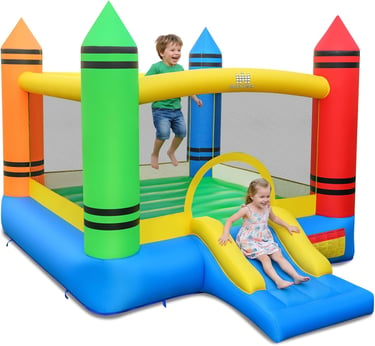
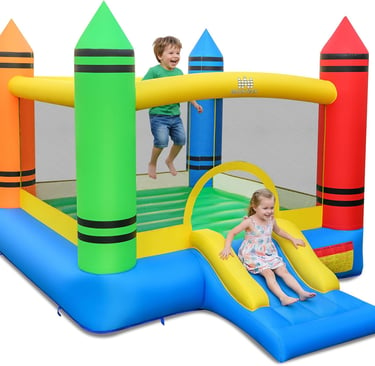
Costzon Inflatable Bounce House with Slide
Search Phrase: Costzon Inflatable Bounce House Kids Slide Bouncer
What it is
A multi-activity inflatable with a bounce area, slide, and climbing section.Why it works
Keeps kids rotating between activities, reducing wear on any single area.Size / footprint
Approx. 12 ft x 9 ft footprint; moderate yard space required.Material & durability
Oxford cloth construction with reinforced seams; standard residential durability.Best user / age range
Ages 3–8; ideal for parties with several younger kids.Why buyers like it
Multi-feature design
Good value for size
Engaging for longer play sessions
Safety or usage notes
More features mean more supervision, but for busy backyard parties, it helps keep kids entertained without needing multiple toys.
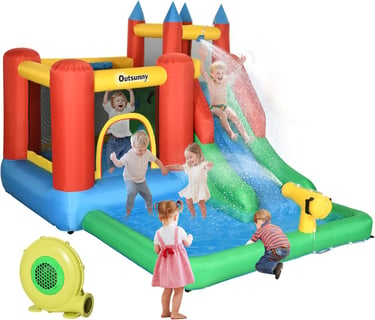
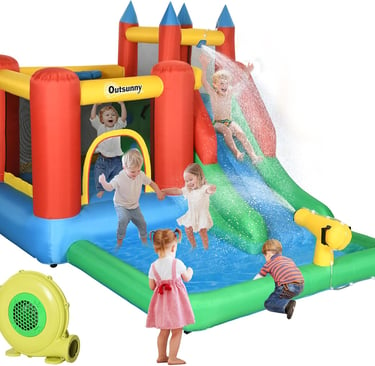
Outsunny Kids Inflatable Bounce House with Blower
Search Phrase: Outsunny Inflatable Bounce House with Slide
What it is
A full backyard inflatable set with bounce area, pool, slide, and included blower.Why it works
All-in-one package simplifies setup and eliminates the need for separate purchases.Size / footprint
Approx. 10 ft x 8 ft footprint; fits most residential yards.Material & durability
Polyester and Oxford fabric blend; typical for this price category.Best user / age range
Ages 3–8; light to moderate use.Why buyers like it
Includes blower
Good entry-level value
Easy to assemble
Safety or usage notes
Blower performance is key, but if you want a ready-to-go setup without piecing things together, this keeps things simple and budget-friendly.
Safety Notes
Budget bounce houses can absolutely be safe—but only if used within their limits.
Know the limits (this is critical)
Follow max weight and occupancy guidelines
Avoid mixing large and small kids
No flips, roughhousing, or overcrowding
For deeper safety guidance, see Are Bounce Houses Safe? (2026 Parent Guide).
Anchoring matters—even for small units
Even lightweight bounce houses need proper anchoring:
Use stakes on grass
Use sandbags on hard surfaces
Secure all anchor points
For anchoring best practices, see Bounce House Anchoring Guide (2026): Stakes, Sandbags & Stability Physics.
Weather awareness
Budget units are more sensitive to conditions:
Avoid wind
Never use in rain
Deflate if weather changes
For full weather rules, see Bounce House Weather Guide (2026): Wind, Rain & Temperature Rules.
Supervision is non-negotiable
Especially with younger kids:
Always have an adult present
Monitor entry/exit
Enforce simple rules
For setup and usage safety, see How to Set Up a Bounce House Safely (2026 Step By Step Guide).
Buying Considerations
When you’re shopping for a bounce house under $300, you’re not just buying “a toy”—you’re choosing how long it’s going to survive real backyard use before it starts wearing out.
At this price point, the difference between a good purchase and a regret usually comes down to a few key factors.
1. Material quality is the first filter
Most budget bounce houses use either:
Polyester (common in entry-level models)
Oxford fabric (slightly stronger, more durable)
Light PVC-coated blends (best in this range)
Here’s the reality:
Polyester = lighter, cheaper, shorter lifespan
Oxford fabric = better tear resistance, better value
PVC blends = closest you get to commercial feel under $300
If you want a deeper breakdown of how materials affect lifespan, see Bounce House Materials Explained (2026): Nylon vs PVC vs Hybrid.
2. Blower inclusion changes total value
Some units include a blower, others don’t.
Why this matters:
Separate blower purchase can add $40–$100+
Inconsistent blower sizing can reduce performance
Matching system = better inflation stability
A bundled system often gives better real-world value, even if the specs look similar on paper.
For airflow matching, see Best Bounce House Blowers (2026): CFM, HP & Noise Levels.
3. Size vs yard reality
A common mistake: buying based on product dimensions, not usable space.
You need to account for:
Clearance around all sides
Blower hose extension space
Safe entry/exit zones
A “10x9 bounce house” often needs closer to a 15x13 usable footprint.
For exact planning, see Bounce House Size Calculator (2026): Yard Fit & Space Requirements.
4. Age usage planning (this is where expectations matter)
Under-$300 units are best suited for:
Ages 3–6 → ideal performance range
Ages 7–10 → acceptable with limits
Ages 11+ → not recommended for safety and durability reasons
This matters because overloading a budget unit is the fastest way to shorten its lifespan.
For age-based guidance, see Best Bounce Houses by Age Group (2026 Guide).
5. Feature inflation vs real value
Budget bounce houses often advertise:
slides
climbing areas
basketball hoops
tunnels
But more features can mean:
more seams (more failure points)
lower structural rigidity
faster wear under heavy use
Simple designs often last longer in this category.
For comparisons, see Bounce House vs. Inflatable Water Slide (2026 Comparison Guide).
Yard Size / Fit Considerations
Even a “small” bounce house can overwhelm a yard if you don’t plan correctly.
Minimum safe clearance rule
For under-$300 units:
Add 3–5 feet on all sides
Add blower clearance zone
Keep overhead space clear
Example:
A 10x9 bounce house may require:
~15x14 total usable space
Surface selection matters more than people think
Best surfaces:
Flat grass (ideal)
Packed dirt (acceptable)
Turf (good alternative)
Avoid:
slopes (creates instability)
gravel (anchor issues)
uneven ground (stress points form fast)
For full prep guidance, see Bounce House Yard Prep Guide (2026): Slope, Clearance & Surface Types.
Wind exposure risk
Lightweight inflatables are more sensitive to:
sudden gusts
open yard layouts
corner wind tunnels between buildings
Even moderate wind can affect stability if anchoring is weak.
For safety thresholds, see Bounce House Weather Guide (2026): Wind, Rain & Temperature Rules.
Layout planning tip (most beginners miss this)
Place your bounce house:
away from fences
away from trees and branches
with clear visibility from seating areas
This improves both safety and supervision efficiency.
Setup
Setting up a bounce house under $300 is usually quick—but “quick” only works if you do it in the right order. Rushing is where most backyard mistakes happen.
Step 1: Choose your location carefully
Pick a space that is:
Flat
Free of sharp objects
Clear of overhead branches
Even lightweight units need stable ground to perform safely.
For planning your layout, see Bounce House Yard Prep Guide (2026): Slope, Clearance & Surface Types.
Step 2: Unroll and orient before inflation
Before turning anything on:
Unfold completely
Align entrance direction
Position blower access point
Once inflated, moving it becomes difficult even for small units.
Step 3: Anchor immediately
Even budget bounce houses need full anchoring:
Stake down all corners (grass)
Use sandbags on hard surfaces
Double-check anchor tension
For stability mechanics, see Bounce House Anchoring Guide (2026): Stakes, Sandbags & Stability Physics.
Step 4: Inflate and inspect
Turn on blower and watch:
Walls rise evenly
No collapsing sections
Air pressure stays consistent
If something looks off, stop and adjust before use.
For airflow troubleshooting, see Bounce House Blower Troubleshooting (2026 Guide).
Step 5: Final safety check
Before kids enter:
Confirm anchors are secure
Check seams and entry points
Set simple rules for play
For full setup walkthrough, see How to Set Up a Bounce House Safely (2026 Step By Step Guide).
Maintenance
Even budget bounce houses last longer with basic care—and this is where most owners lose lifespan without realizing it.
After every use
Shake out debris (grass, dirt, leaves)
Wipe high-contact surfaces
Inspect seams and corners
Small wear caught early prevents bigger failures later.
Weekly use check
If used often:
Wash with mild soap and water
Inspect blower hose connection
Check for stretching at seams
For cleaning steps, see How to Clean a Bounce House (2026 Guide).
Seasonal care
Deep clean before storage
Fully dry before folding
Inspect for weak points or thinning fabric
For repair and prevention, see Bounce House Repair, Cleaning & Mold Prevention (2026 Master Guide).
Storage
Storage is where budget bounce houses either last a season—or several years.
Proper storage steps
Fully dry before folding
Fold along original seams
Store in cool, dry area
Keep away from rodents or moisture
Common mistakes
Storing damp (mold risk)
Tight rolling (fabric stress)
Leaving blower attached or exposed
For long-term care systems, see Bounce House Storage Guide (2026): Folding, Drying & Long Term Care.
Key Takeaways
Under-$300 bounce houses are best for younger kids and occasional use
Material type (polyester vs Oxford) directly affects lifespan
Proper yard sizing is more important than product dimensions
Anchoring and weather awareness are critical even for small units
Simple designs often last longer than feature-heavy models
Mini Conclusion
Here’s the Frosty truth:
A budget bounce house isn’t trying to be everything—it’s trying to be fun, simple, and accessible.
If you match expectations to reality, these units deliver exactly what they’re built for: easy backyard memories without a big investment.
Related Articles
Are Bounce Houses Safe? (2026 Parent Guide)
Bounce House Safety for Parents (2026): Age, Weight & Weather Rules
Bounce House Size Calculator (2026): Yard Fit & Space Requirements
How to Choose the Right Bounce House (2026 Buyer Guide)
Bounce House Materials Explained (2026): Nylon vs PVC vs Hybrid
Bounce House Weather Guide (2026): Wind, Rain & Temperature Rules