
Bounce House Anchoring Guide (2026): Stakes, Sandbags and Stability Physics
Learn how to anchor a bounce house safely in 2026 using Frosty’s engineering backed method. Covers stake angles, sandbag weights, soil types, patio setups, wind resistance, and stability physics for nylon, hybrid, and PVC inflatables.
By Frank “Frosty” Adminei
5/19/20266 min read
Bounce House Anchoring Guide (2026): Stakes, Sandbags and Stability Physics
By Frank “Frosty” Adminei
INTRO
Anchoring is the single most important part of bounce house safety — and the part most people get wrong. A bounce house can have perfect blower power, perfect setup, and perfect supervision, but if the anchoring is weak, uneven, or incomplete, the entire structure becomes unstable.
I’ve anchored hundreds of inflatables across grass, dirt, artificial turf, patios, and concrete. I’ve tested nylon units, hybrid units, and full commercial PVC castles. And the truth is simple:
A bounce house is only as safe as its anchoring.
This guide gives you the engineering‑grade anchoring method I use in the field — including stake angles, sandbag weights, soil behavior, wind resistance, and stability physics. Whether you’re setting up for a birthday party or preparing a commercial‑grade PVC unit, this guide ensures your bounce house stays exactly where it should.
Throughout this guide, you’ll find internal links to deeper resources like the Bounce House Safety Checklist (2026), Bounce House Weather Guide (2026), and How to Set Up a Bounce House Safely (2026 Step‑By‑Step Guide) so you can explore any step in more detail.
WHO THIS GUIDE IS FOR
This anchoring guide is designed for:
Parents setting up a bounce house on grass, patio, turf, or concrete
Homeowners who want a safe, repeatable anchoring method
First‑time users who need clear, non‑technical instructions
Owners of nylon, hybrid, or PVC units
Anyone unsure about stake length, sandbag weight, or wind limits
If you haven’t chosen a bounce house yet, start with the pillar:
How to Choose the Right Bounce House (2026 Buyer Guide).
WHY ANCHORING MATTERS (THE REAL REASON)
Anchoring determines:
Wall stability
Slide stability
Bounce dynamics
Wind resistance
Center‑of‑mass behavior
Safety during high‑energy play
Most bounce house accidents happen because:
Stakes were too short
Stakes were driven straight down
Sandbags were too light
Anchors weren’t tensioned evenly
Only 2–4 anchor points were used
Wind wasn’t monitored
This guide eliminates those mistakes.
AGE‑SPECIFIC ANCHORING DIFFERENCES
Different age groups create different forces on the structure.
Toddlers (2–3)
Nylon units only
Standard stakes or light sandbags
Lower bounce force
Kids 3–7
Nylon or hybrid
Standard stakes or medium sandbags
Moderate bounce force
Kids 8–12
Hybrid or PVC
Reinforced anchoring required
Higher bounce force
Teens & Adults
PVC commercial units only
Full anchoring required
Highest bounce force and lateral load
For buying guidance, see Best Bounce Houses by Age Group (2026 Guide).
THE 3‑METHOD ANCHORING SYSTEM (2026 STANDARD)
Every safe bounce house setup uses one of these three anchoring methods:
Stake Anchoring (Grass / Dirt)
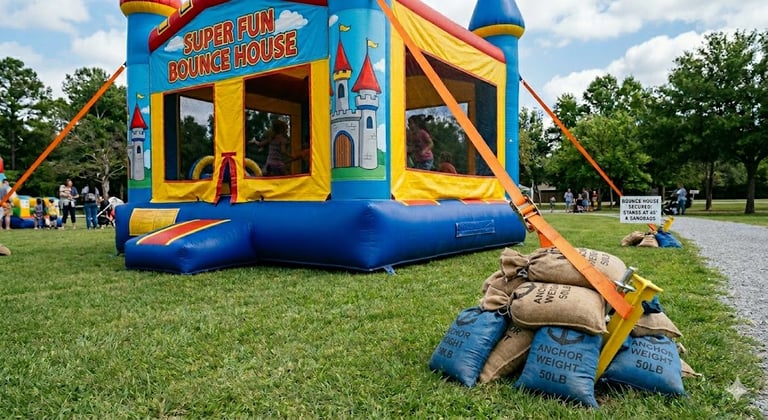
Sandbag Anchoring (Patio / Concrete / Turf)
Hybrid Anchoring (Mixed Surfaces)
Each method has different physics, different load behavior, and different safety requirements.
⭐ METHOD 1 — STAKE ANCHORING (GRASS / DIRT)
Stake anchoring is the strongest and most stable method — but only when done correctly.
🟩 1. Stake Length Requirements
Use 12–18 inch steel stakes.
Why length matters:
Short stakes (6–9") only grip topsoil
Long stakes penetrate deeper, denser soil layers
Deeper penetration = higher horizontal resistance
PVC units require 18" stakes whenever possible.
See Best Bounce House Stakes (2026) for recommended options.
🟩 2. Stake Angle (45° Away From the Unit)
Drive stakes at a 45° angle away from the bounce house.
Why 45° is mandatory:
Maximizes horizontal resistance
Reduces vertical pullout
Distributes load across soil layers
Prevents “walking” during high‑energy play
Driving stakes straight down reduces holding power by 30–50%.
🟩 3. Soil Type Behavior
Different soils behave differently under load.
Loam (Ideal)
Balanced moisture
High friction
Excellent stake retention
Clay (Good but variable)
Strong when dry
Weak when saturated
Stakes may loosen after rain
Sand (Weak)
Low friction
Poor stake retention
Requires deeper stakes or hybrid anchoring
If your soil is sandy, add sandbags or switch to hybrid anchoring.
🟩 4. Anchor Point Tensioning
After inflation:
Pull each anchor point outward
Remove slack
Ensure equal tension around the perimeter
Uneven tension = uneven wall height = unsafe bounce dynamics.
⭐ METHOD 2 — SANDBAG ANCHORING (PATIO / CONCRETE / TURF)
Sandbags are the only safe option when stakes cannot be used.
🟦 1. Sandbag Weight Requirements
Minimum weights per anchor point:
Nylon: 40–60 lb
Hybrid: 60–80 lb
PVC: 80–100 lb
Slide bases: +20–40 lb
These weights are based on:
Bounce force
Lateral load
Center‑of‑mass shift
Wind resistance
See Best Sandbags for Bounce Houses (2026): Patio & Concrete Setups.
🟦 2. Wide‑Base Sandbags Only
Never stack sandbags vertically.
Why stacking is unsafe:
High center of gravity
Low shear resistance
Bags shift under lateral load
Wide‑base sandbags distribute weight horizontally, increasing stability.
🟦 3. Turf Anchoring Rules
Artificial turf cannot accept stakes.
Rules:
Use sandbags only
Add extra weight on corners
Add padding under slide landing zones
Recheck sandbag shift every 30–45 minutes
Turf has low friction — sandbags must compensate.
⭐ METHOD 3 — HYBRID ANCHORING (MIXED SURFACES)
Use hybrid anchoring when:
Half the unit is on grass
Half is on patio
Soil is sandy or unstable
You want maximum stability
Hybrid anchoring = stakes + sandbags.
This method increases stability by combining:
Deep soil penetration
Horizontal weight distribution
Ideal for PVC units.
STABILITY PHYSICS (EXPLAINED SIMPLY)
Anchoring isn’t guesswork — it’s physics.
⭐ 1. Bounce Force = Lateral Load
When kids bounce, the force pushes outward.
Anchors must resist:
Horizontal pull
Vertical lift
Slide impact load
⭐ 2. Center‑of‑Mass Shift
When kids move to one side:
The unit tilts
Anchors on that side take more load
Opposite anchors lose tension
Even tension is mandatory.
⭐ 3. Wind Load
Wind applies force to:
Walls
Mesh
Slide
Roof (if present)
Wind over 15 mph can overpower anchoring.
See Bounce House Weather Guide (2026).
⭐ 4. Slide Impact Load
Slides create the highest localized force.
This is why slide bases require:
Extra stakes
Extra sandbags
Extra tension
WIND RESISTANCE THRESHOLDS (2026 STANDARD)
These thresholds apply to all bounce houses:
0–10 mph: Safe
10–15 mph: Monitor closely
15+ mph: Shut down immediately
Wind gusts are more dangerous than steady wind.
SANDBAG WEIGHT FORMULA (FROSTY METHOD)
Use this formula for custom setups:
Sandbag Weight (lb) = 10 × Bounce House Height (ft)
Examples:
6 ft nylon unit → 60 lb
8 ft hybrid unit → 80 lb
10 ft PVC unit → 100 lb
This formula accounts for:
Wall height
Wind exposure
Bounce force
Center‑of‑mass behavior
THE FROSTY ANCHORING METHOD (FULL STEP‑BY‑STEP)
This is the exact anchoring sequence I use in the field for nylon, hybrid, and PVC units.
Follow this method and your bounce house will stay exactly where it should.
⭐ STEP 1 — POSITION THE UNIT CORRECTLY
Before anchoring:
Entry faces open space
Blower tube faces downwind
Slide landing zone is on the flattest area
No fences, trees, or furniture within clearance
Nylon: 3 ft
PVC: 5 ft
Correct positioning reduces lateral load and improves anchor efficiency.
⭐ STEP 2 — IDENTIFY ALL ANCHOR POINTS
Most bounce houses have:
4 corner anchors
2–4 mid‑wall anchors
2 slide‑base anchors
1–2 blower‑tube anchors
PVC units may have 10–12 anchor points.
Rule:
Use every anchor point the manufacturer provides.
⭐ STEP 3 — GRASS / DIRT ANCHORING (STAKE METHOD)
This is the strongest anchoring method.
🟩 1. Drive Stakes at 45° Away From the Unit
Bounce House
|
|\
| \ ← Stake driven away at 45°
| \
This angle maximizes horizontal resistance and prevents pullout.
🟩 2. Drive Stakes 12–18 Inches Deep
Nylon: 12"
Hybrid: 12–15"
PVC: 15–18"
Deeper stakes = more friction = more stability.
🟩 3. Tension Anchor Straps Evenly
After inflation:
Pull each strap outward
Remove slack
Match tension around the perimeter
Uneven tension = uneven wall height = unsafe bounce dynamics.
🟩 4. Reinforce Slide Bases
Slides create the highest localized load.
Use:
2 stakes
OR 2 sandbags
OR both (PVC recommended)
⭐ STEP 4 — PATIO / CONCRETE ANCHORING (SANDBAG METHOD)
When stakes can’t be used, sandbags become the entire anchoring system.
🟦 1. Use Wide‑Base Sandbags Only
Never stack sandbags vertically.
Stacking creates:
High center of gravity
Low shear resistance
Easy tipping
Wide‑base sandbags distribute weight horizontally.
🟦 2. Weight Requirements (Per Anchor Point)
Nylon: 40–60 lb
Hybrid: 60–80 lb
PVC: 80–100 lb
Slide bases: +20–40 lb
These weights are based on bounce force and wind load.
🟦 3. Position Sandbags Low and Wide
Place them:
Flat
Spread out
Directly over anchor points
This increases friction and stability.
🟦 4. Add Padding Under Slide Landing Zones
Concrete increases impact force.
A landing mat reduces injury risk.
⭐ STEP 5 — ARTIFICIAL TURF ANCHORING (TURF METHOD)
Turf cannot accept stakes.
Rules:
Sandbags only
Add extra weight on corners
Add padding under slide landing
Recheck sandbag shift every 30–45 minutes
Turf has low friction — sandbags must compensate.
⭐ STEP 6 — HYBRID ANCHORING (MIXED SURFACES)
Use hybrid anchoring when:
Half the unit is on grass
Half is on patio
Soil is sandy
You want maximum stability
Hybrid anchoring = stakes + sandbags.
Ideal for PVC units.
AGE‑SPECIFIC ANCHORING VARIATIONS
Different age groups create different forces.
⭐ Toddlers (2–3)
Nylon units only
Standard stakes or light sandbags
Lower bounce force
⭐ Kids 3–7
Nylon or hybrid
Standard stakes or medium sandbags
Moderate bounce force
⭐ Kids 8–12
Hybrid or PVC
Reinforced anchoring required
Higher bounce force
⭐ Teens & Adults
PVC commercial units only
Full anchoring required
Highest bounce force and lateral load
For buying guidance, see Best Bounce Houses by Age Group (2026 Guide).
STABILITY VERIFICATION (MANDATORY)
This is the Frosty‑level safety gate before kids enter.
⭐ 1. Wall Firmness Test
Press the wall with your palm:
Nylon: quick rebound
PVC: rigid with slight give
Soft walls = airflow or anchoring issue.
⭐ 2. Slide Base Tension Test
Check for:
Firm landing zone
No sagging
Even tension left to right
Slides take the highest impact load.
⭐ 3. Anchor Tension Test
Pull each anchor point outward:
No slack
No shifting
No movement
If any anchor moves, retension immediately.

SAFETY SEGMENTATION (MANDATORY)
These rules apply regardless of surface or material.
⭐ Wind Rules
0–10 mph: Safe
10–15 mph: Monitor
15+ mph: Shut down
See Bounce House Weather Guide (2026).
⭐ Supervision Rules
One adult minimum
No phones
No leaving the area
⭐ Capacity Rules
Follow manufacturer limits:
Toddlers: 1–2
Kids 3–7: 2–3
Kids 8–12: 3–4
Teens/Adults: PVC only

RELATED ARTICLES
Before anchoring your bounce house, you may want to explore these related guides to ensure your setup, safety, and weather decisions are fully optimized: