
Home > Setup, Safety, and Repairs > Power and Extension Cords > LED vs Incandescent Holiday Decoration Costs
LED vs Incandescent Holiday Decoration Costs: What Outdoor Decorators Need to Know
Compare LED vs incandescent holiday decoration costs with real electricity examples, seasonal operating costs, and simple ways to lower your power bill without sacrificing your display.
By Frank "Frosty" Adminei
7/18/20269 min read
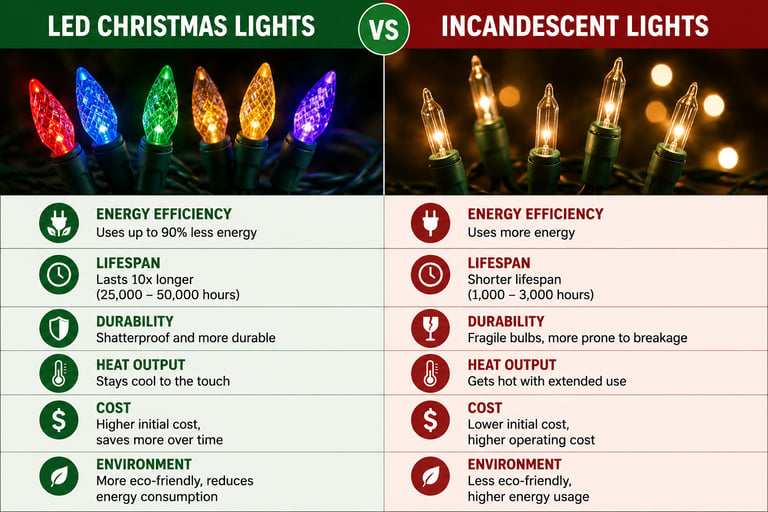
Table of Contents
Why This Guide Is For You
This guide is for homeowners who:
decorate for Christmas, Halloween, Easter, patriotic holidays, or other seasonal celebrations
use outdoor inflatables alongside traditional lighting
are planning to expand an existing display
want lower electric bills without giving up decorations
want practical, real-world guidance instead of confusing electrical calculations
Whether you're hanging a few light strings or building a neighborhood destination display, understanding where your electricity is actually going helps you make smarter purchasing decisions.
Why This Topic Matters
One of the biggest misconceptions about holiday decorating is that adding more lights automatically leads to an enormous electric bill.
That was often true twenty or thirty years ago when most decorations relied on incandescent bulbs. Today's displays are very different.
Modern LEDs consume dramatically less electricity while producing similar—or even brighter—light output. In many outdoor displays, the decorative lighting accounts for only a small portion of the total electricity used throughout the season. Blower motors, animated decorations, projectors, and other accessories can easily consume more power than the lights themselves.
Understanding those differences allows you to:
estimate operating costs more accurately
expand displays with confidence
avoid unnecessary electrical upgrades
choose accessories that provide the biggest long-term savings
If you're building a larger display, our guide to The Ultimate Guide to Powering Outdoor Inflatables Safely: Extension Cords, GFCI Protection, Weatherproofing and Load Planning explains how lighting, extension cords, GFCI protection, and weatherproof connections all work together as part of a safe outdoor power system.
Why LED Lights Have Become the Standard
Walk through almost any neighborhood during the holidays and you'll notice something surprising.
Displays today are often much larger than they were twenty years ago.
More roofline lights.
More pathway lighting.
More illuminated decorations.
More inflatables.
Yet many homeowners actually spend less on electricity than they did with much smaller displays years ago.
The reason is simple:
LED technology has fundamentally changed holiday decorating.
Unlike incandescent bulbs, which create light by heating a tiny filament until it glows, LEDs convert electricity into light much more efficiently. That means far less energy is wasted as heat.
For outdoor decorators, that produces several benefits:
dramatically lower operating costs
cooler operating temperatures
reduced electrical load
longer bulb life
improved durability in outdoor conditions
Instead of worrying that every additional decoration will significantly increase your electric bill, you can often expand an LED-based display while adding only a modest amount to your seasonal energy costs.
LED vs Incandescent: What's the Difference?
Although both technologies illuminate your display, they use electricity in completely different ways.
LED Lights
LED stands for Light Emitting Diode.
Instead of generating light by heating a wire, LEDs use semiconductor technology to produce light directly. Because very little electricity is wasted as heat, nearly all of the energy goes toward illumination.
For outdoor decorators, this means:
lower power consumption
cooler operation
longer service life
less stress on electrical circuits
easier expansion of larger displays
Many modern outdoor inflatables already include built-in LED lighting, which is one reason newer decorations typically consume much less electricity than older models.
Incandescent Lights
Incandescent bulbs rely on a heated filament.
Electricity passes through a tiny wire until it becomes hot enough to glow.
The drawback is efficiency.
A significant portion of the electricity is converted into heat rather than visible light.
That extra heat increases operating costs while also shortening bulb life.
For homeowners who still own older incandescent light strings, replacing them with LEDs is often one of the easiest ways to reduce seasonal electricity usage without changing the overall appearance of the display.
How Holiday Lighting Uses Electricity
Electricity costs are usually easier to understand once you know three basic terms.
Watts
Watts measure how much power a decoration uses while it's running.
Higher wattage means greater electricity consumption.
Kilowatt-hours (kWh)
Your electric company charges based on kilowatt-hours rather than watts.
One kilowatt-hour equals using 1,000 watts for one hour.
For example:
100 watts for 10 hours = 1 kWh
500 watts for 2 hours = 1 kWh
50 watts for 20 hours = 1 kWh
Understanding this simple relationship makes estimating holiday decorating costs much easier.
Operating Time
Perhaps the most overlooked factor isn't the type of lights at all—it's how long they stay on each night.
Running a display for eight hours instead of four nearly doubles the electricity consumed, regardless of whether you're using LEDs or incandescent bulbs.
This is why timers and smart controls often provide surprisingly meaningful savings over the course of an entire holiday season.
Real LED vs Incandescent Cost Comparisons
Example 2: Medium Outdoor Display
Imagine a display with:
roofline lights
bushes wrapped in lights
pathway lights
several illuminated decorations
If all of those lights are LED, the monthly operating cost is often only a few dollars.
The same display using older incandescent technology may cost several times more to operate.
Example 3: Large Holiday Display
Many enthusiasts eventually expand to include:
multiple inflatables
roof lighting
trees
bushes
pathway lighting
animated decorations
This is where LED technology becomes especially valuable.
Instead of worrying about every new light string adding significantly to your electric bill, LEDs allow much larger displays while keeping electrical consumption surprisingly manageable.
Do Holiday Lights or Inflatables Use More Electricity?
This surprises many first-time decorators.
They assume the lights are responsible for most of the electricity used.
In reality, the blower motor inside an inflatable often consumes more electricity than the built-in LED lighting.
For example:
Modern LED lighting may only require a handful of watts.
A continuously running blower motor commonly uses many times that amount throughout the evening.
That doesn't mean inflatables are expensive to operate—it simply changes where your electricity is actually going.
If you're planning a larger display, it's far more important to understand the combined electrical load than to focus only on the light strings. Our article How Many Inflatables Can One Circuit Handle? explains how to estimate circuit capacity safely before adding more decorations.
If you're adding multiple inflatables, extension cords, and lighting together, How to Power Multiple Outdoor Inflatables Safely Without Overloading Your Circuit walks through proper planning so you can expand confidently without overloading a breaker.
The Biggest Ways to Reduce Holiday Display Costs
Fortunately, lowering your seasonal electricity bill usually doesn't require eliminating decorations.
Instead, focus on the improvements that provide the greatest return.
1. Replace Older Incandescent Lights
Nothing has a larger impact than replacing older incandescent strings with LED versions.
You'll reduce:
electricity consumption
heat production
replacement bulbs
maintenance
2. Run Displays for Fewer Hours
Operating your display for five hours instead of eight hours every night can reduce operating costs dramatically over an entire season.
Many homeowners never notice the shorter runtime, especially if the lights turn on automatically at dusk.
3. Use Outdoor Timers
An outdoor timer automatically switches decorations on and off every day.
Benefits include:
consistent schedules
reduced electricity use
no forgotten lights
improved convenience
For informational articles like this, a simple mechanical timer is often sufficient. Larger displays may benefit from programmable or remote-controlled models.
4. Smart Plugs Make Scheduling Even Easier
Outdoor smart plugs allow you to:
change schedules remotely
adjust for weather
activate displays from your phone
coordinate multiple decorating zones
They're especially useful if you frequently change your decorating schedule during the holiday season.
5. Expand Displays Efficiently
Instead of plugging decorations into multiple random outlets around the yard, plan the layout first.
Grouping decorations logically often means:
shorter extension cords
fewer electrical connections
easier troubleshooting
cleaner installation
If you're building a larger display, The Ultimate Guide to Powering Outdoor Inflatables Safely: Extension Cords, GFCI Protection, Weatherproofing and Load Planning explains how to design a safer, more reliable outdoor power system from the beginning.
Measure Your Display Instead of Guessing
Many homeowners are pleasantly surprised when they discover how little electricity their decorations actually use.
Instead of estimating, you can measure the exact consumption of an individual decoration or an entire lighting circuit.
Two excellent tools from your approved product list are:
P3 Kill A Watt Electricity Usage Monitor
This long-time favorite measures:
watts
kilowatt-hours
operating cost
daily, weekly, monthly, and yearly consumption
It's ideal for comparing older incandescent decorations with newer LED replacements.
Mecheer Electricity Usage Monitor
If you're looking for a more budget-friendly option, the Mecheer meter provides similar information, including watts, volts, amps, frequency, power factor, and accumulated energy usage.
Using either meter for a single evening gives you real data instead of relying on estimates or manufacturer specifications.
Planning Larger Outdoor Displays
One of the biggest advantages of modern LED decorations is that they make it practical to build larger, more impressive displays without dramatically increasing electricity usage. That doesn't mean you can ignore electrical planning, though.
As your display grows, the focus shifts from the cost of individual light strings to the overall design of your outdoor power system.
Think about:
Where your outdoor receptacles are located
Which decorations will share the same circuit
The length and gauge of extension cords
Keeping electrical connections protected from rain and snow
Reducing trip hazards across walkways and driveways
Good planning usually makes setup easier, improves reliability, and makes taking everything down at the end of the season much simpler.
Choose Extension Cords That Match the Job
A common mistake is grabbing whatever extension cord happens to be in the garage.
Instead, choose an outdoor-rated cord that's appropriate for:
the total electrical load
the distance being covered
expected winter temperatures
exposure to rain, snow, and sunlight
If you aren't sure which gauge or length you need, our Best Outdoor Extension Cords for Holiday Inflatables (2026 Buyer's Guide) explains when 16-gauge cords are sufficient and when heavier 14- or 12-gauge cords make more sense.
Protect Every Outdoor Connection
Even if LEDs use very little electricity, every outdoor electrical connection still needs protection from moisture.
Small connection covers work well for a single plug connection, while larger weatherproof boxes help protect:
timers
smart plugs
multiple adapters
power strips
For larger displays or challenging weather conditions, see Best Weatherproof Cord Connection Boxes for Outdoor Decorations, which compares different sizes and explains when each style works best.
Organize Cords for Safety
A neat display isn't just about appearance.
Proper cord management can:
reduce accidental unplugging
minimize trip hazards
simplify troubleshooting
help prevent damaged extension cords
If your decorations spread across the yard, Best Outdoor Cord Management Accessories for Holiday Displays (Clips, Stakes, Covers & Safer Setup Guide) covers practical ways to secure cords while keeping everything organized.
Common Myths About Holiday Lighting Costs
Myth: Holiday lights always cause huge electric bills.
Reality: Modern LED lights use so little electricity that many homeowners notice only a modest increase in their monthly bill during the decorating season.
Myth: More decorations always mean much higher costs.
Reality: It depends on what you're adding.
Adding several LED light strings may increase electricity usage only slightly, while adding multiple blower-powered inflatables or animated decorations has a greater impact.
Myth: Timers don't save enough money to matter.
Reality: Runtime is one of the easiest variables to control.
Reducing nightly operation by just a couple of hours can noticeably reduce seasonal energy use without changing the appearance of your display during peak viewing hours.
Myth: You need expensive equipment to measure electricity use.
Reality: A simple plug-in electricity monitor lets you measure actual usage in minutes and often costs less than replacing a single premium light set.
Frequently Asked Questions
Are LED holiday lights worth replacing older incandescent lights?
For most homeowners, yes. LEDs typically use significantly less electricity, generate much less heat, last far longer, and are generally more durable for outdoor use.
How much does it cost to run holiday lights all month?
It depends on the wattage of your decorations, how many hours they run each night, and your local electricity rate. Most modern LED displays cost surprisingly little compared to older incandescent displays.
Do outdoor holiday decorations noticeably increase electric bills?
Usually not as much as people expect. Modern LED decorations are very efficient, although larger displays with multiple inflatables, projection lights, or animated decorations will naturally consume more electricity.
Do inflatables use more electricity than LED lights?
Often, yes. The continuous blower motor typically uses more electricity than the LED lighting inside the inflatable.
Should I use timers with outdoor decorations?
Absolutely. Timers automatically control runtime, reduce wasted electricity, and eliminate the need to remember to switch decorations on and off every evening.
How can I estimate my own decorating costs?
The easiest method is to plug your decorations into an electricity usage monitor such as the P3 Kill A Watt or Mecheer meter. These devices measure actual power consumption so you can calculate operating costs using your local utility rate.
Can I safely add more LED lights to my display?
Usually yes, but you should always consider the total electrical load on the circuit—not just the lights. If you're expanding your setup, calculate the combined wattage of all connected decorations before adding more equipment.
Key Takeaways
Modern LED holiday decorations typically use dramatically less electricity than comparable incandescent decorations.
Operating hours often have as much impact on seasonal energy costs as the type of lighting you choose.
Large outdoor displays can remain affordable when they're planned around efficient LED decorations.
Plug-in electricity monitors remove the guesswork and show exactly how much your display costs to operate.
Safe power planning, proper extension cords, weatherproof connections, and organized cable management become increasingly important as displays grow.
Mini Conclusion
If you're still decorating with older incandescent lights, switching to LEDs is one of the simplest upgrades you can make. Lower electricity consumption, cooler operation, and longer service life make them an easy choice for most outdoor displays.
Just as importantly, remember that the biggest savings often come from combining efficient lighting with smart operating habits. Running your display only during peak evening hours, measuring actual energy use, and planning your power layout carefully will usually have a greater long-term impact than worrying about a few extra strands of lights.
Whether you're decorating for Halloween, Christmas, Easter, Independence Day, or another seasonal celebration, understanding how your display uses electricity allows you to expand confidently while keeping both your electric bill and your outdoor power system under control.
Continue Learning
You may also find these guides helpful as you expand your outdoor display:
The Ultimate Guide to Powering Outdoor Inflatables Safely: Extension Cords, GFCI Protection, Weatherproofing and Load Planning — Learn how to design a safe, reliable outdoor electrical system for seasonal decorations.
Why Your Outdoor Inflatable Keeps Tripping the Breaker (And How to Fix It) — Troubleshoot overloaded circuits, startup surges, and other common electrical problems.
Real-World Outdoor Inflatable Power Problems and How to Fix Them — Practical solutions to the issues homeowners encounter most often.
How Many Inflatables Can One Circuit Handle? — Understand circuit capacity before expanding your display.
Best Outdoor Power Stakes & Multi-Outlet Yard Power Centers (2026 Buyer's Guide) — Compare options for distributing power safely across larger decorating areas.