
Home > Setup, Safety, and Repairs > Power and Extension Cords > How Many Inflatables Can One Circuit Handle?
How Many Inflatables Can One Circuit Handle? Safe Load Planning Guide (2026)
Learn how many holiday inflatables a 15-amp or 20-amp circuit can safely handle. Calculate electrical load, avoid breaker trips, choose proper extension cords, and expand your display safely.
Frank “Frosty” Adminei
7/11/202614 min read
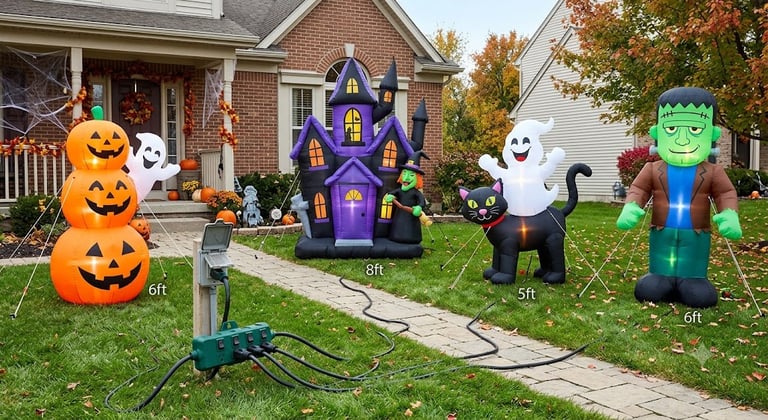
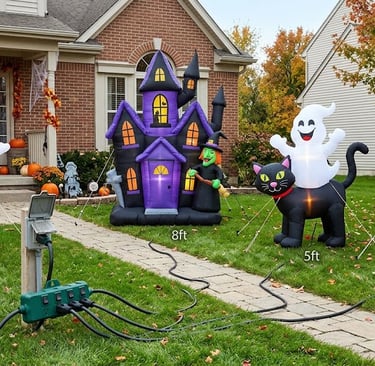
Introduction
One of the most common questions inflatable owners ask is, "How many inflatables can I safely run on one circuit?" Unfortunately, there is no universal answer because every display is different. A circuit that easily powers three large inflatables in one yard may struggle with the same number in another home.
The good news is that determining your safe limit is much easier than most people think.
Instead of guessing, you can calculate your available circuit capacity, measure actual inflatable power consumption, and build a display that operates reliably throughout the holiday season. This approach helps prevent nuisance breaker trips, weak blower performance, damaged extension cords, and frustrating display outages.
In this guide, you'll learn how residential circuits work, how to calculate safe electrical loads, how to measure actual inflatable power usage, and how to safely expand your display as your collection grows.
Who This Guide Is For
This guide is designed for:
First-time inflatable owners
Homeowners building larger holiday displays
Families adding multiple decorations each year
Anyone who has experienced breaker trips during the holidays
DIY decorators who want a safer outdoor power setup
Holiday enthusiasts planning expansion of existing displays
Whether you're running two inflatables or twenty, understanding your circuit capacity can save time, money, and frustration.
Why This Topic Matters
Holiday displays have become larger and more elaborate than ever. Many homeowners gradually add decorations year after year without ever evaluating their electrical capacity.
At first, everything works fine.
Then one season you add another inflatable, plug everything in, and suddenly:
A breaker trips
A GFCI outlet shuts down
One blower sounds weak
Decorations intermittently lose power
Outdoor connections overheat
The problem is usually not the inflatable itself. The problem is often poor load planning.
Understanding how many inflatables one circuit can safely handle helps you:
Avoid overloaded circuits
Improve display reliability
Reduce electrical hazards
Protect expensive decorations
Plan future display expansion safely
The Biggest Mistake Most Inflatable Owners Make
Most homeowners focus on outlets.
Electricians focus on circuits.
That distinction is important.
Many people assume that if they have multiple outlets available, they can continue plugging in decorations indefinitely. In reality, several outlets may be connected to the same circuit breaker.
For example:
Front porch outlet
Garage outlet
Side yard outlet
Exterior receptacle near driveway
All four outlets may be powered by a single breaker.
This means adding decorations across multiple outlets may still increase the load on the same circuit.
Another common mistake is counting inflatables instead of measuring power.
Consider two displays:
Display A:
Four small inflatables
Total load: 250 watts
Display B:
Four large inflatables
Total load: 700 watts
Both displays contain four inflatables, but their electrical demands are dramatically different.
Successful display planning starts with power consumption, not decoration count.
For a broader understanding of holiday display electrical systems, see The Complete Guide to Energy, Power, and Smart Tech for Holiday Inflatables.
Understanding What Actually Limits the Number of Inflatables You Can Run
The true limit is not the number of inflatables.
The limit is available circuit capacity.
Let's start with a few basic electrical terms.
Voltage
Most residential outlets in the United States operate at approximately 120 volts.
Voltage is the electrical pressure pushing power through a circuit.
Amperage
Amperage (amps) measures the amount of electrical current flowing through the circuit.
Most household branch circuits are:
15 amps
20 amps
Wattage
Wattage measures actual power consumption.
Inflatables, lights, timers, and accessories all consume watts.
Breakers
Circuit breakers protect wiring from overload.
When a circuit exceeds safe operating limits, the breaker trips and shuts off power.
That breaker determines how much power your display can safely use.
Common Residential Circuit Capacities
A 15-amp circuit:
120 volts × 15 amps = 1,800 watts
A 20-amp circuit:
120 volts × 20 amps = 2,400 watts
At first glance, it appears you can use the entire capacity.
However, safe display planning requires another important concept.
The 80 Percent Rule: The Number Every Inflatable Owner Should Know
Professional electricians often apply the 80% rule when planning continuous loads.
Holiday inflatables commonly operate for many hours at a time.
Because of this, it's smart to reserve a safety margin rather than pushing a circuit to its absolute maximum.
Safe Planning Capacity
15-Amp Circuit
Maximum capacity:
1,800 watts
Recommended planning capacity:
1,440 watts
(80% of 1,800)
20-Amp Circuit
Maximum capacity:
2,400 watts
Recommended planning capacity:
1,920 watts
(80% of 2,400)
Why This Matters
Let's say your display requires 1,700 watts.
Technically, that may operate on a 15-amp circuit.
However, you have little margin for:
Startup surges
Voltage fluctuations
Additional household loads
Extension cord losses
Operating close to the limit often causes nuisance trips and reliability problems.
Using the 80% rule provides breathing room.
For larger displays, this margin becomes increasingly important.
For a complete outdoor power planning framework, see The Ultimate Guide to Powering Outdoor Inflatables Safely: Extension Cords, GFCI Protection, Weatherproofing and Load Planning.
How to Calculate Exactly How Many Inflatables Your Circuit Can Handle
Instead of asking:
"How many inflatables can I run?"
Ask:
"How many watts are available on my circuit?"
The calculation process is straightforward.
Step 1: Identify Your Breaker Size
Locate the breaker controlling your outdoor outlet.
Most homes use:
15-amp breakers
20-amp breakers
Record the breaker size.
Step 2: Apply the 80 Percent Rule
Example:
15-amp circuit:
1,800 watts × 0.80 = 1,440 watts available
20-amp circuit:
2,400 watts × 0.80 = 1,920 watts available
Step 3: Determine Existing Loads
Ask:
What else uses this circuit?
Examples include:
Garage refrigerators
Freezers
Exterior lighting
Security systems
Battery chargers
Workshop equipment
Subtract those loads from available capacity.
Step 4: Determine Inflatable Wattage
Check blower labels whenever available.
Record wattage for each inflatable.
Step 5: Add Everything Together
Example:
Inflatable 1 = 80 watts
Inflatable 2 = 120 watts
Inflatable 3 = 150 watts
Inflatable 4 = 100 watts
Total:
450 watts
On a 1,440-watt planning budget, this display operates comfortably within safe limits.
The same process can be repeated as your display grows each year.
Why Manufacturer Labels Often Don't Tell the Whole Story
Many decorators rely entirely on blower labels.
While labels are helpful, they don't always reflect real-world operation.
Several factors can affect actual consumption:
Blower efficiency
Motor age
Voltage variations
Temperature
Extension cord length
Manufacturing tolerances
In addition, startup conditions can temporarily increase demand.
Although inflatable blowers generally have modest startup surges compared with large motors, a display with multiple blowers starting simultaneously can briefly draw more power than its normal running load.
This is one reason some displays trip breakers during startup even though they appear to operate normally afterward.
Another issue is mixed displays.
You may have:
Older inflatables
Newer inflatables
Different blower manufacturers
Various blower sizes
Actual consumption can vary significantly between decorations that appear similar.
The safest approach is measurement rather than estimation.
Recommended Measurement Tools
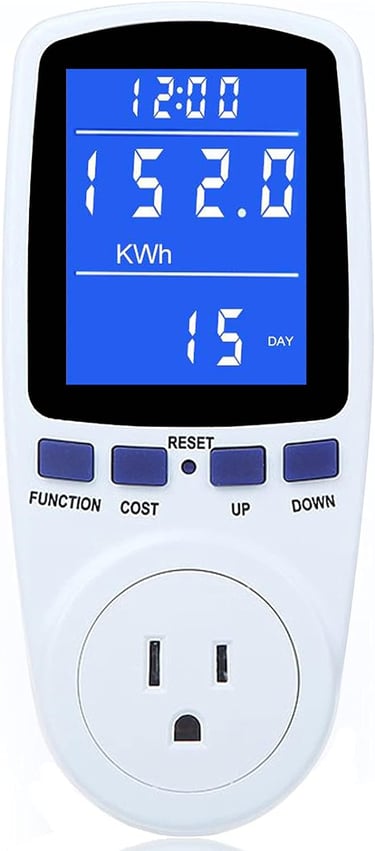
Mecheer Upgraded Watt Power Meter
Provides real-time wattage, amperage, voltage, energy consumption, and overload monitoring.
Why Buyers Like It
Easy-to-read backlit display
Multiple measurement modes
Tracks cumulative power usage
Budget-friendly price point
Best For
Homeowners wanting quick seasonal measurements.
Not Ideal For
Users seeking long-term historical tracking or advanced analytics.
Practical Notes
Measure individual inflatables and then compare totals against your circuit capacity budget.
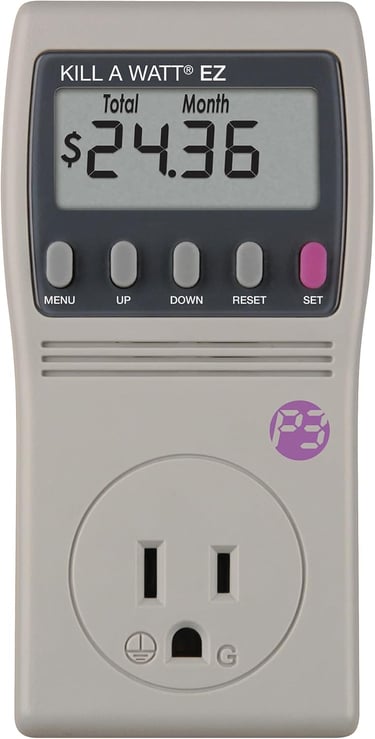
P3 P4400 Kill A Watt Electricity Usage Monitor
A long-established power monitoring device widely used for household electrical testing.
Why Buyers Like It
Straightforward operation
Proven reliability
Multiple usage tracking modes
Good measurement accuracy
Best For
Detailed display load planning.
Not Ideal For
Users who only need a rough estimate.
Practical Notes
Especially useful when building larger displays involving multiple blowers.
Measuring Your Display with a Watt Meter Before Problems Start
Many decorators spend hundreds of dollars on new inflatables but never spend a few minutes measuring actual power consumption.
That small step can prevent many common electrical problems.
A watt meter allows you to replace assumptions with real data.
Measuring a Single Inflatable
Plug the watt meter into the outlet.
Plug the inflatable into the meter.
Allow the blower to stabilize.
Record the wattage reading.
Repeat for each inflatable.
This gives you actual operating consumption rather than estimated values.
Measuring a Complete Display
Once individual measurements are collected:
Add all readings together.
Compare total wattage against your circuit budget.
Maintain reasonable safety margin.
For example:
Available circuit capacity:
1,440 watts
Measured display load:
720 watts
Remaining capacity:
720 watts
This immediately tells you how much room remains for future expansion.
Benefits of Measuring Before Problems Occur
Measurement helps you:
Avoid breaker trips
Identify inefficient equipment
Estimate operating costs
Plan future upgrades
Verify load calculations
Build more reliable displays
Many of the troubleshooting situations discussed later in this guide can be prevented simply by understanding your actual electrical load before installation.
For additional power-monitoring and automation ideas, see The Complete Guide to Energy, Power, and Smart Tech for Holiday Inflatables.
Real-World Display Examples: Small, Medium, Large, and Mega Displays
One of the biggest shortcomings of most online articles is that they explain electrical theory without showing how it applies to actual holiday displays.
The following examples are planning illustrations, not strict limits. Actual wattage varies based on blower size, inflatable design, and manufacturer specifications.
Small Display Example
A typical starter display might include:
Small inflatable snowman
Small inflatable penguin
Medium inflatable Santa
Estimated total load:
Approximately 200–400 watts
This type of display typically operates comfortably within the capacity of either a 15-amp or 20-amp circuit, assuming minimal competing loads.
For many homeowners, this represents a good entry point into inflatable decorating.
Medium Neighborhood Display
A more ambitious display may include:
Several medium inflatables
One larger centerpiece inflatable
Additional lighting elements
Estimated total load:
Approximately 500–900 watts
At this level, load calculations become more important because other devices sharing the circuit can significantly reduce available capacity.
Large Showcase Display
A large front-yard display may include:
Multiple large inflatables
Animated decorations
Additional lighting systems
Timers and smart controls
Estimated total load:
Approximately 900–1,400 watts
At this point, many decorators are approaching the recommended planning limit of a typical 15-amp circuit.
This is where actual measurement becomes increasingly valuable.
Using a watt meter allows you to determine whether you are approaching your available electrical budget.
Mega Display
A mega display may contain:
Numerous large inflatables
Multiple themed scenes
Extensive lighting
Several power distribution points
Loads can easily exceed:
1,500 watts
2,000 watts
More
Displays of this size frequently require:
Multiple circuits
Load balancing
Careful power distribution planning
These setups should never be expanded simply by adding more splitters or extension cords to an already heavily loaded circuit.
The Hidden Problem: Other Devices May Already Be Using Your Circuit
Many homeowners correctly calculate inflatable wattage but still experience breaker trips.
The reason is often shared circuit loads.
Your outdoor receptacle may share a circuit with:
Garage outlets
Basement outlets
Exterior lighting
Utility equipment
Battery chargers
Refrigerators or freezers
These devices consume power even though they are unrelated to your display.
Example
Suppose you have a 15-amp circuit.
Recommended planning capacity:
1,440 watts
Now imagine the circuit also powers:
Garage freezer = 300 watts
Battery charger = 100 watts
Total existing load:
400 watts
Available display capacity:
1,440 − 400 = 1,040 watts
Without accounting for these devices, you may unknowingly overload the circuit.
How to Identify Shared Loads
Start by locating the breaker that powers your outdoor outlet.
Then:
Turn off the breaker.
Identify everything that loses power.
Create a simple circuit map.
Record devices sharing the circuit.
This process often reveals hidden loads that affect display capacity.
Why This Matters for Future Expansion
Many homeowners successfully operate a display for years and then suddenly experience problems after adding one more inflatable.
The actual cause is often not the new inflatable itself.
Instead, the combined load of all connected devices has finally exceeded the available capacity.
For additional energy planning guidance, see Energy Usage for Outdoor Decorations and Money Saving Tips.
Extension Cords, Wire Gauge, and Voltage Drop Explained
Extension cords are one of the most misunderstood parts of holiday display planning.
Many decorators focus only on cord length.
Wire gauge is equally important.
What Is Voltage Drop?
As electricity travels through a cord, some voltage is lost.
Longer cords increase resistance.
Higher resistance increases voltage drop.
Excessive voltage drop can cause:
Reduced blower performance
Increased motor stress
Diminished efficiency
Intermittent operational issues
Understanding Gauge Numbers
Extension cord gauge works opposite of what many people expect.
Lower numbers indicate thicker wire.
Examples:
14-gauge = thicker wire
16-gauge = thinner wire
Thicker wire generally performs better under heavier loads and longer distances.
When a 16-Gauge Cord May Be Appropriate
A 16-gauge cord can work well when:
Loads are relatively light
Cord runs are short
Total amperage remains modest
When a 14-Gauge Cord Is the Better Choice
A 14-gauge cord provides additional margin for:
Larger displays
Longer cord runs
Multiple inflatables
Higher total amperage
Southwire Yellow Jacket Heavy Duty Extension Cord
Why Buyers Like It
Durable construction, visibility, and heavier-duty wiring.
Best For
Large holiday displays and demanding outdoor environments.
Not Ideal For
Situations where a lightweight cord is sufficient.
Practical Notes
Thicker wire can reduce voltage-drop concerns compared with lighter-gauge alternatives.
Avoid Common Extension Cord Mistakes
Avoid:
Daisy-chaining multiple extension cords
Using damaged cords
Using indoor-rated cords outdoors
Exceeding cord amp ratings
Hiding cords where heat cannot dissipate
For a deeper discussion, see Extension Cord Mistakes That Cause Outdoor Inflatable Failures (Gauge, Length, and Voltage Drop Explained).
Powering Multiple Inflatables from One Area Safely
As displays grow, many homeowners need a practical way to distribute power throughout the yard.
The goal is safe distribution—not simply adding more plugs.
Tiffcofio Outdoor Power Strip Weatherproof Power Stake
Why Buyers Like It
Multiple outlets, heavy-duty cord, weather-resistant construction, and overload protection.
Best For
Holiday displays requiring several connection points in one area.
Not Ideal For
Single-inflatable setups.
Practical Notes
Elevating connections can help reduce exposure to standing water and debris.
DEWENWILS Outdoor Power Stake Timer
Why Buyers Like It
Combines power distribution, timer functionality, and remote operation.
Best For
Homeowners wanting both convenience and organization.
Not Ideal For
Decorators who prefer manual control.
Practical Notes
Can reduce the need for separate timer devices throughout the display.
SURAIELEC Outdoor Power Stake Timer
Why Buyers Like It
Multiple timer options, remote control, and integrated overload protection.
Best For
Larger seasonal displays.
Not Ideal For
Very small displays.
Practical Notes
Useful when multiple decorations need synchronized operation.
Splitters
Splitters can also help distribute power when used responsibly.
DEWENWILS GFCI cord
Why Buyers Like It
Simple and inexpensive way to add additional connection points.
Best For
Small expansions where circuit capacity remains well within limits.
Not Ideal For
Solving overload problems.
Practical Notes
A splitter creates additional outlets but does not increase available circuit capacity.
The Key Principle
Adding outlets does not create additional power.
Every inflatable connected to the system still draws from the same available circuit capacity.
For advanced planning, see How to Power Multiple Outdoor Inflatables Safely Without Overloading Your Circuit.
GFCI Protection: What It Does and Why It Matters Outdoors
Outdoor electrical systems are exposed to:
Rain
Snow
Ice
Condensation
Wet ground conditions
Because of these hazards, GFCI protection plays a critical role.
What Is a GFCI?
GFCI stands for Ground Fault Circuit Interrupter.
A GFCI monitors electrical current and quickly disconnects power when it detects an unsafe leakage path.
Its primary purpose is protecting people from electrical shock.
Breaker Trip vs GFCI Trip
Many homeowners confuse the two.
Breaker Trip
Usually caused by:
Excessive load
Short circuits
Overcurrent conditions
GFCI Trip
Usually caused by:
Moisture
Ground faults
Damaged wiring
Electrical leakage
Understanding the difference helps speed troubleshooting.
DEWENWILS 3 FT Automatic GFCI Extension Cord
Why Buyers Like It
Automatic reset functionality and heavy-duty cable design.
Best For
Frequent seasonal use.
Not Ideal For
Applications requiring extensive cord length.
Practical Notes
Can simplify recovery after brief power interruptions.
For a broader discussion of outdoor electrical safety, see The Ultimate Guide to Powering Outdoor Inflatables Safely: Extension Cords, GFCI Protection, Weatherproofing and Load Planning.
Weatherproofing Outdoor Power Connections
A properly sized circuit can still experience failures if outdoor electrical connections are exposed to moisture.
Water intrusion is one of the most common causes of:
GFCI trips
Intermittent inflatable operation
Corrosion
Premature equipment failure
Many decorators focus heavily on wattage calculations while overlooking connection protection.
Why Standard Connections Fail Outdoors
A typical extension cord connection lying on the ground is vulnerable to:
Rain
Snow
Melting ice
Lawn irrigation
Standing water
Condensation
Even minor moisture intrusion can create recurring electrical problems.
Small Connection Protection Solutions
For single extension cord connections, compact weatherproof boxes often provide sufficient protection.
Hrensaw Small Weatherproof Electrical Connection Box
Why Buyers Like It
Compact design, weather resistance, and simple installation.
Best For
Single cord connections and small displays.
Not Ideal For
Large multi-plug power setups.
Practical Notes
Works best when cable entries are properly sealed and elevated from standing water.
For additional troubleshooting guidance, see Why Weatherproof Outdoor Electrical Boxes Still Fail in Rain, Snow, and Ice (And How to Fix Them for Good).
Smart Plugs and Timers for Better Power Management
Many inflatable decorators focus exclusively on power capacity.
Convenience and automation can be equally valuable.
Timers and smart plugs help:
Reduce energy usage
Automate schedules
Simplify daily operation
Prevent forgetting to shut displays off
Smart Plug Benefits
Smart plugs allow remote control through:
Smartphone apps
Voice assistants
Scheduling systems
This is particularly useful for seasonal displays that operate on predictable schedules.
Kasa Outdoor Smart Plug (KP401)
Why Buyers Like It
Simple scheduling, weather resistance, and reliable app control.
Best For
Most homeowners running holiday inflatables.
Not Ideal For
Users who prefer fully manual operation.
Practical Notes
Can automate daily operation without adding complexity to the display itself.
TP-Link Tapo Matter Outdoor Smart Plug (P400M)
Why Buyers Like It
Matter compatibility and independent outlet control.
Best For
Advanced smart-home users.
Not Ideal For
Homes without smart-home ecosystems.
Practical Notes
Provides greater interoperability with multiple smart-home platforms.
Amazon Basics Outdoor Smart Plug
Why Buyers Like It
Alexa integration and dual controlled outlets.
Best For
Amazon Alexa households.
Not Ideal For
Users invested in non-Alexa ecosystems.
Practical Notes
Easy setup for homeowners already using Alexa devices.
Mechanical Timers
Many decorators prefer the simplicity of mechanical timers.
BN-LINK 24-Hour Heavy Duty Mechanical Timer
Why Buyers Like It
Simple operation and dependable daily scheduling.
Best For
Homeowners wanting a set-and-forget solution.
Not Ideal For
Complex scheduling requirements.
Practical Notes
Mechanical timers remain one of the easiest automation options available.
Remote-Control Timers
Remote-control timers provide flexibility without requiring Wi-Fi.
DEWENWILS Outdoor Timer Outlet with Remote Control
Why Buyers Like It
Convenient operation from inside the home.
Best For
Large displays located far from the house.
Not Ideal For
Users who already have smart-home control systems.
Practical Notes
Allows quick adjustments during bad weather without going outdoors.
For broader energy-management strategies, see The Complete Guide to Energy, Power, and Smart Tech for Holiday Inflatables.
Warning Signs Your Display Is Approaching Circuit Capacity
Many overloaded displays provide warning signs before a breaker trips.
Recognizing these symptoms early can prevent disruptions.
Common Warning Signs
Watch for:
Frequent breaker trips
Warm extension cords
Flickering lights
Inflatable blowers that sound strained
Decorations that repeatedly restart
GFCI devices tripping unexpectedly
Any of these issues warrant investigation.
Why Ignoring Warning Signs Is Risky
Electrical systems rarely move directly from normal operation to complete failure.
Warning signs often appear first.
Addressing problems early can help prevent:
Equipment damage
Holiday display downtime
Costly troubleshooting later
What to Do
If warning signs appear:
Measure actual power usage.
Reduce total load.
Inspect cords and connections.
Verify GFCI protection.
Check for moisture intrusion.
Evaluate circuit sharing.
For troubleshooting guidance, see:
Frequently Asked Circuit Planning Mistakes
The same mistakes appear repeatedly among inflatable decorators.
Mistake #1: Assuming Every Outlet Is a Separate Circuit
Many outdoor outlets share the same breaker.
Always verify actual circuit layout.
Mistake #2: Ignoring Existing Loads
Garage appliances, freezers, chargers, and lighting can significantly reduce available capacity.
Mistake #3: Using Undersized Extension Cords
Improper wire gauge increases voltage drop and stress on equipment.
Mistake #4: Relying on Guesswork
Actual measurements are more reliable than assumptions.
P3 P4400 Kill A Watt Electricity Usage Monitor
Why Buyers Like It
Accurate wattage measurements and long-term energy tracking.
Best For
Homeowners expanding beyond small displays.
Not Ideal For
Users unwilling to measure actual consumption.
Practical Notes
Measured data often reveals loads that are much lower—or higher—than expected.
Mistake #5: Expanding Without Recalculating
Each additional inflatable changes total circuit demand.
Recalculate whenever new decorations are added.
Final Answer: How Many Inflatables Can One Circuit Handle?
The number of inflatables a circuit can safely handle depends entirely on the total electrical load—not the number of decorations.
As a practical planning guideline:
A 15-amp circuit should generally be planned around approximately 1,440 watts.
A 20-amp circuit should generally be planned around approximately 1,920 watts.
Many modern inflatable displays consume surprisingly little electricity once running.
As a result, homeowners can often operate several inflatables on a single circuit.
The safest approach is to:
Determine circuit size.
Account for all existing loads.
Measure actual power consumption.
Use properly sized extension cords.
Protect outdoor connections from weather.
Add GFCI protection where appropriate.
Expand displays gradually and verify capacity as you grow.
Following these steps allows most decorators to build larger displays confidently while minimizing the risk of breaker trips, power interruptions, and equipment failures.
Key Takeaways
Circuit capacity is determined by amperage and voltage.
The 80% rule provides a practical planning limit for continuous operation.
Wattage matters more than inflatable count.
Shared circuit loads can dramatically reduce available capacity.
Watt meters provide the most accurate load information.
Extension cord gauge affects performance and voltage drop.
Weatherproofing outdoor connections improves reliability.
GFCI protection is an important outdoor safety measure.
Smart plugs and timers improve convenience and energy management.
Display expansion should always include a new load calculation.
Mini Conclusion
Most holiday inflatable displays can safely operate multiple decorations from a single household circuit when proper planning is used. Understanding circuit capacity, measuring actual power consumption, and protecting outdoor electrical connections are far more important than simply counting inflatables. A little planning upfront can help ensure a reliable display throughout the entire holiday season.
FAQ
Can I run 10 inflatables on one outlet?
Possibly. The determining factor is total wattage, not the number of inflatables. Ten small inflatables may use less power than two very large decorations.
Will a power strip increase my circuit capacity?
No. Power strips and splitters add outlets but do not increase available electrical capacity.
Is a 20-amp circuit always better?
A 20-amp circuit provides more available capacity than a 15-amp circuit, but proper load calculations are still necessary.
Do inflatable blowers use a lot of electricity?
Most modern blowers are relatively efficient, but actual consumption varies by size and design.
What is the easiest way to determine my display's power usage?
A plug-in watt meter is typically the simplest and most accurate solution.
Why does my breaker trip even though my inflatables worked last year?
Additional decorations, shared circuit loads, failing equipment, moisture intrusion, or extension cord issues may have changed the total electrical demand.
Related Articles
Why Your Outdoor Inflatable Keeps Tripping the Breaker (And How to Fix It)
If your display repeatedly loses power, this guide explains the most common causes and the fastest ways to diagnose them.
How to Power Multiple Outdoor Inflatables Safely Without Overloading Your Circuit
Learn advanced load-balancing strategies for expanding displays safely and efficiently.
A comprehensive resource covering every major aspect of outdoor inflatable electrical systems.
Discover how improper extension cord selection can create hidden performance and safety problems.
Outdoor Holiday Power Troubleshooting Guide: Why Decorations Fail and How to Fix Them
A practical diagnostic guide for solving the most common holiday display power issues.