
Home > Setup, Safety, and Repairs > Outdoor Power Accessories > Breaker Tripping Guide
Why Your Outdoor Inflatable Keeps Tripping the Breaker (And How to Fix It)
Learn why your inflatable keeps tripping breakers and how to fix it using real electrical troubleshooting, load planning, GFCI safety, and outdoor power accessories.
Frank “Frosty” Adminei
6/24/20268 min read
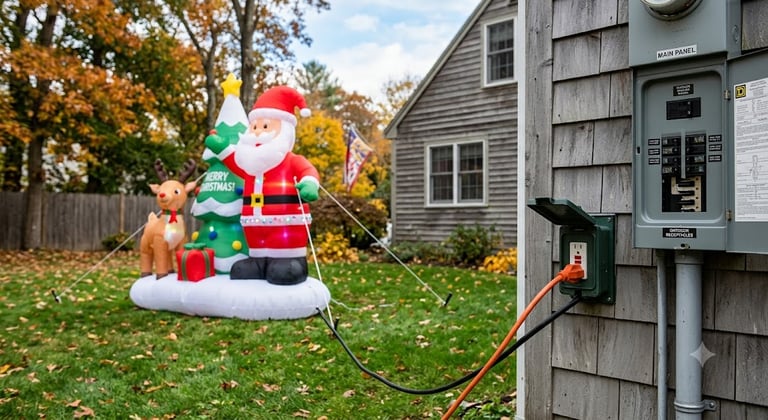
Safety Notes (READ THIS FIRST)
Never exceed circuit rating (typically 15A or 20A)
Do not daisy-chain multiple extension cords
Avoid coiled cords during operation (heat buildup)
Keep all connections off wet ground
Always use outdoor-rated SJTW cords
If breaker trips repeatedly, stop and reassess load
Intro
Outdoor inflatables are simple devices: a blower motor pushes air continuously to keep the structure inflated. But that simplicity hides a major issue—they run on continuous electrical load while exposed to unpredictable outdoor conditions.
That combination makes breaker trips extremely common.
Most homeowners assume the inflatable is defective. In reality, the electrical system feeding it is usually overloaded, poorly protected, or improperly configured.
Who This Guide Is For
This guide is for you if:
Your inflatable randomly shuts off
The breaker trips after a few minutes or hours
It only happens when it rains or snows
Multiple decorations share one outlet
You are using outdoor extension cords (or unsure if they are rated properly)
Why This Topic Matters
Breaker trips are not just inconvenient—they are a warning system.
They can indicate:
Overloaded circuits (fire risk)
Moisture intrusion (shock risk)
Underrated extension cords (heat buildup)
Faulty GFCI protection trips
Understanding the cause prevents:
Electrical fires
Damaged inflatables
Repeated seasonal failures
Unsafe outdoor setups
Common Power Issue Situations
Group A: “One Inflatable Problem”
Single blower trips breaker
Likely GFCI or moisture issue
Group B: “Full Yard Display Problem”
Multiple inflatables + lights
Likely overload + circuit sharing
Group C: “Weather-Triggered Trips”
Works at first, fails in rain/snow
Likely cord/plug moisture intrusion
Group D: “Old House Electrical Systems”
Older breakers trip easily
Likely weak circuit capacity or shared load
Product-Based Fix Solutions
Load Testing Tools
P3 P4400 Kill A Watt Electricity Usage Monitor
What It Is: One of the most trusted electricity usage monitors for measuring watts, amps, volts, frequency, and long-term energy consumption.
Why It Helps
Provides highly accurate readings trusted by electricians and hobbyists.
Tracks cumulative energy usage over days or weeks.
Makes diagnosing intermittent overload problems easier.
Helps determine whether a breaker trip is caused by excessive load or another issue.
Advanced Fix / Best Practices
Leave connected during peak holiday display periods to monitor changing loads.
Compare startup and steady-state consumption to identify problem inflatables.
Use long-term tracking to detect motors that are deteriorating over time.
Measure individual display sections to balance loads across multiple circuits.
Why Buyers Like It
Proven reliability and accuracy.
Easy-to-understand display.
Useful beyond holiday decorating.
Excellent troubleshooting tool for recurring electrical issues.
🔌 Weatherproof Cord Protection (Moisture Fix)
Cismorvex Outdoor Extension Cord Safety Cover
Key Role: Prevents rain, snow, and moisture from reaching plug connections.
Why It Helps
Water intrusion is one of the most common causes of GFCI trips.
Keeps plug connections elevated and protected from puddles.
Reduces corrosion that can develop during long display seasons.
Helps maintain reliable power during storms and wet weather.
Advanced Fix / Best Practices
Position covers so openings face downward whenever possible.
Elevate covered connections off the ground using bricks or stakes.
Inspect covers after heavy snowfall to ensure seals remain intact.
Pair with weather-resistant extension cords for maximum protection.
Why Buyers Like It
Inexpensive solution for moisture-related outages.
Quick installation without tools.
Reusable for multiple seasons.
Works with many plug sizes and adapters.
Flemoon Large Outdoor Electrical Box
Key Role: Fully encloses plugs, adapters, timers, and power strips outdoors.
Why It Helps
Creates a protective barrier against rain, snow, and ice.
Prevents accidental unplugging from wind or foot traffic.
Helps reduce corrosion on electrical connections.
Provides cleaner cable management for larger displays.
Advanced Fix / Best Practices
Place the box on a raised surface rather than directly on soil or mulch.
Use cable strain relief slots to prevent cords from pulling loose.
Group timer and smart plug connections inside one protected enclosure.
Periodically inspect for condensation buildup during extended wet weather.
Why Buyers Like It
Accommodates larger adapters and timer combinations.
Durable enough for seasonal outdoor use.
Helps organize messy electrical setups.
Reduces maintenance during the holiday season.
⚡ Heavy Duty Extension Cords (Overload Prevention)
Skrizcable 16/3 Outdoor Extension Cord 25 ft
HUANCHAIN 12/3 Heavy Duty Outdoor Extension Cord
POWGRN 12/3 50 ft Extension Cord
Why This Matters
Thin cords create voltage drop, which forces motors to work harder.
Excessive voltage drop can cause blower motors to overheat.
Long undersized cords increase the risk of nuisance breaker trips.
Proper cord sizing improves inflatable performance and longevity.
Why It Helps
Maintains more stable voltage at the inflatable.
Reduces heat buildup inside cords.
Supports larger displays safely.
Improves motor startup reliability during cold weather.
Advanced Fix / Best Practices
Use 12-gauge cords for long runs or multiple inflatables.
Keep cord lengths as short as practical.
Avoid daisy-chaining multiple extension cords together.
Periodically feel cords during operation; warm is normal, hot indicates a problem.
Why Buyers Like Them
Better durability than light-duty cords.
Reduced voltage loss.
Improved weather resistance.
Suitable for multi-season use.
🔐 GFCI Protection (Critical Safety Layer)
DEWENWILS GFCI Extension Cord 3 FT
ELEGRP GFCI Inline Plug Replacement
Why It Trips
Detects electrical leakage that may indicate moisture intrusion.
Senses dangerous current paths that could lead to shock hazards.
Reacts quickly to damaged cords or failing equipment.
Protects people even when breakers do not detect the problem.
Why It Helps
Provides an additional safety layer beyond standard breakers.
Can prevent serious electrical accidents.
Quickly identifies moisture-related issues.
Helps protect outdoor holiday displays operating in harsh weather.
Important Insight
Not all trips are "bad"—many indicate the device is doing its job.
Repeated GFCI trips often point to water intrusion somewhere in the system.
Older inflatable blowers may develop leakage currents as they age.
Resetting repeatedly without finding the cause can be unsafe.
Advanced Fix / Best Practices
Disconnect inflatables one at a time to isolate the problem device.
Check all plug connections for moisture before resetting.
Inspect cords for cuts, crushed sections, or exposed conductors.
Replace damaged blowers or cords rather than bypassing GFCI protection.
⏱ Load Balancing & Timers
BN-LINK Outdoor Mechanical Timer
DEWENWILS Outdoor Timer Outlet with Remote
Why It Helps
Reduces simultaneous startup surges from multiple inflatables.
Automates display schedules to reduce energy consumption.
Helps distribute electrical demand more evenly.
Can prevent early-evening breaker trips when everything powers on at once.
Advanced Fix / Best Practices
Split large displays across multiple timers.
Schedule different sections to start 1–5 minutes apart.
Group high-wattage inflatables on separate timer channels when possible.
Test startup behavior before peak holiday weekends.
Why Buyers Like Them
Convenient automation.
Lower energy usage.
Reduced need for manual operation.
Helpful for large decorating displays.
📱 Smart Load Control
Amazon Basics Outdoor Smart Plug
Why It Helps
Allows remote control of individual inflatables.
Makes it easy to isolate problematic decorations.
Supports customized startup schedules.
Provides more control than traditional timers.
Advanced Fix / Best Practices
Stagger inflatable startup times by several minutes to reduce breaker shock load.
Create separate schedules for large and small inflatables.
Use smart groups to cycle displays on in stages during evening hours.
Monitor recurring failures remotely and quickly disable a problem inflatable.
Why Buyers Like Them
Smartphone control from anywhere.
Flexible scheduling options.
Easy troubleshooting of large displays.
Works well with modern smart home ecosystems.
Pro Tip
Startup surge is often the hidden cause of breaker trips. A circuit that handles 10 inflatables once they're running may still trip if all 10 blower motors start at exactly the same time. Smart plugs and timers can dramatically reduce this risk by staggering startup sequences.
Buying Considerations
When fixing inflatable breaker trips, prioritize in this order:
Cord gauge (12/3 > 16/3 for heavy setups)
Moisture protection (cord boxes matter more than people think)
Load measurement (Kill-A-Watt reveals hidden overloads)
GFCI protection (required, not optional)
Timers/smart plugs (prevent surge stacking)
Undersized extension cords can contribute to electrical problems, so review Best Outdoor Extension Cords for Halloween to verify you're using the correct cord before replacing other equipment.
Safety Notes (READ THIS AGAIN)
If breaker trips repeatedly, stop and reassess load
Circuit Reality Check
Most home outdoor outlets are:
15A shared circuits (older homes)
Sometimes tied to garage or basement loads
Inflatable Load Reality
Small blower: ~1–2 amps
Medium inflatable: ~2–4 amps
Multiple inflatables + lights = circuit saturation risk
Compatibility Rule
If you exceed ~80% of circuit capacity, breaker trips become likely.
Step-by-Step Fix System
Step 1: Identify Load
Problem Being Corrected: Overloading an outlet, extension cord, or circuit because the actual power draw is unknown.
Plug the inflatable into a watt meter and record the running wattage.
Confirm amperage draw and compare it to the circuit's capacity.
Measure power consumption during startup as blower motors often draw more power when first turning on.
Test multiple inflatables together if they share the same circuit.
Keep total circuit load below 80% of the breaker rating for continuous operation.
Create a simple power inventory listing each inflatable, its wattage, and the outlet it uses.
Recheck power draw if a blower sounds strained or if the inflatable appears underinflated.
Step 2: Inspect Cord Gauge
Problem Being Corrected: Voltage drop caused by undersized, damaged, or improperly rated extension cords.
Use 12/3 extension cords for long runs, larger inflatables, or multiple decorations.
Avoid thin indoor extension cords for outdoor displays.
Check the cord's amperage rating before connecting high-draw equipment.
Keep extension cords as short as practical to reduce voltage loss.
Inspect cords for cuts, crushed sections, exposed wires, or worn insulation.
Replace cords that feel warm during operation, as heat often indicates excessive resistance.
Use only outdoor-rated cords marked for wet-location use.
Label extension cords by length and gauge to make future setup easier.
Step 3: Add Moisture Protection
Problem Being Corrected: Water intrusion causing GFCI trips, intermittent operation, corrosion, or electrical shorts.
Install a weatherproof cord box or cover at every plug connection.
Elevate connections off the ground whenever possible.
Position plugs so openings face downward to help shed rainwater.
Inspect covers after storms to ensure they remain sealed and secure.
Remove leaves, mulch, and standing water from around electrical connections.
Use outdoor-rated power strips and smart plugs designed for wet environments.
Check connections periodically for corrosion, discoloration, or moisture buildup.
Replace damaged covers immediately to prevent recurring electrical issues.
Step 4: Separate Circuits if Needed
Problem Being Corrected: Frequent breaker trips or dimming lights caused by too many decorations on one circuit.
Distribute inflatables across multiple household circuits when possible.
Do not run an entire yard display from a single outlet.
Identify which outlets belong to the same breaker before adding more decorations.
Balance large inflatables between circuits to spread electrical demand evenly.
Reserve dedicated circuits for high-wattage decorations or lighting displays.
Test each circuit individually before the holiday season begins.
Monitor breakers during the first few nights of operation for signs of overload.
Consider having additional outdoor circuits installed if yearly displays continue to grow.
Step 5: Stagger Startup
Problem Being Corrected: Simultaneous blower startup causing voltage sag, breaker trips, or GFCI nuisance trips.
Use timers or smart plugs to turn decorations on in stages.
Delay startup of large inflatables by 30–60 seconds between groups.
Allow high-draw blowers to reach full speed before starting additional units.
Group decorations into logical zones such as front yard, side yard, and roofline.
Test startup sequences before peak holiday weekends.
Use automation schedules to reduce stress on circuits every evening.
If a breaker trips during startup but not during operation, staggering startup is often the solution.
Review and adjust timer schedules whenever new decorations are added to the display.
Pro Tip
Many inflatable performance problems that appear to be blower failures are actually caused by overloaded circuits, voltage drop, or moisture-contaminated connections. Following these five troubleshooting steps often resolves dim lights, weak inflation, repeated GFCI trips, and nuisance breaker trips without replacing any equipment.
Maintenance / Care Section
Check cords weekly during season
Inspect plugs after storms
Replace cracked insulation immediately
Keep connectors elevated off ground
Reset GFCI only after drying connections
Storage Section
Coil cords loosely (never tight bends)
Store indoors after season
Keep cord ends capped or covered
Avoid UV exposure during storage
Key Takeaways
Breaker trips are usually electrical system issues, not inflatable defects
Moisture + overload are the two biggest causes
Cord gauge matters more than most people realize
GFCI is safety protection—not a malfunction
Load balancing solves most repeat trips
Related Articles:
Real-World Outdoor Inflatable Power Problems and How to Fix Them
How to Power Multiple Outdoor Inflatables Safely Without Overloading Your Circuit
Best Outdoor Extension Cords for Holiday Inflatables (2026 Buyer's Guide)
Best Weatherproof Cord Connection Boxes for Outdoor Decorations
Outdoor Holiday Power Troubleshooting Guide: Why Decorations Fail and How to Fix Them