
Home > Setup, Safety, and Repairs > Outdoor Power Accessories > Best Outdoor Extension Cords for Holiday Inflatables
Best Outdoor Extension Cords for Holiday Inflatables (2026 Buyer's Guide)
Find the best outdoor extension cords for holiday inflatables. Learn which gauge, length, and weatherproof accessories are safest for your display.
By Frank "Frosty" Adminei
7/5/202614 min read
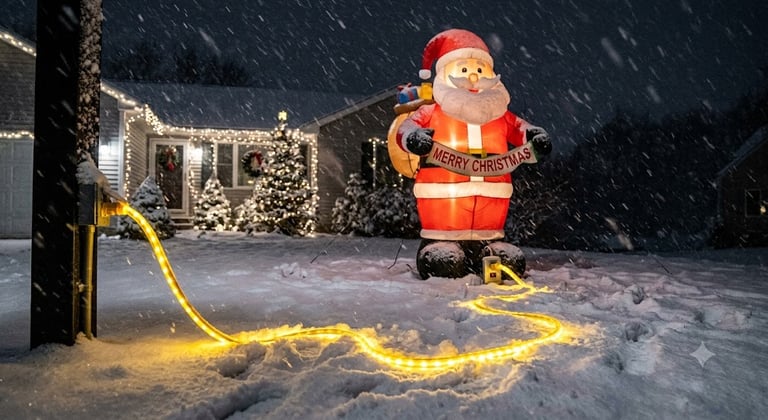
How to Choose the Right Extension Cord for Holiday Inflatables
Before comparing specific products, it's important to understand the four factors that determine whether an extension cord will work properly with your display.
1. Gauge Matters More Than Most People Realize
Extension cord gauge refers to the thickness of the copper wire inside the cord.
The lower the gauge number, the thicker the wire.
Examples:
16 AWG = thinner wire
14 AWG = medium-duty wire
12 AWG = heavy-duty wire
For holiday inflatables, thicker wire generally means:
Less voltage drop
Better blower performance
Cooler operating temperatures
Greater capacity for multiple decorations
A common mistake is assuming all extension cords perform the same. A lightweight cord that works perfectly for a lamp or small power tool may struggle when powering several outdoor decorations over a long distance.
2. Length Changes Everything
Distance creates resistance.
As extension cord length increases, voltage drop increases.
This is one reason a decoration may appear fully inflated when tested near an outlet but seem weaker after being moved farther into the yard.
As a general rule:
25 feet = most displays can use 16/3
50 feet = often better with 14/3 or 12/3
100 feet = typically best served by 12/3
If you're planning future display expansion, buying a heavier-gauge cord now can save money later.
3. Outdoor Ratings Are Non-Negotiable
Never use indoor extension cords for outdoor holiday displays.
Look for cords specifically rated for outdoor use.
Quality outdoor cords typically feature:
Grounded 3-prong plugs
Weather-resistant jackets
Cold-weather flexibility
Abrasion resistance
Outdoor SJTW ratings
These features become especially important during winter decorating seasons when cords may be exposed to freezing temperatures, moisture, snow, and repeated freeze-thaw cycles.
4. Think Beyond the Cord
Many inflatable failures aren't caused by the cord itself.
They're caused by:
Wet plug connections
Damaged outlet covers
Missing GFCI protection
Poor load planning
Inadequate weatherproofing
That's why successful displays often include:
Extension cord
Weatherproof connection cover
GFCI protection
Outdoor timer
Power stake or smart plug
We'll cover those accessories later in this guide.
Many of the failures discussed here began with the wrong extension cord, making Best Outdoor Extension Cords for Halloween a helpful companion guide before setting up your display.
Complete Power Kit for Most Holiday Displays
For a typical display with two to four outdoor inflatables, we recommend building a complete power setup rather than purchasing only an extension cord.
A typical setup includes:
✅ Heavy-duty outdoor extension cord
✅ Weatherproof connection box
✅ Outdoor GFCI protection
✅ Outdoor power stake
✅ Plug-in watt meter
Each item solves a different problem and helps create a safer, more reliable display throughout the holiday season.
Best Outdoor Extension Cords for Holiday Inflatables
After reviewing outdoor display requirements, these are the extension cords that make the most sense for inflatable owners.
Best Overall: POWGRN 12/3 Outdoor Extension Cord (50 FT)
Best For
Medium displays
Multiple inflatables
Long-term reliability
Homeowners who may expand later
Why It Matters
The biggest advantage of this cord is flexibility.
Its 12-gauge construction provides plenty of capacity for most residential inflatable displays while minimizing voltage drop over longer distances.
The lighted end also makes troubleshooting easier during nighttime decorating.
Tradeoffs
Costs more than lightweight cords
Slightly heavier to handle
Skip If
You only run a single small inflatable within 20–25 feet of an outlet.
Upgrade If
You need 100 feet of reach.
Best Budget Choice: Skrizcable 16/3 Outdoor Extension Cord (25 FT)
Best For
Single inflatables
Small front-yard displays
Budget-conscious decorators
Why It Matters
Many homeowners simply don't need heavy-duty contractor-grade cords.
If your inflatable is close to the outlet and your setup is relatively simple, this cord provides a cost-effective solution while still offering outdoor weather resistance.
Tradeoffs
Limited future expansion
Not ideal for long runs
Skip If
Your outlet is more than 25 feet away.
Upgrade If
You expect to add additional decorations later.
Best for Medium Displays: HUANCHAIN 16/3 Outdoor Extension Cord (50 FT)
Best For
Two or three inflatables
Seasonal displays
Moderate distances
Why It Matters
This cord offers a nice balance between affordability and performance.
The 50-foot length works well for many suburban front-yard layouts without requiring homeowners to move decorations closer to the house.
Tradeoffs
Not as robust as a 12-gauge cord
Less margin for future display growth
Skip If
You're planning a large Christmas or Halloween scene.
Upgrade If
You anticipate powering several blowers from a single location.
Best for Long Distances: HUANCHAIN 12/3 Outdoor Extension Cord (100 FT)
Best For
Corner lots
Deep front yards
Large display layouts
Long outlet runs
Why It Matters
Many decorating problems start when homeowners try to stretch undersized cords across large properties.
The heavy-duty 12-gauge design helps maintain performance even when distance becomes a challenge.
Tradeoffs
Higher cost
Bulkier storage
Skip If
Your outlet is close to your display area.
Upgrade If
You eventually move into multi-circuit display planning.
Build the Perfect Outdoor Power Setup
Buying the right extension cord is only one part of building a safe, reliable holiday display. The best outdoor decorating setups work because every component supports the others. A properly sized extension cord helps deliver power safely, but it should also be paired with weather protection, proper circuit planning, and safe power distribution.
If you're planning to decorate year after year, think of your electrical setup as a complete system rather than a collection of individual products. The following six steps will help you build a safer, more dependable setup while avoiding many of the problems that frustrate first-time decorators.
Step 1: Choose the Right Extension Cord
Everything starts with selecting an outdoor-rated extension cord that matches both the distance and electrical load of your display. Longer runs and multiple inflatable blowers often benefit from heavier-duty 12/3 extension cords to reduce voltage drop and improve long-term reliability.
Before choosing a cord, read our guide on Extension Cord Mistakes That Cause Outdoor Inflatable Failures (Gauge, Length, and Voltage Drop Explained) to avoid the sizing mistakes that cause many holiday displays to underperform.
Step 2: Protect Every Electrical Connection
A quality extension cord won't help if the plug connections are left sitting in wet grass, melting snow, or standing water. Weatherproof connection boxes and cord locks keep moisture away from electrical connections while helping prevent accidental unplugging during windy conditions.
For additional protection strategies, see Why Weatherproof Outdoor Electrical Boxes Still Fail in Rain, Snow, and Ice (And How to Fix Them for Good), where we cover common installation mistakes and how to prevent them.
Step 3: Add GFCI Protection
Every outdoor display should be connected to GFCI-protected outlets. Portable GFCI adapters and outdoor GFCI power stakes provide an additional layer of protection against electrical shock while making it easier to distribute power safely throughout your display.
Step 4: Balance the Electrical Load
Avoid plugging every inflatable into a single extension cord or household circuit. Dividing larger displays across multiple circuits reduces breaker trips and improves blower performance, especially when decorations run for several hours each evening.
If you're unsure how many decorations can safely share one circuit, read How to Power Multiple Outdoor Inflatables Safely Without Overloading Your Circuit before expanding your display.
Step 5: Verify Your Power Usage
Many decorators overestimate—or underestimate—the amount of electricity their display actually uses. A plug-in watt meter quickly confirms your real electrical load so you can verify that your extension cord, breaker, and circuit capacity are all appropriate.
To better understand wattage, amperage, and electrical planning, visit The Complete Guide to Energy, Power, and Smart Tech for Holiday Inflatables.
Step 6: Test Everything Before Opening Night
Complete your setup at least one evening before guests arrive. Verify that every inflatable fully inflates, timers activate correctly, extension cords remain cool during operation, and all electrical connections stay dry after watering the lawn or following a rainstorm.
If something doesn't work as expected, our troubleshooting guide Real-World Outdoor Inflatable Power Problems and How to Fix Them walks through the most common electrical issues and their solutions before the holiday season begins.
Common Mistake
Many homeowners purchase a 16/3 extension cord because it costs less, then use it to power several inflatable blowers over a long distance. The display may appear to work, but voltage drop can reduce blower performance and place unnecessary stress on both the cord and the motor.
When in doubt, choosing a heavier-gauge extension cord is usually the safer long-term investment.
Which Gauge Extension Cord Do You Actually Need?
This is the question most buyers are really asking.
The answer depends less on the inflatable itself and more on the overall display.
Single Inflatable Setup
Examples:
4-foot inflatable
6-foot inflatable
Small Easter inflatable
Small Halloween character
Recommended:
16/3 gauge
25 feet or less
For these simple setups, a lightweight outdoor-rated cord is usually sufficient.
The goal is safe operation rather than maximizing capacity.
Small Display Setup
Examples:
Two inflatables
Inflatable plus lighting
Holiday scene near porch
Recommended:
14/3 or 16/3
25–50 feet
This provides more flexibility without moving into heavy-duty territory.
Medium Display Setup
Examples:
Three to six inflatables
Coordinated Christmas scene
Large Halloween yard display
Recommended:
12/3 gauge
At this point, voltage drop becomes more important and heavier wire begins to provide meaningful benefits.
16/3 vs 14/3 vs 12/3 Extension Cords for Holiday Inflatables
Many buyers become stuck trying to choose between 16-gauge, 14-gauge, and 12-gauge extension cords. While all three may power outdoor inflatables, they are not equally suited for every display.
The simplest way to think about gauge is:
Lower number = thicker wire
Thicker wire = less voltage drop
Less voltage drop = better performance over longer distances
16/3 Extension Cords
Best For:
Single inflatable displays
Short runs under 25 feet
Small seasonal decorations
Advantages:
Lightweight
Easy to store
Lower cost
Potential Drawbacks:
Less capacity for future expansion
Not ideal for long distances
Less forgiving when powering multiple decorations
If your display consists of a single inflatable near an outdoor outlet, a quality outdoor-rated 16/3 cord is often all you need.
14/3 Extension Cords
Best For:
Small-to-medium displays
Multiple decorations
Moderate distances
Advantages:
More capacity than 16-gauge cords
Better performance over longer runs
Good balance of cost and capability
Potential Drawbacks:
Heavier than 16-gauge
Usually costs slightly more
Many homeowners find 14/3 cords provide an ideal middle ground because they support future display growth without the weight and cost of contractor-grade cords.
12/3 Extension Cords
Best For:
Larger displays
Multiple inflatables
Long outlet distances
Future expansion
Advantages:
Lowest voltage drop
Highest capacity
Excellent long-term investment
Potential Drawbacks:
Heavier
More expensive
Bulkier to store
While some homeowners worry that 12-gauge cords are overkill, experienced decorators often prefer them because they eliminate many of the power-delivery issues that appear as displays become more complex.
Quick Gauge Recommendation Chart
Choose 16/3 if:
One inflatable
Less than 25 feet
Budget is the priority
Choose 14/3 if:
Two to three inflatables
Up to 50 feet
You may expand later
Choose 12/3 if:
Large display
Long distances
Multiple blowers
You want maximum flexibility and future-proofing
Real-World Display Examples
One of the biggest shortcomings of most extension cord guides is that they focus on wire specifications instead of actual decorating situations.
Most homeowners don't think in terms of amperage and voltage drop.
They think:
"I have three inflatables and one outlet. What should I buy?"
Let's look at some common real-world scenarios.
Example 1: Single Inflatable Near the House
Display:
One 6-foot Christmas inflatable
Outlet located 15 feet away
No additional decorations
Recommended Setup:
16/3 outdoor-rated extension cord
Basic weatherproof plug cover
A heavy-duty contractor cord would work, but it would provide little practical benefit for this setup.
For most homeowners, a quality 16-gauge outdoor cord is the most economical solution.
Example 2: Small Front-Yard Holiday Scene
Display:
Inflatable snowman
Inflatable Santa
Small LED decorations
Outlet located 35 feet away
Recommended Setup:
50-foot 16/3 or 14/3 cord
Weatherproof connection cover
Outdoor timer
This setup begins approaching the point where voltage drop can become a factor.
A slightly heavier cord provides additional safety margin and future flexibility.
Example 3: Large Christmas Display
Display:
Five to eight inflatables
Pathway lighting
Decorative spotlights
Outlet located 60 feet away
Recommended Setup:
12/3 extension cord
Outdoor power stake
GFCI protection
Weatherproof electrical box
This is where many decorating problems begin.
Homeowners frequently attempt to run large displays using inexpensive lightweight extension cords originally intended for temporary household use.
The result can include:
Blower performance issues
Warm cords
Nuisance breaker trips
Reduced reliability during storms
A heavy-duty 12-gauge cord provides significantly more capacity and helps maintain consistent blower performance.
For larger displays, also consider reading:
How to Power Multiple Outdoor Inflatables Safely Without Overloading Your Circuit
Example 4: Halloween Graveyard Display
Display:
Multiple Halloween inflatables
Fog machine
Spotlights
Animated props
Recommended Setup:
12/3 extension cord
Dedicated circuit if available
Weatherproof connection box
Outdoor timer
Halloween displays often combine multiple electrical devices beyond inflatables alone.
This makes load planning even more important.
Many Halloween failures are actually power-management failures.
Extension Cord Mistakes That Cause Inflatable Problems
Most inflatable power problems are surprisingly easy to prevent.
Mistake #1: Choosing Cord Length Before Gauge
Many homeowners buy the cheapest cord available in the desired length.
This is backwards.
Gauge should be determined first.
Length should be selected second.
A properly sized cord minimizes voltage loss and improves reliability.
Mistake #2: Daisy-Chaining Extension Cords
This is one of the most common decorating mistakes.
Example:
25-foot cord + 50-foot cord + another 25-foot cord
Problems include:
Increased resistance
Additional failure points
Greater moisture exposure
Increased voltage drop
Whenever possible, use a single appropriately sized extension cord.
Mistake #3: Leaving Cord Connections Exposed
The cord itself may be outdoor-rated.
The connection often is not.
Many homeowners unknowingly protect the cord but leave the plug connection exposed to:
Rain
Snow
Ice
Standing water
This creates one of the most common outdoor power failure points.
Mistake #4: Using Indoor Extension Cords Outdoors
Indoor cords are not designed for:
UV exposure
Moisture
Freezing temperatures
Ground contact
Even if they appear similar, outdoor-rated cords are built differently.
Never assume an indoor cord is suitable for seasonal outdoor decorating.
Mistake #5: Ignoring Future Expansion
Many decorators add more inflatables every year.
Buying the absolute minimum cord today often results in replacing it next season.
A slightly heavier cord frequently provides better long-term value.
For a deeper breakdown of sizing mistakes, see:
Weatherproofing Outdoor Power Connections
Many homeowners focus exclusively on extension cords.
In reality, the connection point is often the weakest link.
Small Connection Covers
Best for:
Single inflatable setups
Individual plug connections
Temporary displays
Recommended Products:
Advantages:
Inexpensive
Easy installation
Compact size
These products help keep rain, snow, and debris away from vulnerable plug connections.
Large Weatherproof Electrical Boxes
Best for:
Multi-decoration displays
Power strips
Timers
Multiple cord connections
Recommended Products:
Advantages:
More internal space
Better organization
Improved weather protection
These become increasingly valuable as display complexity increases.
For additional protection strategies, see:
Do You Need GFCI Protection?
In many outdoor situations, the answer is yes.
GFCI stands for Ground Fault Circuit Interrupter.
Its purpose is simple:
If electricity begins flowing somewhere it shouldn't, the device quickly cuts power.
This can reduce the risk of electrical shock and certain electrical faults.
Situations Where GFCI Protection Is Especially Valuable
Older homes
Damp environments
Long extension cord runs
Displays crossing lawns
Areas prone to standing water
Winter decorating conditions
Many modern outdoor outlets already include GFCI protection.
If yours does not, adding protection can be a smart upgrade.
Recommended GFCI Solutions
Best For:
Homeowners wanting an all-in-one solution
Why It Matters:
Built-in GFCI protection
Heavy-duty 12/3 cord
Multiple outlet capability
Tradeoffs:
More expensive than standard cords
Best For:
Upgrading an existing extension cord
Why It Matters:
Adds GFCI protection without replacing your cord
Tradeoffs:
Additional connection point
If breaker trips are already occurring, read:
Why Your Outdoor Inflatable Keeps Tripping the Breaker (And How to Fix It)
Smart Plugs, Timers, and Power Stakes
Once homeowners solve their extension cord needs, automation is usually the next upgrade.
Fortunately, several inexpensive options make decorating easier and more efficient.
Outdoor Timers
Timers automatically turn decorations on and off.
Benefits include:
Reduced energy waste
Consistent operation
Less daily effort
Recommended Products:
Mechanical timers work well for simple schedules.
Photocell timers automatically respond to changing daylight conditions.
Outdoor Smart Plugs
Smart plugs provide greater control.
Benefits include:
Smartphone operation
Scheduling
Remote access
Voice assistant compatibility
Recommended Product:
Many decorators find smart plugs especially useful when displays are difficult to access.
Outdoor Power Stakes
Power stakes solve one of the most frustrating outdoor decorating problems:
Not enough conveniently located outlets.
Instead of running multiple extension cords across the yard, a power stake provides several outlets in a centralized location.
Benefits include:
Cleaner installations
Better organization
Fewer visible cords
Easier expansion
Best Power Stake for Larger Displays
Tiffcofio Outdoor Power Strip Weatherproof Power Stake
Best For:
Multiple inflatables
Christmas displays
Halloween scenes
Yard-wide decorating
Why It Matters:
Six grounded outlets
Integrated extension cord
Weather-resistant outlet covers
Built-in overload protection
Tradeoffs:
Larger footprint than a simple extension cord
Upgrade If:
You regularly add new decorations each season.
Best Automated Power Stake
DEWENWILS Outdoor Power Stake Timer
Best For:
Set-it-and-forget-it operation
Automated holiday displays
Why It Matters:
Remote control capability
Multiple timer modes
Dusk-to-dawn functionality
Six powered outlets
Tradeoffs:
More expensive than basic power stakes
Building a Reliable Inflatable Power System
Many homeowners eventually discover that a dependable display is not created by a single extension cord.
Instead, successful displays typically use a complete power system.
Simple Display System
Outdoor-rated extension cord
Weatherproof connection cover
Ideal for:
One inflatable
Small front-yard display
Intermediate Display System
14/3 or 12/3 extension cord
Weatherproof connection box
Outdoor timer
Ideal for:
Multiple inflatables
Seasonal decorating enthusiasts
Advanced Display System
Heavy-duty 12/3 extension cord
GFCI protection
Weatherproof electrical box
Power stake
Smart plug or timer
Ideal for:
Large Christmas displays
Halloween yard scenes
Multi-decoration installations
The goal is not simply powering decorations.
The goal is maintaining reliable operation through:
Rain
Snow
Wind
Freeze-thaw cycles
Long seasonal runtimes
How Much Power Do Holiday Inflatables Actually Use?
One reason homeowners often overspend on extension cords is that they assume inflatables use large amounts of electricity.
In reality, most holiday inflatables consume surprisingly little power once fully inflated.
The blower motor works hardest during startup when the decoration first fills with air. After inflation, the blower's primary job is maintaining air pressure rather than continuously inflating the decoration.
Because of this, many standard residential displays draw less electricity than people expect.
Typical Inflatable Power Consumption
Small inflatables (4–6 feet):
Often under 100 watts
Medium inflatables (6–10 feet):
Typically between 100 and 200 watts
Large inflatables (10–20+ feet):
Can exceed 200 watts depending on blower size and lighting features
Actual usage varies by manufacturer, blower design, lighting systems, and weather conditions.
Why Cord Size Still Matters
A common misconception is:
"My inflatable only uses a small amount of power, so any extension cord will work."
The issue is not usually total power consumption.
The issue is voltage drop.
Long, undersized extension cords can reduce the voltage reaching the blower motor. When this happens, homeowners may notice:
Slower inflation
Softer appearance
Increased blower strain
Reduced efficiency
This is why properly sizing the cord remains important even when electrical consumption appears relatively modest.
Measuring Your Actual Power Usage
If you're curious about real electrical costs, a plug-in power monitor can provide precise measurements.
Recommended options include:
These devices allow you to measure:
Watts
Amps
Voltage
Kilowatt-hours
Operating costs
They are particularly useful for larger displays where homeowners want accurate energy-use information.
For a deeper breakdown of seasonal operating costs, see:
How Much Electricity Do Spring Inflatables Use? Real Costs and Easy Ways to Save
and
Energy Usage for Outdoor Decorations and Money Saving Tips
Many decorators are surprised to discover that properly sized extension cords and efficient power planning improve reliability far more than they affect utility bills.
Frequently Asked Questions
Can I run multiple inflatables on one extension cord?
Often yes, provided the cord is properly sized and the total electrical load remains within the cord and circuit ratings.
Larger displays frequently benefit from heavier-gauge cords and improved load planning.
Is 16-gauge extension cord enough for holiday inflatables?
For many single inflatable setups, yes.
However, longer distances and multiple inflatables often benefit from 14-gauge or 12-gauge cords.
Is 12-gauge extension cord overkill?
Not necessarily.
A 12-gauge cord reduces voltage drop, provides additional capacity, and often remains useful as displays expand over time.
Many experienced decorators consider 12-gauge cords a worthwhile investment.
Can outdoor extension cords stay outside all winter?
Most quality outdoor-rated cords are designed for seasonal outdoor use.
However, regular inspections are recommended.
Replace cords showing:
Cracked insulation
Damaged plugs
Exposed conductors
Significant wear
Why does my inflatable seem partially inflated?
Common causes include:
Undersized extension cords
Excessive cord length
Voltage drop
Weak blower motors
Moisture-related electrical issues
Power-delivery problems are often overlooked during troubleshooting.
Do I need a weatherproof cord box?
While not required for every setup, weatherproof boxes can significantly improve reliability by protecting plug connections from moisture, snow, debris, and ice.
They become increasingly valuable as display complexity increases.
Should I use a smart plug or timer?
Both work well.
Choose:
Mechanical timer for simplicity
Photocell timer for automatic dusk operation
Smart plug for remote control and scheduling flexibility
How long can an extension cord safely be?
The answer depends on:
Cord gauge
Electrical load
Number of devices connected
Longer distances generally benefit from heavier-gauge cords to reduce voltage drop and improve performance.
Our Recommendation Process
When evaluating extension cords for holiday inflatables, we focus on:
Outdoor safety ratings
Gauge and load capacity
Weather resistance
Real-world decorating scenarios
Ease of use
Long-term value
Rather than recommending the most expensive option, our goal is helping homeowners choose the right cord for their specific display size and conditions.
Final Verdict
If you're powering a single inflatable close to an outlet, a quality outdoor-rated 16/3 extension cord is usually sufficient.
For medium-sized displays, a 14/3 or 12/3 cord provides additional flexibility and future expansion potential.
For larger Christmas or Halloween displays, heavy-duty 12/3 cords are often the smartest long-term investment because they reduce voltage drop, improve blower performance, and provide capacity for future decorations.
Just remember that extension cords are only one piece of the puzzle.
The most reliable outdoor inflatable displays combine:
Properly sized extension cords
Weatherproof connection protection
GFCI safety
Timers or smart controls
Thoughtful load planning
Choose the right power system now, and you'll spend less time troubleshooting and more time enjoying your holiday display.
Related Articles
Troubleshooting & Safety
Why Your Outdoor Inflatable Keeps Tripping the Breaker (And How to Fix It)
Real-World Outdoor Inflatable Power Problems and How to Fix Them
Power Planning
How to Power Multiple Outdoor Inflatables Safely Without Overloading Your Circuit
The Complete Guide to Energy, Power, and Smart Tech for Holiday Inflatables
Weather Protection
Energy Usage