
Home > Setup, Safety, and Repairs > Outdoor Power Accessories >Multi-Load Electrical Scaling
How to Power Multiple Outdoor Inflatables Safely Without Overloading Your Circuit
Learn how to safely scale multiple inflatables using real electrical load planning, extension cord sizing, timers, GFCI protection, and failure prevention systems.
Frank “Frosty” Adminei
7/4/20262 min read
TOC
SYSTEM OVERVIEW — WHY FAILURES HAPPEN
Failure Rule #1:
Inflatables don’t fail individually — circuits fail collectively.
Most breakdowns come from:
simultaneous blower startup (inrush current stacking)
cold weather increasing motor load
long extension cords reducing voltage delivery
moisture resistance fluctuations at connectors
Hidden truth:
A “working setup” is often already operating at near-breaker threshold without visible symptoms.
LOAD FAILURE MECHANICS (ROOT CAUSE LAYER)
1. Startup Surge Stacking
Every blower pulls 2–3x running wattage at startup.
When multiple inflatables power on simultaneously:
breaker sees a combined spike
trips even if steady load is safe
2. Voltage Drop (Distance Failure)
Long or undersized cords cause:
reduced blower efficiency
heat buildup in wiring
unstable motor speed
3. Weather Load Amplification
Cold + moisture causes:
higher motor resistance
increased current draw
connector instability
INFLATABLE SCALING DECISION TREE
LEVEL 1 — 1–2 inflatables
single circuit acceptable
16/3 cord acceptable
basic timer usable
LEVEL 2 — 3–4 inflatables
split zones required
12/3 cord recommended
weatherproofing required
LEVEL 3 — 5–6 inflatables
dual circuit distribution required
load measurement mandatory
staggered timers required
LEVEL 4 — 7+ inflatables
system architecture required
dedicated circuits or load balancing
failure monitoring required
Every multi-inflatable setup depends on correctly sized extension cords, so our recommendations in Best Outdoor Extension Cords for Halloween are a good starting point before adding splitters or additional circuits.
ELECTRICAL ARCHITECTURE MODEL
Your yard must be treated as 4 subsystems:
A. Load Layer (Measurement)
Detect real power draw before expansion:
P3 Kill-A-Watt P4400
Failure prevented: invisible overload scaling
B. Distribution Layer (Power Flow)
Moves electricity safely across yard:
HUANCHAIN 12/3 heavy-duty cords
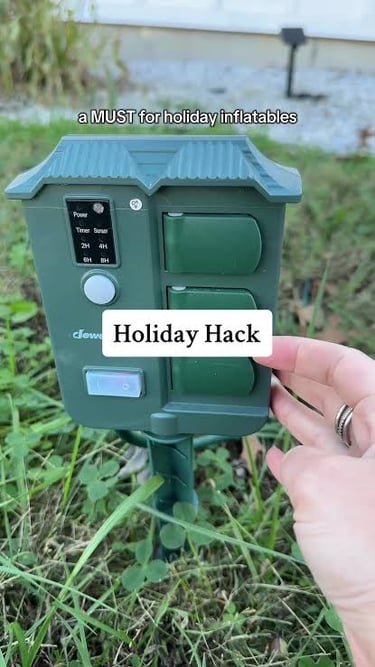
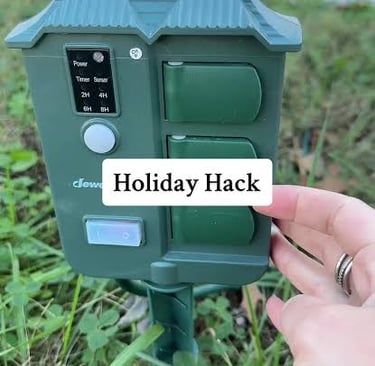
outdoor power stakes
Failure prevented: voltage drop collapse
C. Protection Layer (Environmental Isolation)
Stops weather-related failure:
Failure prevented: moisture shorting + corrosion
D. Control Layer (Timing & Load Shaping)
Prevents simultaneous surge:
Failure prevented: startup load stacking
E. Safety Layer (Fault Shutdown)
Failure prevented: shock + fire risk escalation
SAFETY CONSTRAINTS (NON-NEGOTIABLE)
Never exceed 80% circuit capacity under continuous load
Never stack timers on timers
Never coil active extension cords
Never expose plug junctions to ground-level snow accumulation
Never assume “weatherproof” equals waterproof under freeze conditions
UPGRADE TRIGGERS
These are system failure signals that force upgrades:
Trigger 1:
Breaker trips at startup
→ upgrade: staggered timer system + circuit redistribution
Trigger 2:
Inflatables dim or inflate slowly
→ upgrade: 12/3 cord system + shorter runs
Trigger 3:
Moisture causes intermittent shutdown
→ upgrade: sealed junction box layer
Trigger 4:
Running >3 inflatables on one outlet
→ upgrade: power stake distribution system
Trigger 5:
No idea actual wattage draw
→ upgrade: Kill-A-Watt measurement layer
SETUP ARCHITECTURE (ZONE MODEL)
Zone A — Primary Load (largest inflatables)
shortest cords
12/3 gauge recommended
Zone B — Secondary Load
medium inflatables or decorations
Zone C — Lighting Load
low draw string lights
Zone D — Control Layer
timers + smart plugs isolated from load circuits
MAINTENANCE (SYSTEM HEALTH)
Check plug heat after 30 minutes runtime
Inspect cords after rain/snow cycles
Re-seat weatherproof box seals monthly
Monitor breaker behavior nightly during expansion phases
FAQ
Why do my inflatables trip the breaker only sometimes?
Because startup load varies with temperature and timing overlap.
Can I run 3 inflatables on one outlet?
Only if total load + surge stays within 80% circuit capacity.
Are outdoor cords enough for safety?
No. Weatherproofing + load management are required together.
Do smart plugs reduce load risk?
No—they control timing, not total electrical capacity.