
Home → Setup, Safety, and Repairs >Outdoor Power Accessories > Best Outdoor Power Stakes & Multi-Outlet Yard Power Centers
Best Outdoor Power Stakes and Multi-Outlet Yard Power Centers (2026 Buyer's Guide)
Looking for the best outdoor power stake or yard power center? Compare the best multi-outlet outdoor power solutions for holiday inflatables, lights, and decorations with expert buying advice.
By Frank "Frosty" Adminei
7/13/202615 min read
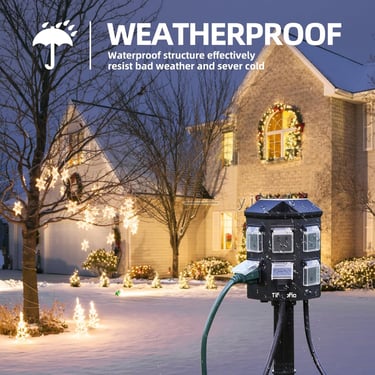
Table of Contents
Introduction
As holiday displays become larger and more elaborate, one problem almost every decorator encounters is running out of convenient outdoor outlets.
Adding another inflatable often means another extension cord. Soon, cords begin crossing sidewalks, timers become scattered throughout the yard, and plugging everything in becomes a frustrating chore.
That's where an outdoor power stake can make a dramatic difference.
Instead of stretching multiple extension cords back to your house, a power stake creates a centralized location where several decorations can connect while remaining protected from rain, snow, and everyday outdoor conditions.
However, many homeowners misunderstand what these products actually do.
One of the biggest myths is that a six-outlet power stake somehow provides six times more electricity. It doesn't. All six outlets still share the same incoming circuit, making proper load planning just as important as choosing the right equipment.
In this guide, we'll compare the best outdoor power stakes available today, explain when a larger multi-outlet yard power center makes sense, and show you how to build a safer, cleaner electrical setup for everything from a couple of Christmas inflatables to neighborhood-famous holiday displays.
Who This Guide Is For
This guide is designed for homeowners who:
Display multiple holiday inflatables.
Decorate for Christmas, Halloween, Easter, patriotic holidays, or other seasonal events.
Need more convenient outdoor outlets.
Want better organization and cleaner cord management.
Plan to automate lights or inflatables using timers or smart controls.
Want to purchase compatible accessories together instead of discovering they need additional equipment after installation.
Whether you're adding your second inflatable or creating a display that spans your entire front yard, selecting the right outdoor power distribution equipment makes decorating easier while helping reduce common electrical problems.
Why This Topic Matters
Outdoor power stakes are one of the most overlooked upgrades for holiday decorating.
Many homeowners spend hundreds—or even thousands—of dollars on inflatables, lighting, and animated decorations but continue relying on a tangled collection of inexpensive extension cords plugged into a single wall outlet.
A thoughtfully planned power system offers several benefits:
Cleaner-looking displays with fewer visible cords.
Easier seasonal setup and takedown.
Better timer and automation options.
Improved weather protection for electrical connections.
More organized power distribution throughout the yard.
Just as importantly, understanding what a power stake can and cannot do helps prevent overloaded circuits, nuisance breaker trips, and damaged equipment.
If you're just beginning to plan your overall electrical layout, be sure to read The Ultimate Guide to Powering Outdoor Inflatables Safely: Extension Cords, GFCI Protection, Weatherproofing and Load Planning before purchasing additional accessories. That guide explains the complete electrical planning process, while this article focuses specifically on selecting the right outdoor power distribution equipment.
Why Outdoor Power Stakes Make Holiday Decorating Easier
If you've ever found yourself kneeling in the snow trying to unplug three extension cords from a weatherproof outlet box while wearing gloves, you've already discovered why outdoor power stakes have become so popular.
A power stake combines several useful features into one convenient device:
Multiple grounded outdoor outlets.
Weather-resistant construction.
Elevated outlet placement above wet ground.
Built-in timer options on many models.
Remote control or dusk-to-dawn automation on premium versions.
Easier organization of multiple decorations.
Instead of having extension cords branching out randomly from your home's exterior outlet, the power stake acts as a central hub closer to the decorations themselves.
For many displays, this results in:
shorter cord runs,
fewer visible cables,
simpler seasonal installation,
easier troubleshooting when decorations stop working.
Another major advantage is flexibility.
As your display grows over the years, you can often continue using the same power stake while simply rearranging where decorations connect. That scalability makes a quality power stake one of the better long-term investments for serious holiday decorators.
That said, a power stake should never be viewed as a substitute for proper electrical planning. It organizes power distribution—it does not increase the amount of electricity available from your home's circuit.
Power Stake vs. Yard Power Center: What's the Difference?
These terms are often used interchangeably, but they don't always describe the same type of equipment.
Understanding the differences helps prevent buying more—or less—than your display actually requires.
Outdoor Power Stake
For most homeowners, this is the ideal solution.
Typical features include:
Four to six grounded outlets.
Built-in timer or photocell on many models.
Stake that inserts directly into the ground.
Weather-resistant outlet covers.
Compact design intended for residential decorating.
Power stakes are perfect for powering clusters of inflatables, pathway lighting, yard décor, and other seasonal decorations from one organized location.
For the vast majority of residential displays, this is all you'll ever need.
Multi-Outlet Yard Power Center
A yard power center generally refers to a larger outdoor distribution hub.
These products may include:
more outlet capacity,
heavier-duty construction,
larger weatherproof enclosures,
commercial or contractor-oriented designs,
support for more complex temporary installations.
While these systems can be useful, they're often unnecessary for typical homeowners.
If your display consists of six or eight inflatables spread across a front yard, purchasing a commercial-style yard power center usually won't solve the real limitation—which is almost always the capacity of the household circuit supplying it.
For most readers, investing in high-quality power stakes, proper extension cords, weatherproof connection boxes, and safe load planning provides a better return than jumping directly to oversized power distribution equipment.
The next section explains why understanding your circuit's limits is far more important than simply adding more outlets.
How Much Power Can a Power Stake Actually Handle?
This is probably the most misunderstood topic when homeowners begin expanding their holiday displays.
Many shoppers see six outlets on a power stake and assume they can safely plug six large inflatables into it. Unfortunately, that's not how electricity works.
The important number isn't the number of outlets—it's the maximum electrical capacity feeding those outlets.
Almost every residential outdoor power stake in this guide is rated for:
15 amps
125 volts
1,875 watts maximum
That entire rating is shared across every outlet on the stake.
Think of it like a pizza. Six people can share the pizza, but buying six plates doesn't create six pizzas.
Likewise, six outlets share the same available electrical capacity.
What Does That Mean in the Real World?
Modern inflatable decorations are surprisingly efficient.
Many small inflatables consume between:
30–80 watts
Medium displays often consume:
80–150 watts
Large commercial-style inflatables may use:
200+ watts
That means a properly planned power stake can often run several inflatables comfortably.
The problem occurs when homeowners begin adding:
floodlights
spotlights
projectors
rope lights
landscape lighting
extension splitters
heaters
snow machines
audio equipment
Those additional loads add up much faster than most people realize.
Six Outlets Does NOT Mean Six Circuits
One of the biggest myths we see online is:
"It has six outlets so each inflatable gets its own outlet."
Technically that's true.
Electrically it is not.
Every outlet is connected to the same incoming cord.
That means all of the devices share:
one extension cord
one breaker
one power source
If the combined load exceeds what the circuit can safely provide, you'll eventually trip the breaker—or worse, create unnecessary heat in undersized cords.
If you're unsure how much power your decorations actually consume, this is an excellent time to use one of the approved energy meters.
The Mecheer Energy Monitor provides an inexpensive way to measure real-world wattage, while the P3 Kill A Watt offers more detailed tracking over time. Rather than guessing, you can determine exactly how much power each inflatable draws before adding more decorations to the circuit.
For a deeper discussion of safe circuit loading, see How Many Inflatables Can One Circuit Handle? That guide walks through real-world examples and helps you estimate how many decorations your electrical circuit can safely support.
How to Choose the Right Outdoor Power Stake
Not every homeowner needs the most expensive model.
Instead, match the power stake to the way you decorate.
Number of Outlets
Most homeowners are well served by six grounded outlets.
That provides enough flexibility for:
several inflatables
pathway lighting
decorative spotlights
timers
occasional accessories
If you regularly find yourself needing additional splitters, it may be time to rethink your power layout rather than simply adding more adapters.
Cord Length
Cord length is one of the biggest differences between models.
Six-foot cords
Best when the exterior outlet is close to the display.
Twenty-five-foot cords
Ideal when decorations are farther from the house or spread across a larger section of the yard.
Longer factory cords can also reduce the number of extension-cord connections you need to make, simplifying installation.
Timer Options
Today's power stakes range from very simple to highly automated.
Mechanical Timers
Pros
inexpensive
reliable
simple
Best for homeowners who decorate on the same schedule every evening.
Digital Timers
Pros
precise scheduling
multiple daily programs
Best for users wanting more control without adding Wi-Fi.
Dusk-to-Dawn Timers
These automatically activate decorations when ambient light drops below a certain level.
Excellent for homeowners who don't want to adjust schedules as sunset changes throughout the season.
Remote-Controlled Models
Remote-controlled power stakes let you switch displays on or off without walking outside.
They're especially convenient during bad weather or when you need to quickly power down a display after guests leave.
Smart Outdoor Plugs
If automation is your priority, pairing a quality power stake with a smart outdoor plug can provide:
phone control
schedules
vacation mode
voice assistants
routines
sunrise/sunset automation
The Kasa Outdoor Smart Plug is an excellent choice for Alexa and Google Home users, while the TP-Link Tapo Matter Outdoor Smart Plug adds broader compatibility through the Matter standard, making it a strong long-term option for mixed smart-home ecosystems.
Weather Resistance
Outdoor electrical equipment spends weeks—or months—exposed to rain, snow, ice, and freezing temperatures.
Look for features such as:
weather-resistant outlet covers
durable molded housings
heavy-duty cords
reinforced plugs
cold-weather flexibility
Remember that "weather resistant" doesn't mean waterproof under every condition. Proper placement still matters.
GFCI Compatibility
A power stake distributes electricity.
A GFCI helps protect people.
Whenever possible, use GFCI-protected outdoor outlets or add one of the approved GFCI products from your equipment list.
This becomes especially important if decorations are installed where standing water, melting snow, or heavy rain are common.
Our Picks for the Best Outdoor Power Stakes
Best Overall: Tiffcofio 25-Foot Outdoor Power Stake
Why we recommend it
For most homeowners, this strikes the best balance of convenience, capacity, and flexibility.
Highlights include:
six grounded outlets
long 25-foot heavy-duty cord
spring-loaded weather covers
14 AWG cord construction
ETL listing
suitable for displays spread farther from the house
Best for
Most residential holiday displays with multiple inflatables.
Consider buying these with it
Hrensaw IP54 Weatherproof Cord Box
POWGRN 12/3 Extension Cord (if additional reach is needed)
Mecheer Energy Monitor
XHF Cable Clips for cleaner cord routing
Best Remote-Controlled Power Stake: DEWENWILS 6-Outlet Remote Stake
If convenience is your priority, this is one of the strongest options in the approved product list.
Standout features include:
wireless remote control
dusk-to-dawn operation
multiple countdown timer modes
six grounded outlets
approximately 100-foot RF range
Being able to control an entire display from inside the house becomes surprisingly valuable once winter weather arrives.
Best for
Homeowners who automate their display every evening without wanting to rely on Wi-Fi.
Best Budget Mechanical Timer: BN-LINK 6-Outlet Outdoor Stake
Sometimes simpler is better.
Mechanical timers remain popular because they are:
dependable
easy to understand
inexpensive
unaffected by Wi-Fi outages
They're an excellent choice for displays that follow the same daily schedule throughout the season.
Best Remote Alternative: SURAIELEC 6-Outlet Outdoor Power Stake
If you like the convenience of remote control but want built-in overload protection, the SURAIELEC model deserves serious consideration.
What We Like
Six grounded outlets
100-foot wireless remote
Built-in photocell modes
Seven timer settings
15A / 1875W rating
Integrated overload protection with reset button
One feature that stands out is the overload protection. If you accidentally exceed the power rating, the built-in breaker trips before the situation becomes more serious. While that doesn't replace proper load planning, it provides another layer of protection.
Best For
Homeowners expanding beyond a basic inflatable display who want additional electrical safeguards.
Best Smart Automation Companion: Kasa Outdoor Smart Plug
Not everyone needs a timer built into the power stake.
Many homeowners prefer combining a standard power stake with a smart outdoor plug.
Advantages include:
Alexa compatibility
Google Home support
App control
Vacation schedules
Sunrise/sunset automation
Remote access while traveling
This combination provides more flexibility than many integrated timers because schedules can be changed without walking outside.
Best For
Smart-home users already invested in Alexa or Google Home.
Best Matter-Compatible Smart Option: TP-Link Tapo Matter Outdoor Smart Plug
Matter compatibility is becoming increasingly important as homeowners mix Apple Home, Google Home, Alexa, and SmartThings devices.
Advantages include:
Two independently controlled outlets
Matter compatibility
IP65 weather resistance
Excellent Wi-Fi range
Voice control
Individual scheduling
For users building a long-term smart home ecosystem, this is probably the most future-proof smart plug in the approved product list.
Do You Actually Need a Yard Power Center?
This is one of the most common questions we receive—and one where buying a larger product is often not the best answer.
A yard power center sounds like the logical next step once your display grows, but in most residential situations the limiting factor isn't the number of outlets—it's the available electrical capacity from your home's circuits.
Here's a simple decision framework.
Small Display (1–3 Inflatables)
Typical setup:
Two or three inflatables
Porch lights
Small pathway decorations
Recommended equipment:
Outdoor timer
Quality extension cord
A power stake is convenient but often optional.
Medium Display (4–8 Decorations)
Typical setup:
Several inflatables
Spotlights
Decorative lighting
Animated props
Recommended equipment:
Six-outlet power stake
Weatherproof cord box
Heavy-duty extension cord
GFCI protection
This is where most homeowners will see the greatest benefit from adding a power stake.
Large Display (9–15 Decorations)
Now electrical planning becomes much more important.
Rather than purchasing one oversized power center, it's usually better to distribute the load across:
Multiple household circuits
Multiple power stakes
Properly sized 12/3 extension cords
Protected connection points
This approach reduces voltage drop, minimizes overloaded cords, and makes troubleshooting much easier.
Extreme Display (16+ Inflatables)
This is the point where larger outdoor power distribution equipment may begin to make sense.
Examples include:
Commercial-style Christmas displays
Large Halloween walk-throughs
Neighborhood attraction displays
Community decorating events
Even then, a yard power center is only one piece of the system.
You may also need:
Multiple dedicated household circuits
Heavy-duty extension cords
Larger weatherproof connection boxes
Careful load balancing
Energy monitoring
For most homeowners, a properly planned combination of quality power stakes and safe circuit management remains the better solution.
Recommended Accessories
A power stake works best as part of a complete outdoor power system rather than as a standalone purchase.
Measure Before You Expand
P3 Kill A Watt Meter
If you're unsure how much electricity your decorations actually use, this is one of the smartest purchases you can make.
Instead of estimating, you can measure:
Watts
Amps
Energy usage
Long-term operating costs
It's especially helpful before adding additional inflatables to an existing display.
Mecheer Energy Monitor
A more budget-friendly option that still provides real-world power measurements.
Great for homeowners who simply want to verify they're operating within safe limits.
Protect Your Connections
Outdoor plugs are often the weakest point of any display.
Rain, melting snow, ice, and even lawn sprinklers can eventually reach exposed electrical connections.
Recommended choices include:
Choose the size based on the number of plugs and adapters you're protecting—not just the size of the extension cord.
For a deeper look at these products and how they perform in real winter conditions, see Best Weatherproof Cord Connection Boxes for Outdoor Decorations.
Upgrade Your Extension Cords
Power stakes are only as good as the cord feeding them.
For longer runs or larger displays, consider upgrading to:
Their heavier wire gauge reduces voltage drop and provides greater durability during cold-weather decorating.
Add GFCI Protection
Even if your outdoor receptacle already includes GFCI protection, portable GFCI devices can add flexibility when extending power farther into the yard.
These are particularly useful around wet grass, melting snow, fountains, and other damp environments.
If You're Buying a Power Stake, Also Consider...
One of the easiest ways to improve both safety and convenience is to purchase the supporting accessories at the same time rather than discovering you need them halfway through setup.
A practical shopping bundle for most homeowners includes:
A six-outlet outdoor power stake
A heavy-duty outdoor extension cord sized for the distance to your display
A weatherproof connection box to protect plug connections
A GFCI extension cord or weatherproof GFCI power strip if additional protection is needed
A Kill A Watt or Mecheer energy monitor to verify electrical load before adding more decorations
This combination provides a cleaner installation, simplifies troubleshooting, and reduces the temptation to rely on multiple splitters or improvised power setups as your display grows.
Common Mistakes When Using Outdoor Power Stakes
A quality power stake can make your holiday display safer and easier to manage—but only if it's used correctly. These are the mistakes we see most often.
Mistake #1: Assuming More Outlets Mean More Power
This is the biggest misconception.
Adding a six-outlet power stake doesn't increase the amount of electricity available from your home's circuit. Every outlet still shares the same incoming power source.
If your display is growing each year, it's much better to distribute decorations across multiple household circuits than to keep adding splitters and adapters to a single outlet.
If you're unsure where your electrical limit is, How Many Inflatables Can One Circuit Handle? explains how to estimate safe loading before adding another decoration.
Mistake #2: Daisy-Chaining Multiple Power Devices
It's tempting to connect:
Extension Cord →
Power Stake →
Power Strip →
Splitter →
Another Extension Cord
While each component may be individually rated, chaining multiple devices together increases connection points, voltage drop, and opportunities for loose or overheated plugs.
Whenever possible, simplify your power layout instead of extending it.
Mistake #3: Using the Wrong Extension Cord
One of the most common causes of nuisance breaker trips and voltage loss is using an undersized extension cord for a long run.
For larger displays or longer distances, a heavier 12/3 extension cord is usually the better choice.
If you aren't sure which gauge to choose, Best Outdoor Extension Cords for Holiday Inflatables (2026 Buyer's Guide) explains when to use 16/3, 14/3, and 12/3 cords.
Mistake #4: Leaving Plug Connections Exposed
Even weather-resistant plugs benefit from additional protection.
Rain, melting snow, irrigation systems, and ice can all find their way into poorly protected electrical connections.
Whenever extension cord plugs connect outdoors, protect them with a properly sized weatherproof electrical box rather than leaving them lying on the ground.
For product recommendations and sizing advice, see Best Weatherproof Cord Connection Boxes for Outdoor Decorations.
Mistake #5: Ignoring GFCI Protection
Ground Fault Circuit Interrupter (GFCI) protection is one of the most important safety features for outdoor electrical equipment.
If your outdoor receptacle isn't already GFCI protected—or if you're extending power a significant distance from the house—consider adding one of the approved portable GFCI solutions discussed earlier in this guide.
Mistake #6: Expanding Without Measuring Power Usage
Many decorators estimate electrical load instead of measuring it.
A simple energy monitor like the P3 Kill A Watt or Mecheer Energy Monitor lets you see the actual power consumption of your decorations before expanding your display.
That small investment can prevent overloaded circuits and unnecessary troubleshooting later.
Mistake #7: Thinking Bigger Equipment Is Always Better
One of the goals of this guide is to save you money—not encourage unnecessary purchases.
A large yard power center may look impressive, but for most residential holiday displays it doesn't solve the underlying issue if everything still feeds from a single household circuit.
For the vast majority of homeowners, a well-planned combination of:
quality power stakes,
correctly sized extension cords,
weatherproof connection boxes,
GFCI protection,
and thoughtful circuit planning
is the safer, simpler, and more economical solution.
Key Takeaways
Outdoor power stakes organize power distribution—they do not increase electrical capacity.
Most residential models are rated for 15 amps / 1,875 watts, shared across all outlets.
Choose a power stake based on your display size, desired automation, cord length, and weather protection—not simply the number of outlets.
Smart plugs, timers, weatherproof connection boxes, and GFCI protection work together to create a safer and more convenient outdoor power system.
Yard power centers are best reserved for unusually large residential or commercial-style displays. Most homeowners will achieve better results by distributing decorations across multiple properly planned circuits.
Mini Conclusion
A quality outdoor power stake is one of the simplest upgrades you can make to a growing holiday display.
It won't magically create additional electrical capacity, but it will make your decorations easier to organize, easier to automate, and easier to maintain throughout the season.
When paired with heavy-duty extension cords, weatherproof connection boxes, GFCI protection, and careful load planning, a power stake becomes the centerpiece of a cleaner and more reliable outdoor electrical setup—whether you're decorating for Christmas, Halloween, Easter, Independence Day, or any other seasonal celebration.
Choose equipment that matches your display today, but leaves room to expand safely tomorrow.
Frequently Asked Questions
Are outdoor power stakes waterproof?
Most are weather-resistant, not completely waterproof. They are designed for outdoor exposure but should still be installed according to the manufacturer's instructions, with outlets protected from standing water and plug connections enclosed in weatherproof connection boxes when appropriate.
Can I plug six inflatables into one outdoor power stake?
Sometimes—but it depends on the combined electrical load of those inflatables and anything else connected to the same circuit.
The number of outlets does not determine how much power is available.
Do outdoor power stakes replace extension cords?
No.
Most homeowners still need at least one properly sized extension cord between the house and the power stake.
The stake simply creates a convenient distribution point closer to the decorations.
Are smart plugs better than built-in timers?
Neither is universally better.
Built-in timers are simple and reliable.
Smart plugs offer:
remote control
scheduling
voice assistants
vacation modes
smartphone automation
Choose the option that best fits how you manage your display.
When should I consider a yard power center?
Only after you've evaluated your display size and electrical requirements.
For most residential displays, multiple quality power stakes on properly balanced household circuits provide a better solution than moving immediately to a larger power center.
Should I use GFCI protection with outdoor decorations?
Yes.
Outdoor electrical equipment should always be connected to GFCI-protected circuits or portable GFCI devices whenever appropriate to reduce the risk of electrical shock in wet conditions.
Can I leave my power stake outside all winter?
Many outdoor power stakes are designed for seasonal outdoor use, but always follow the manufacturer's instructions regarding installation, exposure limits, and off-season storage.
Building a dependable holiday display isn't about buying the most expensive electrical accessories—it's about choosing equipment that works together.
Start with a realistic assessment of your display size, invest in quality outdoor-rated components, and expand gradually as your decorating ambitions grow. Measuring electrical loads, protecting outdoor connections, and avoiding common setup mistakes will do far more for reliability than simply adding more outlets.
Our goal is to recommend products because they solve real decorating problems—not because every display needs the biggest or most expensive equipment available.
Related Articles
If you're planning to expand your outdoor display, these guides complement the information in this article:
The Ultimate Guide to Powering Outdoor Inflatables Safely: Extension Cords, GFCI Protection, Weatherproofing and Load Planning — Build a complete outdoor electrical system from the ground up.
How to Power Multiple Outdoor Inflatables Safely Without Overloading Your Circuit — Learn practical strategies for distributing electrical loads across multiple decorations.
Best Outdoor Extension Cords for Holiday Inflatables (2026 Buyer's Guide) — Compare wire gauges, cord lengths, and cold-weather performance.
Best Weatherproof Cord Connection Boxes for Outdoor Decorations — Protect extension cord connections from rain, snow, and ice.
Why Your Outdoor Inflatable Keeps Tripping the Breaker (And How to Fix It) — Diagnose the most common electrical problems before they interrupt your display.