
Home > Setup, Safety, and Repairs > Outdoor Inflatable Power Accessories > Real-World Holiday Decoration Power Setup Fails — and How to Prevent Them
Real-World Holiday Decoration Power Setup Fails (And How to Prevent Them)
Discover the most common outdoor holiday decoration power failures, learn why they happen, and see the best ways to prevent breaker trips, wet plugs, voltage drop, damaged cords, and other costly problems.
By Frank "Frosty" Adminei
7/6/202610 min read
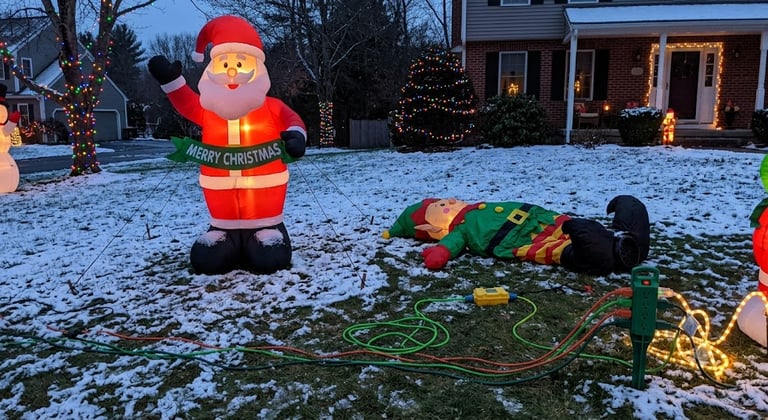
Real-World Holiday Decoration Power Setup Fails — and How to Prevent Them
Nothing is more frustrating than spending hours setting up a beautiful outdoor holiday display only to discover that half the inflatables won't inflate, the breaker trips every evening, or everything suddenly stops working after the first rainstorm.
These problems happen during Christmas, Halloween, Easter, Valentine's Day, Fourth of July celebrations, birthdays, and virtually every other outdoor decorating season. Fortunately, they usually aren't random failures. Most can be traced back to a handful of predictable electrical mistakes.
In this guide, you'll learn how to recognize the most common outdoor holiday decoration power failures, understand why they happen, and choose the right solutions before they ruin your display. Along the way, we'll also recommend practical accessories that can make your setup safer, more reliable, and easier to maintain year after year.
If you're just beginning to build your decorating setup, our guide to The Ultimate Guide to Powering Outdoor Inflatables Safely: Extension Cords, GFCI Protection, Weatherproofing and Load Planning provides a complete overview of planning a safe electrical system before your first decoration goes into the yard.
Who This Guide Is For
This guide is designed for:
First-time outdoor decorators
Homeowners expanding beyond a single inflatable
Christmas light enthusiasts
Halloween display builders
Easter and spring decorators
Patriotic and Fourth of July displays
Anyone who has experienced unexplained outdoor electrical problems
Families wanting a safer, more reliable decorating setup
Whether your display includes one inflatable or dozens of decorations spread across the yard, the same electrical principles apply.
Why Outdoor Holiday Decorations Fail More Often Than People Expect
Outdoor decorating places electrical equipment into one of the harshest environments found around a home.
Unlike indoor appliances, holiday decorations must operate through:
Rain
Snow
Ice
Freezing temperatures
Direct sunlight
Wind
Dirt
Lawn moisture
Constant temperature swings
Every extension cord, plug connection, timer, splitter, and power stake becomes another possible failure point.
Many homeowners assume that because an extension cord is labeled "outdoor rated," it can simply be placed anywhere. In reality, outdoor-rated equipment still has limitations involving water intrusion, connector orientation, cable length, amperage, and physical damage.
As displays become larger, electrical complexity increases quickly. One inflatable becomes three. Then six. Soon multiple blowers, extension cords, timers, smart plugs, splitters, and yard power centers are sharing the same household circuit.
That complexity is why many experienced decorators eventually create dedicated power plans instead of adding accessories one at a time.
If you're planning a larger display, you'll also benefit from reading How to Power Multiple Outdoor Inflatables Safely Without Overloading Your Circuit, which explains how to distribute electrical loads before overloads begin.
Failure #1: Everything Worked Until It Rained
This is probably the most common real-world failure.
A homeowner finishes decorating on Saturday.
Everything works perfectly.
Sunday morning arrives with a light rain.
Sunday evening...
Half the display won't turn on.
Nothing actually "broke."
Instead, moisture found its way into one or more electrical connections.
Common water entry points include:
Plug-to-plug extension cord connections
Power splitter joints
Timer connections
Low-lying extension cords sitting in puddles
Poorly sealed weatherproof boxes
Connections resting directly on wet grass
Even outdoor-rated plugs aren't designed to sit submerged in standing water or allow water to run directly into an exposed connection.
Signs Moisture Is the Problem
Decorations worked before rain.
GFCI suddenly trips.
Breaker trips after storms.
Display returns to normal after drying out.
One section repeatedly fails after wet weather.
How to Prevent It
The simplest improvements include:
Elevate plug connections off the ground.
Keep cord joints away from areas where water collects.
Route cords so water drips away from connections rather than toward them.
Protect exposed connections with weatherproof cord locks or electrical connection boxes.
Inspect rubber seals before every season.
Recommended Solutions
For a single extension cord connection, compact cord locks are inexpensive and easy to install.
As displays become more complex, weatherproof electrical boxes provide better protection for timers, adapters, splitters, and multiple plug connections.
If moisture-related failures keep occurring, our dedicated guide Best Weatherproof Cord Connection Boxes for Outdoor Decorations compares the different box sizes and explains when each type makes the most sense.
Failure #2: The Breaker Trips Every Night
One of the most confusing problems for decorators is a breaker that trips at almost exactly the same time every evening.
The display may operate perfectly during setup and testing. Hours later, after everything has been running for a while—or when timers switch multiple decorations on simultaneously—the circuit suddenly shuts off.
Many homeowners assume the breaker is defective. In reality, the breaker is usually doing exactly what it was designed to do: protecting the wiring from excessive current.
Common causes include:
Too many inflatables on one circuit
Combining lights, blowers, and other outdoor devices on the same breaker
Startup surge when several blowers begin at once
Space heaters or garage appliances sharing the same circuit
Underestimating the combined electrical load
Large displays often grow over several seasons. One inflatable becomes five, then ten, with extension cords and splitters added wherever another outlet is needed. Eventually the circuit reaches its limit.
Warning Signs
Breaker trips only after timers activate.
Breaker resets successfully but trips again.
Everything shuts off at once.
The problem becomes worse as more decorations are added.
Best Practice
Instead of guessing, measure the actual electrical load.
A plug-in energy monitor quickly shows how much power a blower, light string, or accessory actually uses. This makes it much easier to determine whether you're approaching the circuit's safe capacity.
Recommended Products
Budget
Mecheer Upgraded Watt Meter
Premium
Both eliminate guesswork and are especially valuable when expanding an existing display.
If this sounds familiar, Why Your Outdoor Inflatable Keeps Tripping the Breaker (And How to Fix It) explores breaker diagnostics in much greater detail.
Failure #3: The Inflatables Furthest Away Look Weak
This problem often surprises decorators because nothing actually stops working.
Instead:
inflatables seem soft
blowers sound slower
lights appear dimmer
decorations recover when moved closer to the house
The culprit is usually voltage drop.
As electricity travels through longer extension cords, small amounts of voltage are lost. The longer the run and the higher the load, the greater the loss.
Using an undersized extension cord makes the problem even worse.
For example:
A short 16/3 extension cord may work perfectly for one small inflatable.
The same cord stretched 75–100 feet while powering multiple blowers can noticeably reduce performance.
Best Practices
Use heavier-gauge cords for longer distances.
Keep cord runs as short as practical.
Avoid unnecessary adapters and splitters.
Distribute decorations across multiple circuits when possible.
Recommended Products
For a complete explanation of wire gauge, cord length, and voltage drop, see Extension Cord Mistakes That Cause Outdoor Inflatable Failures (Gauge, Length, and Voltage Drop Explained). If you're shopping for new cords, Best Outdoor Extension Cords for Holiday Inflatables (2026 Buyer's Guide) compares the best options for different display sizes.
Failure #4: Everything Turns On…Then Half the Display Dies
Another common scenario looks something like this:
Everything powers up.
Five minutes later…
Half the decorations stop working while the other half continue operating normally.
Unlike a breaker trip, only part of the display loses power.
Possible causes include:
Loose extension cord connection
Failing splitter
Water inside one branch of the system
Damaged power strip
Overloaded timer
Defective outlet on a power stake
The biggest mistake is replacing decorations before checking the power distribution system.
Start at the point where power branches into multiple directions.
Inspect:
splitters
timers
power stakes
weatherproof boxes
extension cord connections
Most failures occur at one of these transition points.
Recommended Products
If you're deciding between these options, Best Heavy Duty Outdoor Power Splitters for Multi Inflatable Displays (2026 Buyer's Guide) explains when a splitter is appropriate and when a yard power center is the safer choice. Larger displays should also review Best Outdoor Power Stakes & Multi-Outlet Yard Power Centers (2026 Buyer's Guide) before adding more decorations.
Failure #5: Timers Work…Until They Don't
Timers make decorating easier, but they introduce another possible point of failure.
Mechanical timers, digital timers, photocell timers, smart plugs, and remote-controlled outlets each have strengths—and each has situations where they perform better than the others.
Real-world issues include:
Moisture entering the housing
Weak Wi-Fi signal
Incorrect programming
Batteries dying in remote controls
Timers mounted where water collects
Cold temperatures affecting electronics
Sometimes the timer isn't actually failing.
Instead, it's switching on several blowers simultaneously, creating a temporary startup surge that trips the breaker.
Choosing the Right Timer
Mechanical timers remain excellent for simple daily schedules.
Photocell timers automatically adjust to seasonal daylight changes.
Remote timers are convenient when decorations are difficult to access.
Smart plugs provide scheduling, automation, and remote control—but depend on reliable Wi-Fi coverage.
Recommended Products
Mechanical
Photocell / Remote
Smart
Failure #6: Your Extension Cord Feels Warm or Hot
An extension cord should never become uncomfortably hot during normal operation.
While a slightly warm cord on a hot summer day isn't unusual, excessive heat is a warning sign that should never be ignored.
Common causes include:
Using a cord that's too small for the electrical load
Running multiple inflatables from one lightweight cord
Leaving excess cord tightly coiled while carrying a heavy load
Loose plug connections creating electrical resistance
Damaged wire insulation
Corroded plug blades
Heat is wasted electricity. If a cord is generating significant heat, that energy isn't reaching your decorations—and prolonged overheating shortens cord life while increasing fire risk.
What To Do Immediately
If an extension cord feels unusually warm:
Turn off the display.
Unplug the cord.
Inspect both plug ends for discoloration or melting.
Check whether the cord is undersized.
Replace damaged cords immediately.
Upgrade to a heavier gauge if the load has increased.
Best Practices
For larger holiday displays:
Choose 12-gauge cords for longer runs or higher loads.
Fully uncoil cords before use.
Avoid covering cords with rugs, mulch, or leaves where heat cannot dissipate.
Replace cords with cracked insulation or loose connectors.
Recommended Products
For heavier-duty applications consider:
For shorter displays:
Failure #7: The GFCI Keeps Tripping
Few electrical components frustrate decorators more than a GFCI that refuses to stay reset.
Fortunately, repeated GFCI trips usually indicate the protection is working—not failing.
Common causes include:
Moisture inside plug connections
Damaged insulation
Water entering blowers
Faulty extension cords
Damaged decorations
Ground leakage caused by worn equipment
Simply resetting the GFCI without finding the cause often leads to repeated trips.
Troubleshooting Sequence
Disconnect everything.
Reset the GFCI.
Add one decoration at a time.
Identify which device causes the trip.
Inspect that entire power path.
Many decorators discover the problem is actually a damaged extension cord rather than the inflatable itself.
Recommended Products
Failure #8: Your Cords Become Damaged During the Season
Not every failure is electrical.
Sometimes the cord itself suffers physical damage.
Outdoor holiday displays expose extension cords to:
Foot traffic
Lawn mowers
Snow blowers
Pets
Ice
Vehicle tires
UV exposure
Constant bending
Small cuts in insulation may not cause immediate problems but often become next year's mysterious electrical failure.
Prevention Tips
Secure cords instead of leaving them loose across the yard.
Use clips to keep wiring organized along fences, railings, and siding.
Protect cords crossing sidewalks or driveways with proper cable protectors.
Store extension cords properly after the season ends by loosely coiling them and hanging them instead of wrapping them tightly around your arm.
If you want to reduce trip hazards while extending the life of your cords, Best Outdoor Cord Management Accessories for Holiday Displays (Clips, Stakes, Covers & Safer Setup Guide) covers these accessories in detail.
Holiday Decoration Power Fail Checklist: How to Prevent Tripped Circuits, Wet Plugs, and Cord Damage
Before turning on your display each season, run through this checklist:
✅ Inspect every extension cord for cuts, cracks, or damaged insulation.
✅ Verify every outdoor outlet is GFCI protected.
✅ Keep all plug connections off the ground.
✅ Weatherproof every plug-to-plug connection.
✅ Place timers and splitters inside weatherproof connection boxes when appropriate.
✅ Avoid overloading a single circuit.
✅ Upgrade to heavier-gauge extension cords for long distances or multiple inflatables.
✅ Fully uncoil extension cords before use.
✅ Secure cords to reduce trip hazards and lawn equipment damage.
✅ Test timers before the decorating season begins.
✅ Check that smart plugs maintain a reliable Wi-Fi connection.
✅ Verify that all decorations operate correctly before leaving them unattended overnight.
Best Prevention Setups
Budget Setup
Ideal for one to three inflatables.
Recommended accessories:
Heavy-duty outdoor extension cord
Cord lock
Mechanical timer
Cable clips
Best for homeowners with a simple seasonal display.
Better Setup
Ideal for growing displays.
Recommended accessories:
12/3 extension cord where needed
Weatherproof electrical box
Kill-A-Watt meter
Outdoor power stake
Remote timer
Cord organizers
Provides better load management and easier troubleshooting.
Premium Setup
Designed for larger displays with multiple inflatables.
Recommended accessories:
Heavy-duty 12-gauge extension cords
Large weatherproof electrical boxes
Outdoor GFCI power strip
Yard power center
Heavy-duty splitter where appropriate
Smart plug automation
Cable ramps
Weatherproof cord management throughout
This setup minimizes downtime while making future expansion much easier.
Key Takeaways
Most outdoor holiday decoration failures are predictable and preventable.
Moisture remains the leading cause of power interruptions.
Proper extension cord selection prevents voltage drop and overheating.
Splitters add convenience—not electrical capacity.
GFCIs are safety devices that should never be bypassed.
Organized cord management improves both safety and reliability.
A few well-chosen accessories can prevent many common failures before they happen.
Mini Conclusion
Holiday decorating should be enjoyable—not a troubleshooting exercise every weekend.
The good news is that most power failures aren't caused by defective decorations. They're usually the result of moisture, overloaded circuits, undersized extension cords, damaged connections, or poor power planning.
By understanding the common failure patterns and investing in the right preventive accessories, you can spend less time chasing electrical problems and more time enjoying a display that works reliably throughout the season.
Whether you're decorating for Christmas, Halloween, Easter, Independence Day, or another special occasion, building a dependable outdoor power system will make every future display easier to set up and maintain.
Frequently Asked Questions
Why do my outdoor decorations stop working after it rains?
Moisture entering plug connections, timers, splitters, or extension cord joints is one of the most common causes. Elevating and weatherproofing connections significantly reduces this risk.
Can one extension cord safely power several inflatables?
It depends on the total electrical load, cord length, and wire gauge. Always calculate the combined wattage and choose a cord rated for that load.
Why does my breaker trip only at night?
Many timers activate multiple decorations simultaneously, creating a startup surge that pushes the circuit beyond its capacity.
Should I buy a smart plug or a mechanical timer?
Mechanical timers are simple and dependable for basic schedules. Smart plugs add remote control, automation, and scheduling but require a stable Wi-Fi connection.
Why does my GFCI keep tripping?
Repeated GFCI trips usually indicate moisture, damaged wiring, or ground leakage somewhere in the connected equipment.
Are weatherproof electrical boxes worth buying?
Yes. They help protect extension cord connections, timers, adapters, and splitters from rain, snow, and debris, reducing one of the most common causes of outdoor electrical failures.
What's the best extension cord gauge for multiple inflatables?
For larger displays or longer cord runs, 12-gauge outdoor-rated extension cords generally provide the best performance and minimize voltage drop.
Can I keep adding splitters if I run out of outlets?
No. Splitters increase the number of available receptacles but do not increase the amount of power available from the circuit.
Remember: Outdoor electrical safety is more important than adding one more decoration. If you encounter repeated breaker trips, damaged wiring, melted plugs, or signs of overheating that you cannot confidently diagnose, disconnect the display and correct the underlying problem before restoring power. A reliable display starts with a safe electrical system.
Related Articles
If you're expanding or improving your outdoor display, these guides provide more in-depth information:
The Ultimate Guide to Powering Outdoor Inflatables Safely: Extension Cords, GFCI Protection, Weatherproofing and Load Planning — Learn how to design a safe, reliable electrical system from the start.
How to Power Multiple Outdoor Inflatables Safely Without Overloading Your Circuit — Step-by-step guidance for expanding displays without creating overload problems.
Best Outdoor Extension Cords for Holiday Inflatables (2026 Buyer's Guide) — Compare cord gauges, lengths, and cold-weather performance.
Best Weatherproof Cord Connection Boxes for Outdoor Decorations — Find the right weatherproof box for simple or complex power setups.
Best Outdoor Power Stakes & Multi-Outlet Yard Power Centers (2026 Buyer's Guide) — Centralize power distribution for cleaner, safer multi-decoration displays.