
Home > Setup, Safety, and Repairs > Outdoor Power Accessories > GFCI Protection for Outdoor Holiday Decorations: What It Is, Why It Trips, and When You Need It
GFCI Protection for Outdoor Holiday Decorations: What It Is, Why It Trips, and When You Need It
Learn what GFCI protection does, why outdoor holiday decorations trip GFCI outlets, how to troubleshoot safely, and which products help build a safer display.
By Frank "Frosty" Adminei
7/7/202612 min read
Introduction
Nothing is more frustrating than spending hours setting up your outdoor holiday decorations only to have everything suddenly go dark because a GFCI outlet tripped.
For many homeowners, that little RESET button becomes the enemy. They press it over and over, hoping the decorations will stay on this time. Unfortunately, repeated GFCI trips are usually telling you something important about your electrical setup.
The good news is that a tripped GFCI doesn't automatically mean you have a serious electrical problem. In many cases, it's simply doing exactly what it was designed to do—protect people from electrical shock when moisture, damaged wiring, or another ground fault is detected.
Whether you're decorating for Christmas, Halloween, Easter, Independence Day, Valentine's Day, or any other holiday, understanding how GFCI protection works can make your display both safer and more reliable.
In this guide you'll learn:
what a GFCI actually does
why outdoor holiday decorations cause GFCIs to trip
how to determine whether the problem is moisture, overload, or damaged equipment
which products can help improve the safety and reliability of your setup
practical troubleshooting tips that work in the real world
By the end of this guide, you'll know how to work with your GFCI protection—not against it.
Who This Guide Is For
This guide is designed for homeowners and decorators of every experience level.
It is especially useful if you:
decorate for multiple holidays throughout the year
use outdoor inflatables
install large Christmas light displays
power several decorations from one area of your yard
use outdoor timers or smart plugs
frequently experience unexplained GFCI trips
want to build a safer outdoor electrical system
If you're just beginning to build a display, you'll learn best practices that can help prevent many common problems before they happen.
If you've been decorating for years, you'll likely discover a few troubleshooting techniques and equipment upgrades that can improve reliability while maintaining important safety protection.
If you're planning a larger display, our article The Ultimate Guide to Powering Outdoor Inflatables Safely: Extension Cords, GFCI Protection, Weatherproofing and Load Planning explains how GFCI protection fits into an overall outdoor power strategy rather than treating it as a standalone component.
What Is a GFCI?
GFCI stands for Ground Fault Circuit Interrupter.
Its job is simple:
Protect people from electric shock.
Unlike a standard electrical outlet, a GFCI constantly compares the amount of electricity leaving the outlet with the amount returning.
Under normal conditions, those amounts are equal.
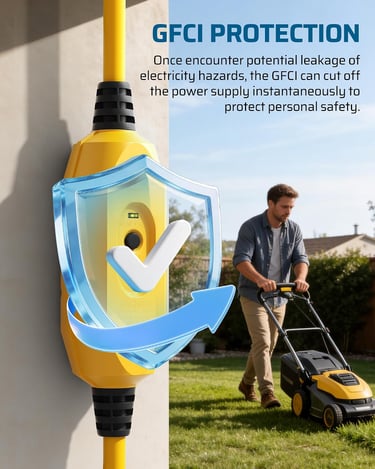
If even a tiny amount of electricity begins leaking somewhere else—through standing water, damaged insulation, wet equipment, or even a person—the GFCI detects the imbalance and disconnects power almost instantly.
That rapid shutdown is why outdoor outlets, bathrooms, garages, basements, kitchens, and other damp locations commonly use GFCI protection.
What Does a GFCI Actually Detect?
A GFCI is looking for ground faults.
Examples include:
water entering an electrical connection
damaged extension cords
cracked insulation
moisture inside decorations
worn plugs
damaged blower motors
frayed wiring
defective outdoor timers
failing smart plugs
It does not simply trip because you're using "too much electricity."
That's one of the biggest misconceptions among holiday decorators.
If too much electrical load is placed on a circuit, the breaker is usually the device that responds—not the GFCI.
Understanding that distinction makes troubleshooting much easier.
GFCI vs. Circuit Breaker
These two devices are often confused because both can shut off power, but they protect against very different hazards.
A breaker protects your home's wiring from excessive current.
A GFCI protects you from electrical shock.
Because they monitor different problems, it's entirely possible for one to trip while the other remains unaffected.
For example, a small amount of water inside an extension cord connection may trip the GFCI even though the total electrical load is well below the circuit's capacity. On the other hand, plugging too many high-wattage decorations into one circuit may trip the breaker without the GFCI ever detecting a ground fault.
If you're unsure whether your display is simply overloaded or has a wiring issue, our guide Why Your Outdoor Inflatable Keeps Tripping the Breaker (And How to Fix It) walks through the differences and provides practical troubleshooting steps.
Why Outdoor Holiday Decorations Trip GFCIs
The most common reason outdoor decorators become frustrated with GFCI protection is that it seems to trip "for no reason."
In reality, a properly functioning GFCI almost always trips because it detects a small amount of electricity flowing somewhere it shouldn't. That doesn't necessarily mean there's a dangerous electrical fault, but it does mean something deserves attention before you simply press the reset button and walk away.
Below are the most common causes.
Moisture Is the Number One Cause
Outdoor decorations spend weeks—or even months—exposed to changing weather conditions.
Even if it isn't actively raining, moisture can enter electrical connections through:
overnight condensation
melting snow
freezing rain
heavy fog
lawn irrigation
puddles
morning dew
Many nuisance GFCI trips happen first thing in the morning after a cool, damp night.
One slightly wet plug connection may leak enough current to trip the GFCI while the decorations themselves continue working perfectly once everything dries.
This is one reason experienced decorators try to keep every plug connection elevated off the ground whenever possible.
If you've ever wondered why a "weatherproof" connection still failed during bad weather, our article Why Weatherproof Outdoor Electrical Boxes Still Fail in Rain, Snow, and Ice (And How to Fix Them for Good) explains the most common installation mistakes and how to avoid them.
Damaged Extension Cords
Extension cords take far more abuse than most homeowners realize.
Over time they can develop:
cracked insulation
cuts from lawn equipment
crushed sections
loose plug blades
broken strain relief
internal conductor damage
Sometimes the damage is obvious.
Sometimes it isn't.
A cord that looks perfectly normal can develop internal damage after years of:
repeated coiling
freezing temperatures
being stepped on
being pinched in doors
being driven over
As insulation ages, tiny leakage currents become more likely—exactly what a GFCI is designed to detect.
Wet Plug Connections
Many outdoor decoration failures occur where two plugs connect—not inside the decoration itself.
Typical trouble spots include:
extension cord connections
timer connections
smart plugs
splitter connections
blower plugs
These connection points often sit directly on wet grass or snow.
Even products rated for outdoor use perform much better when kept off saturated ground and protected from standing water.
This is why weatherproof cord connection boxes are among the best investments for larger holiday displays.
Older Decorations
Holiday decorations often remain in storage for eleven months every year.
During storage, wiring may become:
brittle
cracked
chewed by rodents
damaged during packing
weakened from repeated folding
Older incandescent light strings are especially prone to insulation problems compared with newer LED products.
Inflatables can also develop damaged wiring where blower cords repeatedly bend near the housing.
Blower Motors
Outdoor inflatables rely on continuous airflow.
While blower motors are generally reliable, problems can occur if:
water enters the housing
bearings begin wearing
internal insulation deteriorates
cords become damaged
A failing blower may still operate while leaking enough current to trip the GFCI intermittently.
If one inflatable consistently causes trips while others don't, isolate that blower first during troubleshooting.
Timers and Smart Plugs
Outdoor timers and smart plugs simplify automation, but they also introduce additional electrical connections.
Every additional connection point is another opportunity for:
moisture intrusion
corrosion
loose contacts
damaged seals
That doesn't mean you should avoid automation—it simply means every component should be outdoor-rated and inspected regularly.
If you're planning automated displays, you'll also want to read Best Smart Plugs for Holiday Inflatables (2026 Buyer's Guide) and Smart Plug Automation Strategies for Outdoor Holiday Decorations and Inflatables, which explain where smart devices fit into a reliable outdoor power system.
Animal Damage
This cause surprises many homeowners.
Squirrels, mice, rabbits, and even pets occasionally chew extension cords or decoration wiring.
The damage may be minor enough that everything still appears to work—but enough exposed conductor exists to create leakage current.
If GFCI trips begin suddenly after your display has been operating normally for weeks, inspect exposed wiring carefully for bite marks.
Multiple Small Problems
Sometimes there isn't one obvious culprit.
Instead, several small issues combine:
damp extension cord
aging timer
partially damaged decoration
worn extension cord
slight corrosion
Individually, none may trip the outlet.
Together, they can exceed the GFCI's sensitivity threshold.
This is why systematic troubleshooting works much better than random guessing.
Why GFCI Trips Are Usually a Good Thing
Although nuisance trips are frustrating, it's important to remember why GFCIs exist in the first place.
A standard breaker protects your home's electrical wiring.
A GFCI protects people.
That distinction matters.
Imagine a damaged extension cord lying in wet grass during a December rainstorm.
Without GFCI protection, that damaged cord could continue operating while creating an electrical shock hazard.
With GFCI protection, power is interrupted almost immediately.
In other words, the outage you experience may actually be preventing a much more serious problem.
Don't Bypass GFCI Protection
Some homeowners become so frustrated with repeated trips that they look for ways to eliminate GFCI protection altogether.
That is never a good solution.
If a GFCI repeatedly trips, treat it as valuable diagnostic information.
Something in the system needs inspection.
Replacing the safety device with a standard outlet—or using unsafe workarounds—doesn't eliminate the underlying issue.
It simply removes one of the most effective electrical safety devices in your outdoor display.
Resetting Once Is Fine—Resetting Repeatedly Isn't
A single trip after a severe rainstorm may simply indicate temporary moisture.
Repeated trips every few minutes usually point toward:
damaged equipment
moisture that hasn't been addressed
deteriorating cords
defective timers
failing smart plugs
damaged decorations
If the same GFCI trips repeatedly under similar conditions, stop resetting it until you've identified the source.
Step-by-Step Troubleshooting Guide
Rather than replacing parts at random, use a systematic process.
Doing so often identifies the problem much faster.
Step 1 — Reset the GFCI
Press RESET once.
If it immediately trips again with nothing connected, the outlet itself may require inspection by a qualified electrician.
If it resets normally, continue.
Step 2 — Disconnect Everything
Unplug:
extension cords
inflatables
lights
timers
smart plugs
power stakes
splitters
Start with a completely empty outlet.
Step 3 — Reconnect One Item at a Time
Reconnect equipment individually.
When the GFCI trips, you've narrowed the problem considerably.
This simple process often finds the defective device in only a few minutes.
Step 4 — Inspect Every Cord
Look for:
cuts
flattened sections
exposed copper
cracked insulation
loose molded plugs
bent blades
Even minor damage is enough to justify replacement.
If you're unsure what to look for, Extension Cord Mistakes That Cause Outdoor Inflatable Failures (Gauge, Length, and Voltage Drop Explained) includes examples of common cord problems.
Step 5 — Check Every Plug Connection
Verify:
plugs fully seated
no standing water
no corrosion
no dirt inside connectors
weatherproof boxes properly closed
cords exiting through the correct gasket openings
Many "mystery" GFCI trips are ultimately traced to a single wet plug connection.
Step 6 — Verify Electrical Load
If the outlet isn't tripping but the breaker occasionally does, measure the actual electrical demand.
A watt meter such as P3 Kill A Watt or Mecheer Energy Monitor can confirm:
watts
amps
voltage
cumulative energy usage
This won't diagnose a ground fault, but it helps rule out overloads and supports smarter circuit planning for larger displays.
Step 7 — Replace or Isolate Suspect Components
Once you've narrowed the problem to a specific decoration or accessory, don't simply keep resetting the GFCI and hope for the best.
Instead:
Replace damaged extension cords immediately.
Replace cracked timers or smart plugs.
Dry and inspect any wet connections before reconnecting them.
Remove questionable decorations from service until they can be repaired or replaced.
Holiday decorations are relatively inexpensive compared to the potential cost of electrical damage—or worse, an electrical injury.
Step 8 — Test the Entire Display Again
After correcting the problem:
reconnect everything
verify the GFCI resets normally
allow the display to operate for at least 30–60 minutes
recheck after sunset when timers and smart plugs activate
inspect again following the next rain or heavy dew
Many intermittent problems only appear after several hours of operation.
Products That Help Build a Safer Outdoor Display
No product can prevent every GFCI trip. However, the right combination of equipment can significantly reduce nuisance trips while improving the overall safety and reliability of your display.
Think of these products as layers of protection rather than individual fixes.
1. GFCI Extension Cords
Best for:
Temporary holiday displays
Older homes without convenient outdoor GFCI outlets
Portable protection closer to decorations
Recommended products:
Advantages
✓ Built-in GFCI protection
✓ Easy seasonal installation
✓ Heavy-duty 12/3 construction
✓ Excellent for inflatables and outdoor decorations
Limitations
They cannot fix damaged decorations.
They cannot eliminate moisture.
They should still be paired with outdoor-rated extension cords and proper weather protection.
2. Outdoor GFCI Power Strips
Ideal when powering several low-to-moderate wattage decorations from one location.
Recommended:
These products provide:
multiple outlets
integrated GFCI protection
surge protection
centralized power distribution
These work particularly well when combined with weatherproof connection boxes for larger holiday displays.
3. Weatherproof Connection Boxes
One of the best investments you can make.
Recommended:
Why They Help
They protect:
plug connections
timers
smart plugs
splitters
adapters
from:
rain
snow
melting ice
sprinkler spray
dirt
Important
A weatherproof box does not stop a ground fault inside the decoration itself.
Instead, it reduces one of the most common causes of nuisance GFCI trips—wet electrical connections.
For a deeper look at choosing the right size and style, see Best Weatherproof Cord Connection Boxes for Outdoor Decorations.
4. Outdoor Extension Cords
Your extension cord is the foundation of your display.
Choose the proper gauge for both the distance and electrical load.
General guidance:
Cord
Best Use
16/3
Small inflatables and light displays
14/3
Moderate holiday displays
12/3
Large displays, long runs and higher loads
Recommended products:
5. Watt Meters
Many decorators assume a GFCI trip means overload.
Often it doesn't.
A watt meter helps determine whether your display is approaching the circuit's capacity.
Recommended:
Use them to measure:
watts
amps
voltage
power factor
total electrical consumption
This is especially useful before adding "just one more inflatable."
Example Outdoor Display Setups
Budget Setup
Perfect for:
one or two inflatables
several LED light strings
Suggested combination:
16/3 outdoor extension cord
GFCI outlet
weatherproof connection box
mechanical timer
Mid-Level Setup
Ideal for:
multiple inflatables
pathway lighting
animated decorations
Suggested combination:
12/3 extension cord
GFCI power strip
weatherproof box
smart plug or timer
Kill-A-Watt meter during setup
Premium Setup
Ideal for:
large Christmas displays
Halloween yard haunts
multiple circuits
synchronized displays
Suggested combination:
multiple dedicated GFCI circuits
12/3 extension cords
outdoor power stake
several weatherproof boxes
watt meter
smart automation
labeled circuits for easier troubleshooting
If you're planning a display with ten or more inflatables, Best Outdoor Power Solutions for Large Multi-Inflatable Displays (10+ Units) covers advanced planning techniques that complement the safety practices discussed here.
Helpful Hints
Experienced decorators often follow a few simple habits that greatly reduce electrical problems throughout the season.
Test every GFCI outlet before decorating.
Keep all electrical connections off the ground whenever possible.
Use weatherproof connection boxes instead of plastic bags or tape.
Label extension cords by length and gauge for faster setup each year.
Inspect cords during storage and again before installation.
Dry connections completely before repeatedly resetting a tripped GFCI.
Replace aging cords rather than hoping they'll survive one more season.
Leave enough slack in cords to avoid unnecessary strain on plugs.
Group decorations by circuit to simplify troubleshooting.
Keep a spare extension cord and weatherproof box available during the season.
Common Mistakes
Avoid these frequent errors:
❌ Assuming every GFCI trip means an overloaded circuit
❌ Plugging outdoor decorations into indoor-rated extension cords
❌ Leaving plug connections lying in wet grass
❌ Ignoring cracked insulation or loose plugs
❌ Daisy-chaining multiple extension cords unnecessarily
❌ Overlooking moisture inside timers, splitters, or smart plugs
❌ Repeatedly pressing RESET without investigating the cause
❌ Attempting to bypass GFCI protection to keep decorations running
Key Takeaways
GFCIs protect people from electrical shock—not just equipment.
Moisture is the leading cause of nuisance GFCI trips.
Ground faults and overloaded circuits are different problems requiring different solutions.
Systematic troubleshooting is faster and safer than guessing.
Weatherproof connection boxes, outdoor-rated cords, and quality GFCI devices reduce many common issues.
Never bypass GFCI protection simply to keep decorations operating.
Mini Conclusion
A tripped GFCI can be inconvenient, but it's also one of the best early warning systems built into your outdoor electrical setup. By understanding what causes ground faults, inspecting your equipment regularly, and using quality outdoor-rated accessories, you can enjoy a display that's both reliable and significantly safer for your family and visitors.
Rather than treating the RESET button as a nuisance, think of it as confirmation that an important safety device is doing exactly what it was designed to do.
Frequently Asked Questions
Do I need GFCI protection for all outdoor holiday decorations?
Yes. Any outdoor decorations plugged into exterior receptacles should be connected to properly GFCI-protected circuits, whether you're using lights, inflatables, timers, or other electrical accessories.
Why does my GFCI only trip when it rains?
Moisture is the most common cause. Water entering plug connections, damaged cords, or electrical devices can create a small leakage current that trips the GFCI.
Can a smart plug cause a GFCI to trip?
Yes. Although uncommon, a damaged or defective outdoor smart plug—or moisture entering its housing—can create a ground fault that trips the GFCI.
Can I plug a GFCI extension cord into a GFCI outlet?
Yes. While it isn't usually necessary, it is generally acceptable. Just remember that if a fault occurs, either device may trip, so you'll need to determine which one needs to be reset.
Why won't my GFCI reset?
Common causes include:
an active ground fault
moisture still present
a damaged device connected to the circuit
a failed GFCI outlet that requires replacement
Does a weatherproof connection box stop GFCI trips?
Not by itself. It helps keep plug connections dry, reducing one of the most common sources of nuisance trips, but it cannot correct damaged wiring or faulty decorations.
Can extension cords cause GFCI trips?
Yes. Damaged insulation, loose plugs, internal conductor damage, or moisture entering connections can all create leakage current that trips a GFCI.
Is a breaker trip the same as a GFCI trip?
No. A breaker primarily protects your home's wiring from overloads and short circuits, while a GFCI protects people from electrical shock caused by ground faults.
Related Articles
If you're building or expanding your outdoor display, these guides provide the next steps:
The Ultimate Guide to Powering Outdoor Inflatables Safely: Extension Cords, GFCI Protection, Weatherproofing and Load Planning — Learn how every component works together in a complete outdoor power system.
How to Power Multiple Outdoor Inflatables Safely Without Overloading Your Circuit — Calculate electrical loads and expand your display without tripping breakers.
Best Outdoor Extension Cords for Holiday Inflatables (2026 Buyer's Guide) — Compare gauges, lengths, and cold-weather performance to choose the right cord.
Best Weatherproof Cord Connection Boxes for Outdoor Decorations — Find the right enclosure for plugs, timers, smart plugs, and power strips.
Best Outdoor Power Stakes & Multi-Outlet Yard Power Centers (2026 Buyer's Guide) — Simplify larger displays with centralized outdoor power distribution.