
Home > Setup, Safety, and Repairs > Outdoor Power Accessories > Weatherproof Box Failures
Why Weatherproof Outdoor Electrical Boxes Still Fail in Rain, Snow, and Ice (And How to Fix Them for Good)
Learn why weatherproof outdoor electrical boxes fail in rain, snow, and ice—and how to fix them with real-world setups, extension cords, cord covers, and GFCI protection systems.
Frank “Frosty” Adminei
6/22/20263 min read
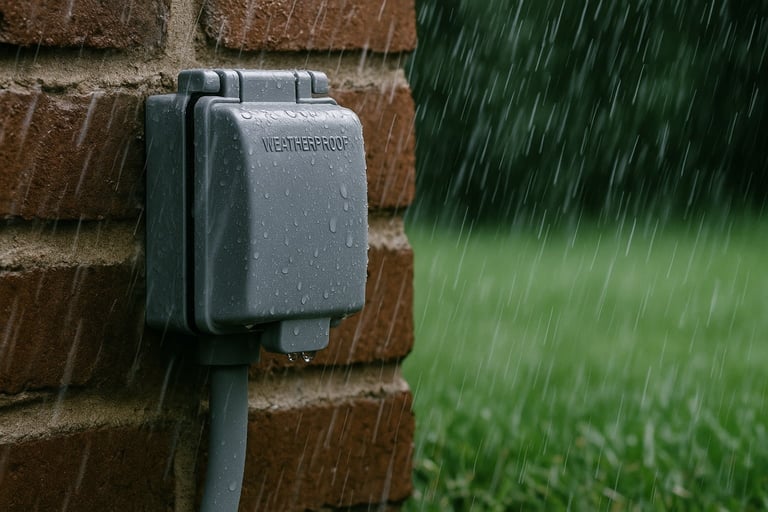
TABLE OF CONTENTS
INTRODUCTION
Outdoor electrical systems fail for one simple reason:
They are designed as single products—but used as complete systems.
A weatherproof box is only one link in a chain that includes:
extension cords
plugs
timers or smart plugs
load devices (inflatable blowers, lights, pumps)
environmental exposure (rain, snow, ice, wind)
When one link weakens, the entire system fails.
Most homeowners assume:
“If the box is weatherproof, the system is safe.”
But in real storms, that assumption breaks immediately.
WHO THIS GUIDE IS FOR
Holiday inflatable owners
Outdoor lighting installers
Homeowners with yard power setups
Users experiencing GFCI trips after rain or snow
WHY THESE FAILURES HAPPEN
Core Reality:
Weatherproof ratings assume ideal test conditions—not real-world seasonal stress.
5 Failure Drivers:
wind-driven rain intrusion
gasket fatigue over time
condensation inside sealed enclosures
freeze-thaw expansion cycles
overloaded multi-device setups
THE 5 REAL FAILURE POINTS
1. Cable entry is the weakest link
Every cord entry point is a micro-leak path.
2. Gasket compression loss
Rubber seals degrade after repeated seasonal use.
3. Internal condensation loop
Warm humid air trapped inside box cools → water forms inside.
4. Load stress overheating
Inflatable blowers + timers increase internal heat + humidity.
5. Ground-level exposure
Snow melt pools directly around connection points.
RAIN vs SNOW vs ICE FAILURE BEHAVIOR
Rain
immediate penetration via wind pressure
fast GFCI tripping
Snow
slow melt infiltration
hidden internal moisture buildup
Ice
expansion forces crack seals
moisture gets locked inside enclosure
HIGH-RISK SYSTEM: INFLATABLE HOLIDAY SETUPS
Inflatable systems are the worst-case scenario for outdoor electrical boxes:
long runtime (8–24 hours)
constant vibration at plug points
multiple extension cord connections
ground-level exposure to snow and puddles
Failure chain example:
Snow → melt → seepage → freeze → expansion → micro-gap → rain intrusion → GFCI trip
FIXING THE SYSTEM (NOT JUST THE BOX)
To stop failures, you must build a layered protection system.
LAYER 1 — CORD ENTRY PROTECTION (CRITICAL)
Budget Fix:
Cismorvex Outdoor Extension Cord Safety Cover
prevents direct rain splash intrusion
good for short seasonal installs
weak in deep freeze cycles
LAYER 2 — MID-SYSTEM ENCLOSURE (CORE FIX)
Standard Upgrade:
Flemoon Large Outdoor Electrical Box
fits timers, plugs, and small power strips
best all-around inflatable protection
reduces direct water exposure risk
LAYER 3 — HEAVY DUTY EXTENSION INFRASTRUCTURE
Load Stability Upgrade:
POWGRN 12/3 Heavy Duty Outdoor Extension Cord
cold-weather flexible insulation
handles high-load inflatables safely
reduces overheating resistance issues
LAYER 4 — SYSTEM TIMER / CONTROL POINT
Automation Layer:
DEWENWILS Outdoor Power Stake Timer
reduces manual plugging/unplugging
distributes load across outlets
improves seasonal reliability
LAYER 5 — SMART CONTROL OPTION (ADVANCED)
Remote Control Upgrade:
remote shutdown during storms
scheduling reduces constant load stress
integrates with smart home systems
INSTALLATION MISTAKES (80% FAILURE DRIVER)
Mistake 1: No drip loop
Water travels directly into enclosure via cord surface.
Mistake 2: Ground contact placement
Boxes sit in melting snow or puddles.
Mistake 3: Overfilled enclosure
No air circulation → condensation trap.
Mistake 4: Mixing ratings
IP44 + IP65 components create weakest-link failure.
Mistake 5: Top-entry cords
Gravity funnels water into box.
BUYING CONSIDERATIONS
When selecting products, prioritize:
cold-weather rated insulation (SJTW or better)
gasket compression design (not snap-only seals)
cable entry size match (critical leak point)
UL/ETL listing (load safety baseline)
enclosure volume (airflow reduces condensation)
MAINTENANCE CHECKLIST
inspect seals before each season
replace cracked gaskets immediately
test GFCI monthly during outdoor use
clear snow buildup around enclosures
re-seat all cord connections mid-season
STORAGE
store boxes uncompressed (prevents seal deformation)
avoid cold-bending extension cords tightly
disconnect all outdoor systems after season
dry all enclosures fully before storage
KEY TAKEAWAYS
Weatherproof is a rating, not a system guarantee
Most failures come from cord entry points
Snow + freeze cycles are more destructive than rain
Inflatable setups expose every weak point simultaneously
Reliability requires layered system design
MINI CONCLUSION
Outdoor electrical failures are not product failures—they are system design failures.
Once you understand that, the solution becomes simple:
Stop relying on one “weatherproof box” and start building a layered power protection system.
FAQ
Why do weatherproof boxes still fail?
Because wind-driven rain, condensation, and freeze cycles bypass static seals.
Are IP65 boxes waterproof?
No—only resistant under controlled test conditions.
Why does my GFCI trip after rain?
Moisture creates leakage current in plugs, cords, or enclosures.
What is the #1 failure point?
Cable entry points into the enclosure.
How do I stop repeat failures?
Use layered protection: cord cover → enclosure → proper extension cord → GFCI protection.
This article is based on real-world failure patterns observed in outdoor electrical systems, seasonal holiday installations, and consumer-grade weatherproof enclosure behavior under rain, snow, and ice stress conditions.