
Best Sandbags for Bounce Houses (2026) – Secure Anchoring Guide
Discover the best sandbags for bounce houses in 2026. Learn how to safely anchor inflatables without stakes, compare top options, and choose the right weight for wind protection.
Frank “Frosty” Adminei
5/6/20269 min read
Best Sandbags for Bounce Houses (2026): Safe, Stable and Stake-Free Anchoring Guide
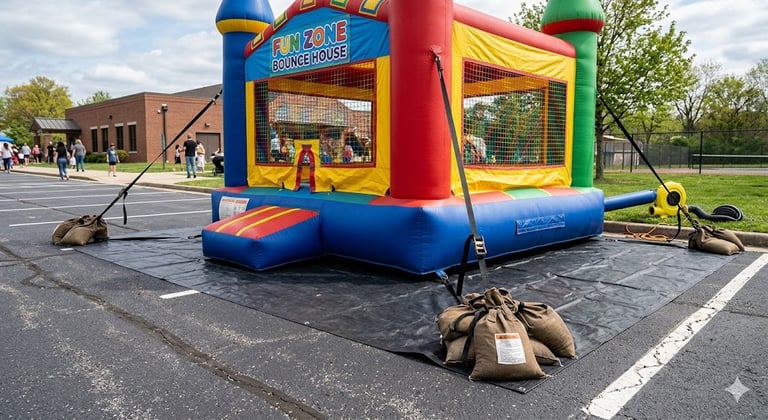
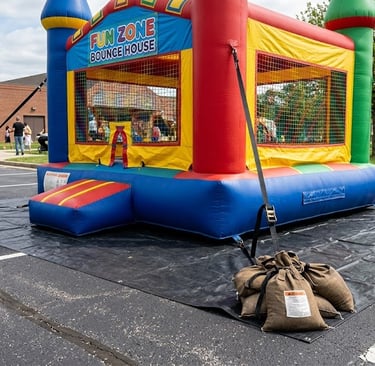
TABLE OF CONTENTS
INTRODUCTION
Bounce houses are only as safe as their anchoring system. While stakes are the traditional solution, many users simply cannot use them due to concrete surfaces, rental restrictions, or soil conditions. That’s where sandbags become essential.
In 2026, sandbag anchoring has become one of the most practical and accessible ways to stabilize inflatables without modifying the ground. But not all sandbags are created equal—weight capacity, strap design, and durability all matter more than most buyers realize.
This guide focuses on real-world performance, not theory, so you can confidently secure your inflatable in typical backyard conditions.
WHO THIS GUIDE IS FOR
This guide is designed for:
Homeowners setting up bounce houses on driveways, patios, or turf
Parents hosting backyard parties without permanent installation options
Rental users who are prohibited from staking into the ground
First-time inflatable owners unsure how much anchoring weight is required
Anyone upgrading from weak or improvised anchoring methods (bricks, water jugs, etc.)
If you’ve ever worried about wind lifting your inflatable, this guide is built for you.
WHY THIS TOPIC MATTERS
Anchor failure is one of the most overlooked safety risks in inflatable use.
Unlike stakes that physically lock into soil, sandbags rely on mass and friction, which means proper selection is critical. Underweighted or poorly attached bags can shift during gusts, especially on smooth surfaces like concrete or deck boards.
Competitor guides often miss key details such as:
Real wind-load behavior vs “recommended weights”
Differences between strap systems (loop vs hook vs sewn anchor points)
Multi-point vs perimeter anchoring strategies
Surface-specific anchoring limitations
Understanding these gaps helps prevent unsafe setups and improves overall inflatable stability.
AGE GROUP SEGMENTATION
Different bounce house users require different anchoring strategies:
Ages 2–5 (Toddler Units)
Lightweight inflatables
Lower wind exposure due to smaller height
Sandbags still required for sudden gust protection
Ages 6–10 (Standard Backyard Units)
Most common use case
Medium-height structures with higher wind surface area
Requires full perimeter sandbagging strategy
Ages 11–14 (Large Combo Units / Slides)
Highest wind exposure due to height and surface area
Requires heavier sandbags or hybrid anchoring systems
Often needs reinforced tie-down points
Commercial / Multi-Age Units
Requires maximum anchoring redundancy
Sandbags should be treated as secondary backup, not sole anchor in strong wind zones
PRODUCT MODULES
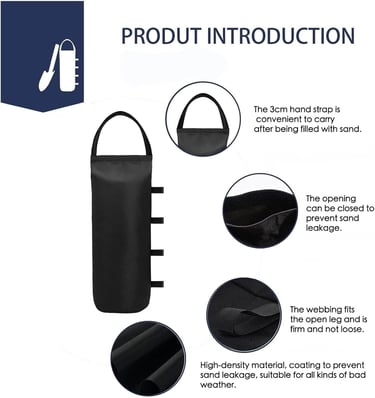
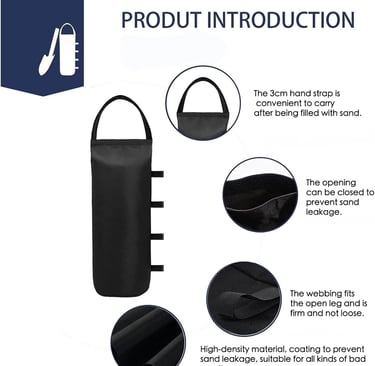
IALNAI 112 LBS Canopy Weight Sand Bags
1. What it is
A set of heavy-duty canopy sandbags designed for stabilizing pop-up tents, sunshades, and inflatable structures like bounce houses.
2. Why it works
The 112 lb total weight capacity helps counteract lift forces caused by wind, especially on open backyard setups where stakes cannot be used.
3. Size / footprint
Compact wrap-around design that sits at each leg of the inflatable or tent structure without taking up play space.
4. Material & durability
Made from reinforced outdoor-grade fabric designed for repeated seasonal use; built to hold sand securely without leaking.
5. Best user / age range
Ideal for residential bounce house owners using medium-sized inflatables in typical backyard environments.
6. Why buyers like it
Users like the straightforward fill-and-secure design that doesn’t require tools or hardware adjustments.
7. Safety or usage notes
Works best when distributed evenly across all anchor points—an accessible, no-hardware solution for improving bounce house stability when stakes aren’t an option.
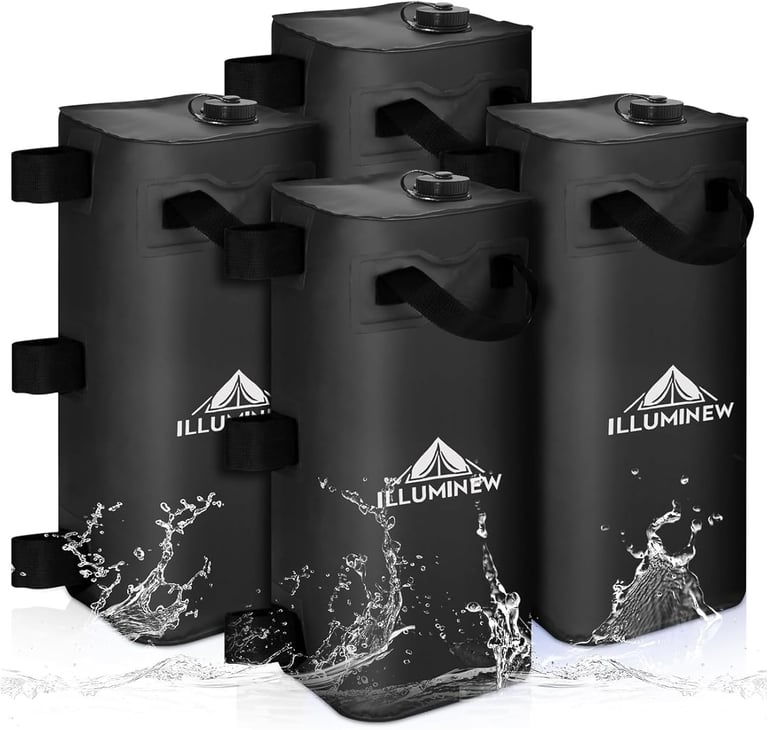
ILLUMINEW 4 Pack Canopy Water Weight Bags (220 LBS Total)
1. What it is
A four-pack set of water-fill weight bags designed for canopy legs, tents, and inflatable anchoring support.
2. Why it works
When filled to capacity, the system provides up to 220 lbs of total anchoring force, improving stability against wind uplift and lateral movement.
3. Size / footprint
Each bag wraps neatly around canopy or inflatable legs, keeping the ground area clear for foot traffic and play.
4. Material & durability
Heavy-duty PVC-style construction designed to withstand repeated filling cycles and outdoor exposure.
5. Best user / age range
Best for users needing portable anchoring where sand is not readily available.
6. Why buyers like it
Convenient water-fill system eliminates the need to transport heavy sand, making setup faster and more flexible.
7. Safety or usage notes
Provides strong performance for temporary setups—an efficient anchoring option for bounce house owners who prioritize portability and fast assembly.
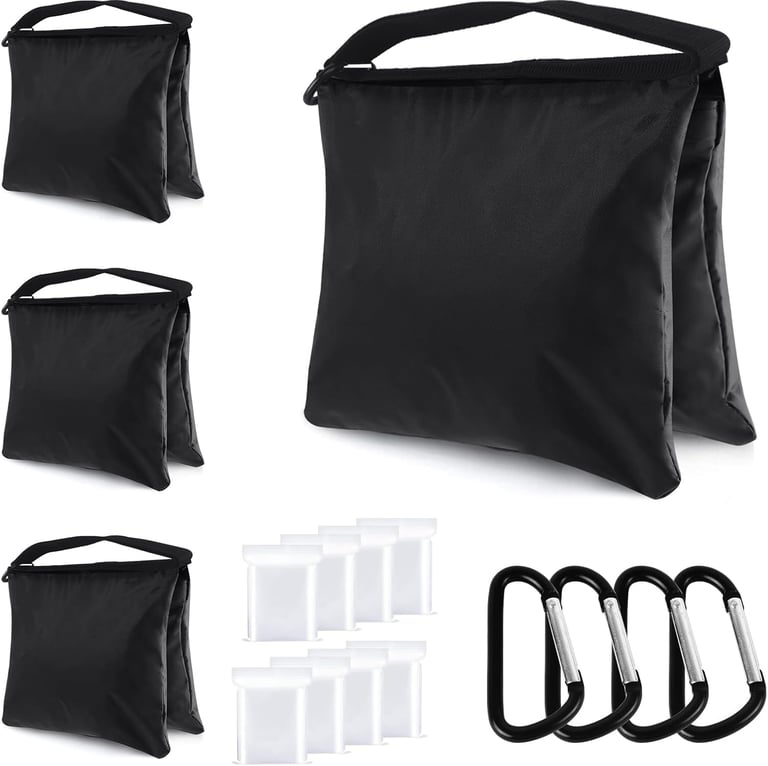
ABCCANOPY Photography Sandbag (4-Pack Heavy Duty Weight Bags)
1. What it is
A multi-purpose heavy-duty sandbag set originally designed for photography stands, tripods, and outdoor stabilization—but widely used for inflatables.
2. Why it works
Each bag can be filled with sand to create customizable weight, allowing users to match anchoring strength to wind conditions.
3. Size / footprint
Low-profile design that sits flat around anchor points without interfering with bounce house entrances or play zones.
4. Material & durability
Reinforced polyester construction built to withstand repeated loading and outdoor wear.
5. Best user / age range
Great for smaller to medium bounce houses or as supplemental anchoring for larger setups.
6. Why buyers like it
Highly versatile and widely reused across different outdoor equipment setups, making it a flexible investment.
7. Safety or usage notes
Best used in multi-point configurations—an adaptable, budget-friendly anchoring upgrade for improving inflatable safety without permanent installation.
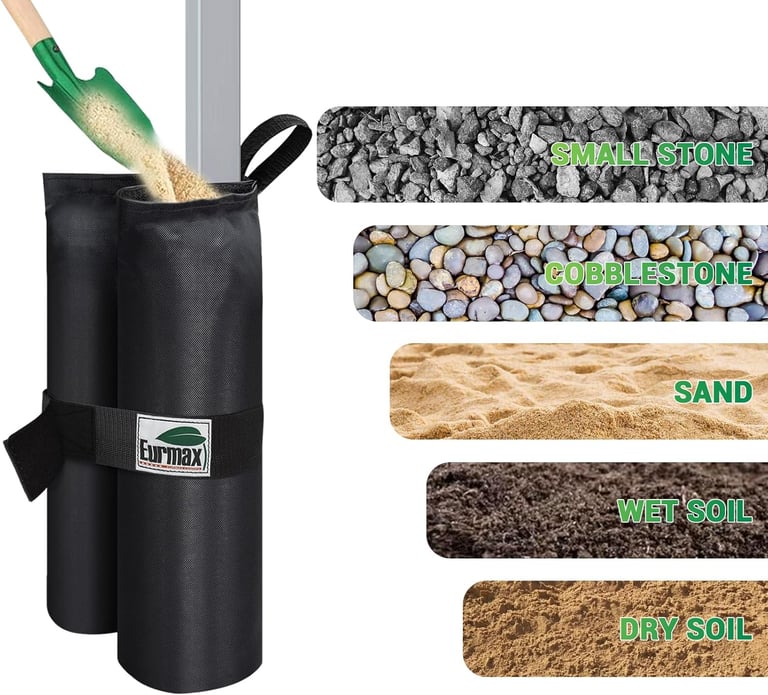
Eurmax USA 4-Pack 150 LBS Capacity Universal Canopy Weight Bags
1. What it is
A premium-grade universal weight bag system designed for pop-up tents, shelters, and inflatable anchoring systems.
2. Why it works
Each bag supports heavy fill capacity, allowing up to 150 lbs total per set depending on fill material and configuration.
3. Size / footprint
All-around wrap design fits securely around canopy or inflatable legs for stable, balanced anchoring.
4. Material & durability
Commercial-quality fabric engineered for high-wind environments and repeated outdoor commercial use.
5. Best user / age range
Best suited for large bounce houses, commercial inflatables, or high-traffic backyard setups.
6. Why buyers like it
Known for stability, durability, and strong strap retention under load—especially in unpredictable weather conditions.
7. Safety or usage notes
A strong choice for users in wind-prone areas—provides professional-grade anchoring confidence for larger inflatable setups where safety margins matter.
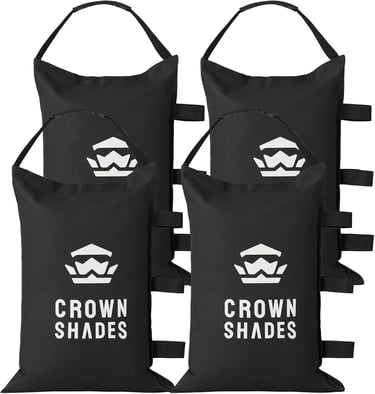
CROWN SHADES Sand Bags for Canopy Legs (120 LBS Capacity)
1. What it is
A set of unfilled canopy leg sandbags designed for stabilizing tents and inflatable bounce houses.
2. Why it works
The 120 lb capacity per set provides reliable downward force to reduce uplift during moderate wind conditions.
3. Size / footprint
Compact leg-wrap design ensures the bags stay tight against structure supports without obstructing surrounding space.
4. Material & durability
Durable outdoor fabric built to handle repeated filling and long-term outdoor exposure.
5. Best user / age range
Ideal for residential bounce house owners who need a balanced mix of affordability and stability.
6. Why buyers like it
Popular for its simplicity, solid build, and dependable performance in typical backyard conditions.
7. Safety or usage notes
A practical everyday anchoring option that improves bounce house stability without requiring complex installation or permanent ground changes.
BUYING CONSIDERATIONS
Choosing the right sandbags for a bounce house is less about picking the “heaviest option” and more about understanding how weight, surface type, and wind exposure interact in real backyard conditions.
One of the biggest gaps in competitor guides is that they list products without explaining why certain weight ranges actually matter in different environments. For example, a 120 lb setup behaves very differently on concrete versus grass due to friction loss and lack of ground resistance.
Before buying, focus on these core factors:
1. Total Anchoring Weight (System vs Single Bag)
Most bounce houses require multiple anchor points. A single heavy bag will not stabilize wind lift across a full inflatable structure. Instead, think in terms of a distributed system.
This is explained in detail in "Bounce House Anchoring Guide (2026): Stakes, Sandbags & Stability Physics", where anchoring force distribution is broken down across full perimeter setups.
2. Wind Exposure Level
Sheltered yards: lighter systems (100–120 lb total per corner set)
Open yards: mid-range systems (120–150 lb per corner)
High wind exposure: reinforced or commercial-grade systems (150+ lb per corner system)
Most competitors fail to clearly separate “light breeze stability” from “true gust resistance,” which leads to under-anchored setups.
3. Fill Type (Sand vs Water vs Hybrid)
Sand: highest density and best stability
Water: easiest portability but lower resistance in gusts
Hybrid systems: flexible but inconsistent under sustained wind
This becomes especially important when referencing real-world setup guidance from "Bounce House Weather Guide (2026): Wind, Rain & Temperature Rules", which outlines safe operating conditions that directly impact anchoring needs.
4. Anchor Compatibility
Not all sandbags attach the same way. Some wrap around legs, while others rely on hook-and-loop systems or strap compression.
Poor compatibility is one of the most overlooked causes of failure during wind shifts.
5. Durability & Reusability
Since bounce house owners typically reuse gear across seasons, stitching strength and UV resistance matter more than most buyers initially realize.
YARD SIZE / FIT CONSIDERATIONS
Your yard layout directly affects how sandbags perform, especially when airflow is unrestricted.
A key mistake many users make is assuming anchoring is purely a “weight problem.” In reality, yard geometry and surface type significantly influence how wind interacts with the inflatable structure.
For layout planning, the "Bounce House Size Calculator (2026): Yard Fit & Space Requirements" guide helps determine whether your inflatable setup is properly scaled for safe anchoring clearance.
1. Small Yards (tight perimeter spaces)
More wind deflection from fences and structures
Reduced wind tunnel effect
Sandbags perform more efficiently due to natural shielding
Best approach: lighter-to-mid sandbag systems evenly distributed.
2. Medium Yards (standard suburban layouts)
Most common setup environment
Moderate wind variability
Requires full perimeter anchoring consistency
Best approach: balanced 120–150 lb distributed systems.
3. Large/Open Yards
Highest wind exposure risk
No natural barriers
Wind uplift increases significantly across tall inflatables
Best approach: heavier commercial-grade sandbag systems with redundant anchor points.
4. Surface Type Impact
Grass: friction helps stabilize sandbags slightly
Concrete: full reliance on sandbag weight (no ground resistance)
Decking: vibration can amplify movement if under-anchored
Surface planning is often overlooked in competitor content but is critical for safe installation.
For deeper installation alignment, see "How to Set Up a Bounce House Safely (2026 Step-By-Step Guide)", which connects surface prep directly to anchoring performance outcomes.
SETUP
Proper setup is where most anchoring failures begin—not because of weak sandbags, but because of uneven installation.
A bounce house should always be anchored in a fully inflated state, with sandbags applied only after the structure has taken its full shape. This ensures each anchor point is under equal tension.
Step-by-step setup flow
Inflate bounce house completely and allow it to stabilize
Position sandbags evenly at all anchor points
Secure straps or wraps tightly (no slack loops)
Re-check tension after 10–15 minutes of inflation
Reassess during use if wind conditions change
The biggest mistake users make is placing sandbags before full inflation, which leads to uneven load distribution.
For a complete safety-first setup workflow, reference "How to Set Up a Bounce House Safely (2026 Step-By-Step Guide)" which breaks down inflation timing, anchoring sequence, and safety verification steps.
MAINTENANCE
Sandbags are reusable safety equipment, but only if maintained properly.
Key maintenance practices:
Inspect seams and stitching before each use
Check straps for UV wear or fraying
Ensure fill material is dry (especially sand)
Avoid leaving filled bags exposed to rain long-term
Shake out debris after each setup
Water-fill bags (like the ILLUMINEW system) should be fully drained after use to prevent mold buildup or internal material stress.
STORAGE
Proper storage extends the lifespan of sandbag systems significantly.
Best practices:
Store fully dry before folding
Keep in a sealed container or storage bin
Avoid prolonged sun exposure (UV degradation risk)
Do not store with wet sand inside
Fold loosely to avoid fabric stress points
Most users underestimate storage impact, but poor storage is one of the top reasons anchoring gear fails prematurely.
For broader seasonal protection strategies, see "Bounce House Storage Guide (2026): Folding, Drying & Long-Term Care" which includes inflatable + accessory storage systems.
KEY TAKEAWAYS
Sandbags are essential for no-stake bounce house setups
Weight distribution matters more than total weight
Water-fill systems offer portability but lower wind resistance
Sand-fill systems provide the strongest anchoring performance
Multiple anchor points are required for all full-size inflatables
Yard type and wind exposure dramatically affect anchoring needs
Proper setup and storage directly impact safety and durability
MINI CONCLUSION
Sandbag anchoring is no longer a backup option—it’s a primary safety system for modern bounce house setups where stakes aren’t possible. Choosing the right combination of weight, material, and distribution ensures safer play conditions and more reliable performance in changing backyard environments.
RELATED ARTICLES
Bounce House Anchoring Guide (2026): Stakes, Sandbags & Stability Physics
Bounce House Weather Guide (2026): Wind, Rain & Temperature Rules
Best Bounce House Accessories (2026): Stakes, Blowers, Tarps & Sandbags
How to Set Up a Bounce House Safely (2026 Step-By-Step Guide)
Bounce House Yard Prep Guide (2026): Slope, Clearance & Surface Types