
Home > Setup, Safety, and Repairs > Outdoor Power Accessories > Outdoor Holiday Power Troubleshooting Guide
Outdoor Holiday Power Troubleshooting Guide: Why Decorations Fail and How to Fix Them
Learn how to diagnose outdoor holiday decoration power problems including breaker trips, GFCI failures, voltage drop, weak inflatables, overloaded circuits, and weather-related electrical issues.
Frank “Frosty” Adminei
7/7/20267 min read
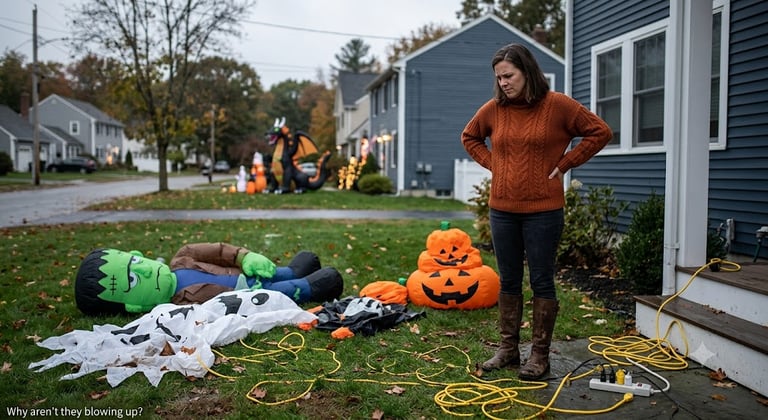

Table of Contents
Introduction
Nothing is more frustrating than spending hours setting up a holiday display only to discover that an inflatable won't inflate, lights won't turn on, or a breaker keeps tripping every night.
The good news is that most outdoor holiday power problems follow predictable patterns. In many cases, the issue is not the decoration itself. The real culprit may be an overloaded circuit, moisture inside a connection, a failing extension cord, voltage drop, or a protective device doing exactly what it was designed to do.
This guide will help you diagnose the most common outdoor holiday power problems, understand why they occur, and determine the safest solution.
Who This Guide Is For
This guide is designed for:
First-time inflatable owners
Experienced holiday decorators
Homeowners managing large outdoor displays
Anyone dealing with breaker trips, weak blowers, or power interruptions
Users looking to improve electrical safety around outdoor decorations
Why This Topic Matters
Many holiday display failures are preventable.
A simple extension cord mistake or poorly protected connection can lead to:
Repeated breaker trips
Damaged equipment
Poor inflatable performance
Electrical safety hazards
Increased energy costs
Understanding the fundamentals of outdoor power management can save money, reduce frustration, and help your display run reliably throughout the season.
One of the first troubleshooting steps is confirming that your extension cord is appropriate for the electrical load, which we cover in Best Outdoor Extension Cords for Halloween.
Start Here: The 5-Minute Power Troubleshooting Process
Before replacing parts or purchasing new equipment, follow this simple process:
Step 1: Verify the Outlet Has Power
Plug in a known working device.
Step 2: Check the Breaker Panel
Look for partially tripped breakers.
Step 3: Check the GFCI
Many outdoor outlets are GFCI protected and may require resetting.
Step 4: Inspect Extension Cord Connections
Look for loose, wet, or damaged connections.
Step 5: Test the Decoration Directly
Temporarily eliminate timers, smart plugs, and extra extension cords.
This process alone solves a surprising percentage of outdoor display failures.
For additional real-world examples, see Real-World Outdoor Inflatable Power Problems and How to Fix Them.
Why Outdoor Decorations Lose Power Completely
Total power loss is usually easier to diagnose than intermittent issues.
Common causes include:
Tripped Breaker
A breaker may trip because of:
Excess load
Short circuits
Faulty equipment
Failed GFCI
Outdoor GFCIs often trip after:
Heavy rain
Snow melt
Moisture buildup
Failed Timer
Mechanical timers eventually wear out.
Smart Plug Problems
Firmware issues, Wi-Fi disruptions, or accidental schedules can disable displays.
Loose Connections
Outdoor plugs expand and contract with temperature changes, occasionally loosening connections.
If breaker trips are recurring, see Why Your Outdoor Inflatable Keeps Tripping the Breaker (And How to Fix It).
Why Breakers Trip and How to Find the Real Cause
Many people simply reset the breaker and move on.
That approach rarely solves the underlying problem.
Overloaded Circuits
A standard household circuit is commonly rated for:
15 amps
20 amps
Large displays can exceed safe limits surprisingly quickly.
Shared Circuits
Outdoor outlets often share circuits with:
Garages
Basements
Interior rooms
You may overload a circuit without realizing it.
Short Circuits
Damaged cords and water intrusion can create direct faults.
Startup Load
Some equipment briefly draws higher current during startup.
This temporary surge can trigger weak breakers.
For larger displays, read How to Power Multiple Outdoor Inflatables Safely Without Overloading Your Circuit.
Understanding GFCI Trips: Protection or Problem?
A GFCI (Ground Fault Circuit Interrupter) protects against electric shock.
When it trips, it is usually responding to a safety concern.
Common causes include:
Wet plugs
Damaged cords
Moisture inside timers
Water intrusion into decorations
Faulty equipment
Many users assume the GFCI itself is defective.
In reality, it is often identifying an unsafe condition.
Product Solution
DEWENWILS 3 FT Automatic GFCI Extension Cord
Why We Selected It
Adds portable GFCI protection where existing protection is questionable.
Best For
Outdoor displays using older outlets.
ELEGRP Inline GFCI Plug
Why We Selected It
Provides additional monitoring and protection for outdoor equipment.
Best For
Large seasonal displays with multiple electrical components.
For more information, see The Ultimate Guide to Powering Outdoor Inflatables Safely: Extension Cords, GFCI Protection, Weatherproofing and Load Planning.
Extension Cord Mistakes That Cause Decoration Failures
Extension cords are one of the most common causes of holiday display problems.
Common Mistake #1
Using cords that are too long.
Common Mistake #2
Using undersized wire gauges.
Common Mistake #3
Connecting multiple extension cords together.
Common Mistake #4
Leaving coiled cords under load.
Common Mistake #5
Using indoor-rated cords outdoors.
Product Solutions
POWGRN 12/3 Outdoor Extension Cord
Best For
Long-distance runs and larger displays.
HUANCHAIN 12/3 Outdoor Extension Cord
Best For
Heavy-duty seasonal setups.
HUANCHAIN 16/3 Outdoor Extension Cord
Best For
Smaller inflatables and shorter runs.
Additional guidance is available in Extension Cord Mistakes That Cause Outdoor Inflatable Failures (Gauge, Length, and Voltage Drop Explained).
Voltage Drop Explained in Plain English
Voltage drop is one of the least understood causes of outdoor display problems.
Imagine trying to drink through a very long straw.
The farther electricity must travel through a cord, the harder it becomes to deliver full voltage to equipment.
Symptoms include:
Weak blowers
Dim lights
Motor overheating
Reduced performance
Longer runs generally require heavier gauge extension cords.
This is one of the biggest hidden causes of inflatable performance problems.
Why Your Inflatable Blower Runs But Doesn't Inflate Properly
A running blower does not automatically mean proper airflow.
Possible causes include:
Air Leaks
Check:
Seams
Zippers
Velcro closures
Restricted Air Intake
Leaves and debris can block intake openings.
Low Voltage
Long extension cords may reduce blower performance.
Aging Motors
Older blowers can lose efficiency over time.
If the blower sounds different than normal, investigate before permanent damage occurs.
Weather-Related Failures: Rain, Snow, Ice and Condensation
Outdoor displays face environmental challenges every season.
Rain
Water can enter poorly protected plug connections.
Snow
Melting snow frequently introduces moisture into electrical connections.
Ice
Freeze-thaw cycles can stress plugs and extension cords.
Condensation
Moisture can accumulate even when no rain occurs.
Product Solutions
Cismorvex Outdoor Cord Cover
Excellent for protecting individual plug connections.
Flemoon Electrical Box
Useful when protecting larger power strips and timer assemblies.
Hrensaw Electrical Box
Compact solution for smaller display setups.
Related reading:
Diagnosing Power Consumption Problems
When troubleshooting electrical issues, measuring actual power usage can reveal hidden problems.
Key measurements include:
Watts
Volts
Amps
Kilowatt-hours
Product Solutions
Mecheer Upgraded Watt Meter
Why We Selected It
Provides detailed consumption information and overload monitoring.
P3 P4400 Kill A Watt
Why We Selected It
Industry-standard energy monitoring device.
These tools can help identify:
Unexpected energy spikes
Failing equipment
Excessive loads
For deeper analysis, see The Complete Guide to Energy, Power, and Smart Tech for Holiday Inflatables.
Why Decorations Work During the Day but Fail at Night
This issue appears frequently in decorating forums.
Possible causes include:
Timer Programming Errors
Incorrect schedules remain one of the most common causes.
Smart Plug Scheduling
Accidental automation settings can disable displays.
Moisture Accumulation
Evening condensation may trigger GFCI trips.
Temperature Effects
Cold temperatures can expose weaknesses in aging electrical components.
Product Solutions
These devices can improve reliability when configured correctly.
How to Safely Power Multiple Decorations on One Circuit
As displays grow, power planning becomes increasingly important.
Understand Circuit Capacity
Know whether you have:
15-amp circuit
20-amp circuit
Spread Loads
Avoid placing every decoration on one outlet.
Plan for Expansion
Future additions should be considered when designing the initial power layout.
Product Solutions
DEWENWILS Outdoor Power Stake
SURAIELEC Outdoor Power Stake
Tiffcofio Outdoor Power Stake
These products help distribute power more effectively while keeping outlets elevated above wet ground.
Preventing Future Outdoor Power Problems
A few minutes of preseason inspection can prevent major issues.
Checklist:
✓ Inspect extension cords
✓ Test GFCI outlets
✓ Examine blower cords
✓ Inspect timers
✓ Check weatherproof boxes
✓ Remove damaged equipment
✓ Verify all outdoor cords are rated for outdoor use
Preventive maintenance is far easier than troubleshooting failures in freezing weather.
Key Takeaways
Most outdoor display failures originate from power delivery issues rather than decoration defects.
Breakers and GFCIs usually indicate an underlying problem rather than causing one.
Voltage drop is a major but often overlooked source of inflatable performance problems.
Weatherproofing connections is critical for long-term reliability.
Measuring actual power consumption can simplify troubleshooting.
Preventive maintenance reduces seasonal failures.
Mini Conclusion
Outdoor holiday decorations operate in demanding conditions, but most power problems can be diagnosed systematically. By understanding circuits, extension cords, GFCI protection, weather exposure, and power consumption, you can keep your display running safely and reliably throughout the season while avoiding unnecessary equipment replacement.
FAQ
Why does my inflatable keep tripping the breaker?
The most common causes are overloaded circuits, damaged cords, moisture intrusion, or a failing blower motor.
Why does my GFCI trip when it rains?
Moisture entering plugs, cords, or equipment can create ground faults that trigger the GFCI.
Can extension cords cause inflatable problems?
Yes. Long or undersized cords can cause voltage drop, overheating, and reduced blower performance.
Why is my inflatable blower running but not inflating?
Possible causes include air leaks, blocked intakes, voltage drop, or a failing motor.
How many inflatables can I run on one circuit?
The answer depends on the wattage of each inflatable and the circuit capacity.
Why is my outdoor extension cord warm?
A warm cord often indicates excessive current draw or an undersized extension cord.
Do outdoor smart plugs work in winter?
Most weather-rated smart plugs work well in winter but should remain within their temperature specifications.
How do I test an outdoor outlet?
Use a known working device or an outlet tester to verify power and proper wiring.
What size extension cord should I use for holiday decorations?
Use the shortest cord possible and choose a gauge appropriate for the load and distance.
How can I reduce holiday decoration power problems?
Inspect equipment before each season, protect connections from moisture, avoid overloads, and use properly rated outdoor electrical components.
Related Articles
Why Your Outdoor Inflatable Keeps Tripping the Breaker (And How to Fix It)
Learn how to identify overloads, faulty equipment, and hidden electrical issues before they become recurring problems.
Discover how improper cord selection can reduce performance and create safety concerns.
How to Power Multiple Outdoor Inflatables Safely Without Overloading Your Circuit
Learn practical load-planning strategies for expanding your display safely.
Best Weatherproof Cord Connection Boxes for Outdoor Decorations
See which weatherproof solutions provide the best protection against rain, snow, and moisture.
Real-World Outdoor Inflatable Power Problems and How to Fix Them
Explore common failure scenarios and the solutions decorators use to keep displays running.