
Home > Setup, Safety, and Repairs > Safety Guides > When Should You Turn Off Outdoor Holiday Decorations? Rain, Snow, Wind, and Ice Guidelines
When Should You Turn Off Outdoor Holiday Decorations? Rain, Snow, Wind, and Ice Guidelines
Learn exactly when to turn off outdoor holiday decorations during rain, snow, wind, and ice with practical safety advice and real-world weather examples.
By Frank "Frosty" Adminei
7/7/202618 min read
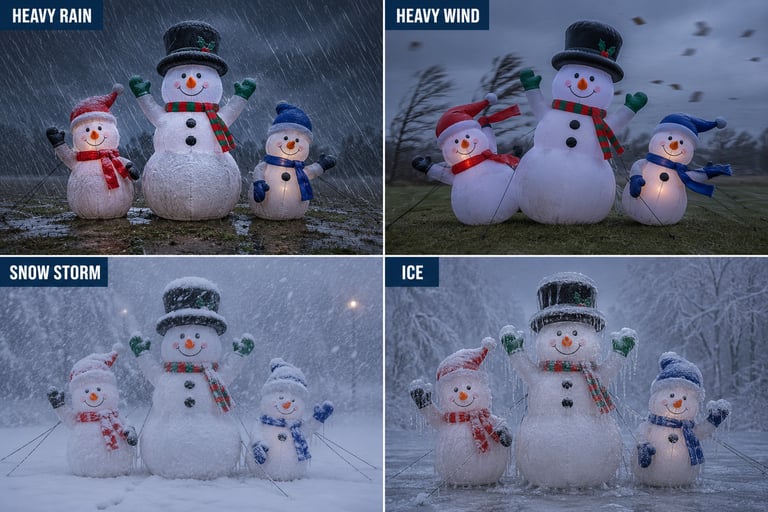
Table of Contents
Introduction
One of the most common questions holiday decorators ask is surprisingly difficult to answer with a simple yes or no:
"Should I turn my decorations off because of today's weather?"
The answer depends on far more than whether it's raining or snowing. A light drizzle on a calm afternoon is very different from freezing rain coating power cords with ice. Likewise, a gentle breeze that barely moves nearby leaves presents far less risk than gusts that cause your inflatable snowman to lean sideways or your Halloween dragon to whip back and forth.
Many people assume outdoor decorations are either completely weatherproof or extremely fragile. In reality, the truth falls somewhere in between. Most quality outdoor inflatables, lights, timers, and extension cords are designed to handle normal outdoor conditions, but every display has limits. Knowing where those limits are can help you avoid damaged decorations, tripped breakers, soaked electrical connections, worn-out blower motors, and unnecessary repairs.
Instead of relying on complicated weather instruments or guessing based on the forecast, this guide focuses on practical observations you can make simply by looking outside. You'll learn how experienced decorators decide whether it's safe to leave a display running, when it's smarter to shut everything off temporarily, and when conditions justify unplugging everything until the weather improves.
You'll also discover a handful of accessories that can make your display safer in challenging conditions, helping you spend more time enjoying your decorations and less time troubleshooting them after every storm.
Who This Guide Is For
This guide is designed for anyone who displays outdoor holiday decorations, including:
Homeowners with one or two inflatable decorations
Families building larger Christmas or Halloween displays
Decorators using multiple extension cords and timers
Anyone decorating for Easter, Valentine's Day, patriotic holidays, birthdays, graduations, or other celebrations
First-time inflatable owners wondering how much bad weather is "too much"
Experienced decorators looking for realistic best practices instead of overly cautious or overly simplistic advice
Whether your display consists of one inflatable penguin or twenty animated decorations spread across the yard, the decision-making process remains largely the same: understand the weather, recognize the warning signs, and protect your equipment before small problems become expensive ones.
Why This Topic Matters
Outdoor decorations continue to improve every year. Modern inflatables use more efficient blower motors, LED lighting consumes less electricity, and many outdoor extension cords remain flexible even during extremely cold temperatures. Weatherproof connection boxes, GFCI protection, smart plugs, and programmable timers have also made decorating both easier and safer.
Despite those improvements, weather remains the single biggest threat to most outdoor displays.
It's rarely the rain itself that causes problems. More often, issues develop because water finds its way into an exposed plug connection, snow blocks an inflatable's blower intake, wind places excessive strain on guy lines, or ice adds weight that decorations simply weren't designed to support.
Making the right decision at the right time can:
Extend the life of expensive inflatables
Reduce unnecessary blower motor wear
Prevent nuisance GFCI trips
Minimize extension cord damage
Lower the risk of electrical problems
Reduce emergency repairs during the busiest decorating season
If you're still building your outdoor electrical setup, our guide to The Ultimate Guide to Powering Outdoor Inflatables Safely: Extension Cords, GFCI Protection, Weatherproofing and Load Planning explains how proper planning reduces many weather-related problems before they ever occur.
Not All Bad Weather Requires Shutting Everything Down
One of the biggest misconceptions in holiday decorating is that any rain, snow, or wind means your display should immediately be turned off. Fortunately, that's usually not the case.
Most outdoor holiday decorations sold today are designed to withstand normal seasonal weather. Manufacturers know these products will spend weeks outdoors during late fall and winter, so inflatables, LED light strings, outdoor timers, and heavy-duty extension cords are generally built with moisture resistance and cold-weather operation in mind.
However, "outdoor rated" does not mean "invincible."
Think of your display as a complete electrical system rather than a collection of individual decorations. A single inflatable may be perfectly capable of operating during a light rain, but if its extension cord connection is lying in a puddle or partially separated because the cord has been pulled tight, the overall setup is no longer operating under ideal conditions.
The same principle applies to wind. A gentle breeze that causes your inflatable's fabric to flutter slightly is normal. The real concern begins when wind starts pulling on stakes, stretching guy lines, or causing decorations to rock repeatedly. At that point, you're no longer protecting just the inflatable—you are protecting blower motors, stitching, anchor points, extension cords, and electrical connections from unnecessary stress.
Rather than reacting to every forecast, experienced decorators evaluate a handful of practical factors:
Is water collecting around electrical connections?
Are decorations remaining upright and stable?
Are cords staying securely connected?
Is snow beginning to block blower intakes?
Are guy lines remaining tight without excessive strain?
Is ice beginning to accumulate on fabric or wiring?
Will conditions likely worsen while you're asleep or away from home?
These simple observations often provide better guidance than a weather app alone. In the next sections, we'll examine each type of weather individually and explain exactly when it's reasonable to keep your display operating—and when shutting it down is the smarter choice.
Rain: When Can Decorations Stay On?
Rain causes more anxiety than almost any other weather condition, but it's also one of the most misunderstood. Many homeowners unplug everything the moment they see raindrops, while others leave displays running through severe downpours without giving it a second thought.
The safest approach falls somewhere in between.
Modern outdoor inflatables, LED decorations, and outdoor-rated extension cords are built to operate in normal wet weather. The greater risk usually isn't the decoration itself—it's what happens at the electrical connections.
Light Rain
A passing shower or light drizzle typically isn't a reason to shut down a properly installed display.
If your setup has:
Outdoor-rated extension cords
Tight plug connections
Elevated electrical connections
GFCI protection
No standing water
…it can usually continue operating safely.
Take a quick walk around the display and verify:
No cords have come unplugged slightly.
No plugs are lying in puddles.
Water isn't collecting around power strips or timers.
Blower air intakes remain unobstructed.
Many experienced decorators continue operating displays through ordinary rain with no problems because their electrical setup was designed correctly from the beginning.
Heavy Rain
As rainfall becomes heavier, conditions change.
Large volumes of water increase the chances that:
plugs become partially submerged
water pools around timers
extension cord connections shift
saturated ground allows cords to sink into mud
inflatable fabric becomes significantly heavier
Heavy rain is often the point where temporarily shutting off decorations becomes the smart choice—even if everything appears to be functioning normally.
The goal isn't to prevent immediate failure.
It's to prevent the small problems that often appear hours later.
After wet or icy conditions, do not simply deflate the decoration and forget about it. The Complete Cleaning, Maintenance and Storage Guide for Holiday Inflatables explains how to dry, inspect and care for an inflatable before it is stored or returned to service.
Standing Water Is the Real Warning Sign
Standing water deserves far more attention than rainfall itself.
For example:
Good setup:
✓ Plug connection sits inside a weatherproof electrical box mounted several inches above the ground.
Poor setup:
✗ Cord connection lies directly in mulch where water collects after every storm.
Those two displays experience completely different levels of risk even if they receive exactly the same amount of rain.
If electrical connections are surrounded by water, shut the display down until conditions improve.
Check Your Plug Connections First
Many weather-related electrical problems begin with a simple issue:
The plugs have pulled apart slightly.
Wind…
People walking nearby…
Children playing…
Pets…
Lawn equipment…
Even the weight of long extension cords can slowly separate two connected plugs.
A connection that's only partially engaged allows moisture to enter much more easily than one that's fully seated and protected.
This is one reason weatherproof connection covers are such valuable accessories.
Products like the Farm Innovators CC-1 Cord Connect, Cismorvex Extension Cord Safety Cover, and compact Iwillink Waterproof Covers help keep plug connections together while reducing direct exposure to rain. For displays using timers, adapters, or multiple connected plugs, larger weatherproof boxes such as the OUTDSPLY Medium Outdoor Electrical Box, Hrensaw Small Weatherproof Box, or Flemoon Large Outdoor Electrical Box provide considerably more protection.
If you want a deeper look at why even "weatherproof" electrical boxes sometimes fail, be sure to read Why Weatherproof Outdoor Electrical Boxes Still Fail in Rain, Snow, and Ice (And How to Fix Them for Good).
When Rain Means You Should Shut Everything Down
Turn off your decorations if you notice:
Water entering electrical boxes
Standing water around plugs
Partially separated connections
Blower motors sounding different
Decorations beginning to lean because saturated ground loosened stakes
Repeated GFCI trips
If GFCI protection repeatedly interrupts power during wet weather, don't simply reset it and continue decorating. First determine why it tripped. Our article GFCI Protection for Outdoor Holiday Decorations: What It Is, Why It Trips, and When You Need It explains the most common causes and how to correct them safely.
Snow and Ice: Know the Difference
Many people think of snow and ice as the same hazard.
They're not.
Light snow is often little more than a cosmetic issue.
Ice can become one of the most damaging conditions your decorations experience all season.
Light Dry Snow
Dry, powdery snow usually creates very few problems.
Many inflatables continue operating normally as long as:
blower intakes remain open
snow isn't accumulating inside folds
electrical connections stay protected
decorations remain upright
Brushing off accumulated snow every few hours is often all that's necessary.
Heavy Wet Snow
Wet snow behaves differently.
It sticks.
It becomes heavy.
It places continuous weight on:
inflatable fabric
stitching
guy lines
stakes
lighted wire frames
As weight increases, blower motors must work harder to keep inflatables inflated.
If large amounts of wet snow begin collecting, temporarily shutting down the display and removing the snow is usually the safest option.
Ice Changes Everything
Freezing rain deserves special attention.
Unlike snow, ice doesn't simply sit on top of decorations.
It bonds to them.
Ice accumulation can:
restrict blower airflow
freeze moving parts
add surprising amounts of weight
make extension cords stiff
pull guy lines tighter
create slipping hazards while servicing decorations
When freezing rain or significant ice accumulation is expected, most experienced decorators choose to shut down displays before conditions worsen.
It's much easier to restart a display later than repair torn fabric or broken support points.
Don't Forget the Blower Intake
Inflatables depend entirely on unrestricted airflow.
Snow drifting over blower intakes can slowly reduce airflow until decorations begin sagging.
Ice around intake openings can make the problem worse.
During snowstorms, inspect blower areas periodically.
Clearing five minutes of snow may prevent hours of drying and troubleshooting later.
Winter Accessories That Make Life Easier
Cold-weather decorating becomes much simpler when your equipment is designed for freezing temperatures.
Cold-weather extension cords remain flexible instead of becoming rigid and difficult to reposition. Large weatherproof electrical boxes provide additional room for timers, oversized plugs, and multiple connections while helping keep blowing snow away from electrical components.
After storms, heavy-duty extension cord organizers make drying, inspecting, and storing cords much easier before the next weather event.
Wind: Use What You See, Not a Wind Meter
One of the biggest mistakes decorating guides make is telling homeowners to monitor wind speeds using weather stations or handheld anemometers.
Most people don't own one.
Fortunately, you don't need one.
Your yard already tells you when conditions are becoming risky.
If the Leaves Are Barely Moving...
Generally, your display is probably fine.
Continue monitoring, but no action is usually necessary.
If Small Branches Begin Swaying...
Now it's time to pay attention.
Walk your display.
Look for:
loose guy lines
shifting stakes
twisting inflatables
cords beginning to tighten
Everything may still be perfectly safe—but this is often where small problems first appear.
Knowing when to shut a display down is only one part of weather safety. The Complete Guide to Installing and Securing Holiday Inflatables: Anchors, Wind Protection, Tie-Downs, Weights and Safe Setup explains how to build a more stable installation before wind and changing conditions become a problem.
If Your Inflatable Starts Leaning...
The inflatable is telling you something.
Even if it hasn't fallen over, repeated leaning places additional stress on:
anchor points
stitching
blower housing
internal seams
If leaning continues despite properly installed stakes and guy lines, temporarily shutting the display down is usually the smarter decision.
Watch the Guy Lines
Guy lines should remain firm.
They shouldn't snap tight repeatedly like guitar strings every few seconds.
That repeated loading eventually weakens:
knots
plastic clips
ground stakes
attachment points sewn into the inflatable
Wind damage often develops gradually—not during one huge gust, but after thousands of smaller movements over several hours.
When Stakes Begin Moving
One of the clearest shutdown signals is movement at ground level.
If stakes begin lifting…
If anchors rotate…
If ropes loosen repeatedly…
If decorations rock back and forth…
Conditions are approaching the point where shutting the display down may prevent much more expensive damage.
This is especially true for tall character inflatables with large surface areas that effectively become sails in stronger winds.
If you're looking for additional ways to secure decorations before windy weather arrives, see Defending Your Holiday Inflatables from Snow, Wind, and Pets, where we cover anchoring strategies, placement tips, and seasonal best practices.
Thunderstorms and Lightning
When thunderstorms enter the forecast, the decision becomes much easier.
Unlike ordinary rain or light snow, thunderstorms introduce hazards that no weatherproof extension cord, cord box, surge protector, or outdoor timer can completely eliminate.
The safest approach is simple:
Turn the display off and unplug it before the storm arrives whenever practical.
If lightning is already nearby, don't go outside just to unplug decorations. Wait until conditions are safe before inspecting or disconnecting your display.
Why Lightning Is Different
Many people assume that a surge protector will protect outdoor decorations from a nearby lightning strike.
Unfortunately, that's not how surge protection works.
A quality surge protector can help absorb many everyday voltage spikes caused by utility switching or equipment cycling, but it is not designed to withstand the massive energy associated with a direct or nearby lightning strike.
Once thunderstorms become likely, reducing exposure is far more effective than relying on protective equipment.
What About GFCI Protection?
A GFCI is designed to protect people from electrical shock by disconnecting power when it detects an imbalance in electrical current.
It is not lightning protection.
Think of it this way:
A GFCI protects against ground faults.
A surge protector helps reduce damage from many everyday electrical surges.
Neither replaces the safety of disconnecting equipment during severe thunderstorms.
If your display includes expensive inflatables, animated decorations, or multiple controllers, unplugging before severe storms is inexpensive insurance.
Before Restarting After the Storm
After severe weather passes, avoid immediately turning everything back on.
Instead, perform a quick inspection:
Check for fallen branches.
Look for damaged extension cords.
Verify plug connections remain fully seated.
Make sure no electrical boxes filled with water.
Confirm inflatables are still securely anchored.
Inspect guy lines for stretching or fraying.
Five minutes of inspection can prevent hours of troubleshooting later.
Should You Leave Decorations Running Overnight?
Ask ten experienced decorators this question and you'll probably receive ten slightly different answers.
That's because there isn't one universally correct approach.
Instead, the decision depends on your display, the weather forecast, and your comfort level.
Reasons Many People Turn Decorations Off Overnight
Turning decorations off overnight can:
Reduce blower motor run time
Lower electricity usage
Minimize wear on moving decorations
Prevent overnight weather surprises from damaging displays
Reduce the chance of discovering a problem only after several unattended hours
For homeowners who simply enjoy their display during the evening, automatic shutdown after bedtime often makes perfect sense.
When Overnight Operation May Be Reasonable
Many decorators leave displays running overnight when:
Weather is stable.
No storms are forecast.
Electrical connections are properly protected.
GFCI protection is installed.
Decorations are securely anchored.
The display has operated reliably throughout the season.
This is especially common for neighborhood displays that attract evening visitors or are visible from busy roads.
Timers Make Better Decisions Than We Do
One of the easiest upgrades you can make is adding an outdoor timer.
Instead of remembering to unplug decorations every night, a timer can automatically:
Turn displays on at dusk.
Shut everything off at a preset time.
Repeat the schedule every day.
If your schedule changes frequently, smart plugs provide even more flexibility by allowing you to adjust operating hours from your phone.
For larger displays, this also prevents accidentally leaving everything running until sunrise after a busy evening.
Products such as the DEWENWILS Outdoor Timer, BN-LINK Mechanical Outdoor Timer, and Tiffcofio Dusk-to-Dawn Timer are excellent choices for homeowners who prefer simple automatic operation.
If you'd rather control your display remotely, smart plugs like the Kasa Outdoor Smart Plug or TP-Link Tapo Matter Outdoor Smart Plug provide scheduling, remote control, and automation without walking outside every evening.
For more ideas, see Best Smart Plugs for Holiday Inflatables (2026 Buyer's Guide) and Smart Plug Automation Strategies for Outdoor Holiday Decorations and Inflatables.
Should You Turn Everything Off When Leaving Home?
The answer depends largely on how long you'll be gone.
A Quick Trip to the Store
If weather conditions are stable and your display has been operating normally, leaving decorations running during a short errand is generally a personal choice.
Gone for the Entire Workday
This is where timers and smart plugs become much more valuable.
Weather forecasts can change dramatically over eight or ten hours.
An unexpected thunderstorm or wind event may occur while no one is home to respond.
Scheduling your display to shut down automatically during the day—or allowing yourself to turn it off remotely—adds an extra layer of protection with very little effort.
Weekend Trips and Vacations
If you'll be away overnight or for multiple days, shutting down the display is generally the safest decision.
For longer absences:
Turn decorations off.
Unplug electrical equipment.
Inspect extension cords.
Store portable decorations if severe weather is forecast.
Disable unnecessary timers if the display won't be operating.
The goal isn't simply saving electricity.
It's preventing minor problems from becoming major ones while no one is available to notice them.
Signs It's Time to Shut Everything Down Immediately
Weather forecasts are helpful.
Your decorations are even better.
They'll often warn you that something is wrong long before complete failure occurs.
If you notice any of the following, stop using the display until you've identified the cause.
Electrical Warning Signs
Extension cord feels unusually warm
Plug connection appears loose
Repeated GFCI trips
Breaker trips more than once
Flickering lights
Burning odor
Melted insulation
Water entering electrical connections
These are never normal.
Don't simply reset breakers or GFCIs and continue decorating.
Determine why the protection device activated.
If you've experienced repeated breaker trips, our guide Why Your Outdoor Inflatable Keeps Tripping the Breaker (And How to Fix It) walks through the most common causes and solutions.
Decoration Warning Signs
Electrical problems aren't the only reason to shut everything down.
Watch for:
Inflatable repeatedly collapsing
Blower motor becoming unusually loud
Fabric twisting excessively
Stakes pulling loose
Guy lines becoming slack
Decorations leaning farther with every gust
Heavy snow accumulating faster than you can remove it
Ice forming around moving parts
None of these necessarily means your decoration has failed.
They simply indicate that continuing to operate under current conditions may increase the chance of damage.
A temporary shutdown often prevents a much more expensive repair later.
Best Accessories That Help Prevent Emergency Shutdowns
You can't control the weather, but you can build a display that's much better prepared for it.
One of the biggest differences between experienced decorators and beginners isn't the size of the display—it's the attention paid to the supporting equipment. The right accessories won't stop rain, snow, or wind, but they can greatly reduce the number of times you're forced to shut everything down unexpectedly.
Instead of thinking of these as "extra purchases," think of them as inexpensive insurance for decorations you've already invested in.
Protect Electrical Connections From Rain
Most weather-related electrical issues begin at the plug connection—not inside the inflatable.
A loose or exposed connection allows water to reach areas it shouldn't, increasing the chances of nuisance GFCI trips or intermittent power problems.
For displays with a single extension cord connection, compact weatherproof cord covers are often all that's needed.
For displays using timers, adapters, smart plugs, or multiple connected cords, a larger weatherproof electrical box provides much better protection while keeping connections elevated and organized.
Best applications:
Small displays: Farm Innovators CC-1, Cismorvex, or Iwillink cord covers
Medium displays: OUTDSPLY Medium Weatherproof Box
Larger setups: Flemoon or Hrensaw Large Weatherproof Boxes
These products are particularly helpful if your display remains outdoors for several weeks during changing winter weather.
Improve Safety With GFCI Protection
If your outdoor outlet isn't already protected by a GFCI, adding portable GFCI protection is one of the smartest electrical upgrades you can make.
Portable GFCI extension cords and outdoor GFCI power strips continuously monitor for ground faults and disconnect power if a potentially dangerous electrical imbalance is detected.
They don't prevent bad weather—but they do provide an important layer of protection if moisture reaches an electrical component.
Good choices include:
Choose Extension Cords Designed for Outdoor Conditions
Not all outdoor extension cords perform equally well.
If you decorate during late fall or winter, choose cords that remain flexible in freezing temperatures and are rated for outdoor use.
Depending on your display size, that may mean:
16/3 cords for lighter inflatable setups
14/3 cords for moderate loads
12/3 heavy-duty cords for longer runs or larger displays
Features worth looking for include:
Lighted power indicators
Bright, high-visibility jackets
Cold-weather flexibility
Heavy-duty molded plugs
Outdoor SJTW construction
If you're unsure which cord size is appropriate, see Best Outdoor Extension Cords for Holiday Inflatables (2026 Buyer's Guide) for a detailed comparison of gauge, length, voltage drop, and recommended applications.
Automate Safe Shutdowns
One of the easiest ways to protect your decorations is to remove human forgetfulness from the equation.
Instead of remembering to walk outside every evening, let a timer or smart plug do it automatically.
Benefits include:
Automatic nightly shutdown
Consistent schedules
Lower electricity usage
Reduced blower wear
Easy vacation operation
Remote shutdown if weather changes unexpectedly
Mechanical timers work well for homeowners who prefer simplicity.
Smart plugs add remote control, flexible scheduling, and automation routines without requiring major changes to your display.
Reduce Wind-Related Cord Movement
Strong winds don't only affect inflatables.
They also move extension cords.
Repeated movement can gradually loosen plug connections, create trip hazards, or allow cords to rub against concrete, brick, or sharp landscaping edges.
Simple accessories like:
help keep cords secured while reducing unnecessary movement throughout the decorating season.
Stay Organized During Storm Cleanup
After a major weather event, many decorators temporarily remove part of their display.
Heavy-duty extension cord organizers make this process much easier.
Instead of dealing with tangled, muddy extension cords, organizers allow cords to dry, inspect, and store neatly until conditions improve.
The VELCRO Easy Hang organizers and ZTSXLLIM storage straps are inexpensive additions that many decorators appreciate long after the holidays are over.
Key Takeaways
Outdoor-rated decorations are designed for normal weather, but every display has practical limits.
Light rain or dry snow often doesn't require shutting down a properly installed display.
Standing water, freezing rain, and heavy ice are much greater concerns than ordinary precipitation.
Watch your yard—not just the weather forecast. Leaning inflatables, moving stakes, and tightening guy lines are excellent indicators that conditions are becoming unsafe.
Thunderstorms are different from ordinary rain. If practical, turn off and unplug decorations before severe weather arrives.
Automatic timers and smart plugs make it much easier to protect displays overnight or while you're away.
Regular inspections of cords, plugs, stakes, and blower motors help prevent small problems from becoming expensive repairs.
Investing in quality extension cords, GFCI protection, weatherproof connection boxes, and cord management accessories can significantly reduce weather-related issues throughout the decorating season.
Mini Conclusion
Outdoor holiday decorations are meant to be enjoyed—not constantly worried about.
The good news is that most weather conditions don't require immediate action. A well-planned display with quality outdoor equipment can safely handle the occasional shower, light snow, or calm winter evening without issue.
The key is knowing when conditions have changed enough to justify shutting everything down. By paying attention to what you actually see in your yard—rather than reacting to every weather alert—you'll make better decisions, extend the life of your decorations, and reduce the chances of unexpected electrical or mechanical failures.
When in doubt, remember that a temporary shutdown is always easier and less expensive than replacing damaged inflatables, cords, or electrical equipment.
Frequently Asked Questions
Can outdoor inflatables stay on in the rain?
Yes, many outdoor inflatables are designed to operate during normal rainfall. However, you should inspect plug connections, extension cords, and electrical boxes to ensure water isn't collecting around them. Standing water and partially separated plug connections present much greater risks than rain itself.
Should I unplug my outdoor decorations every night?
Not necessarily. Many homeowners use timers or smart plugs to turn displays off automatically overnight, while others leave decorations running when weather conditions are stable. Automatic scheduling provides a good balance between convenience and equipment longevity.
What wind is too strong for outdoor inflatables?
Instead of focusing on a specific wind speed, watch your decorations. If inflatables lean repeatedly, guy lines snap tight, stakes begin pulling loose, or decorations rock continuously, it's time to consider shutting them down until conditions improve.
Can outdoor decorations stay out during snow?
Light, dry snow is usually not a problem. Heavy, wet snow and freezing rain can add significant weight, block blower intakes, and increase stress on decorations. Removing accumulated snow promptly helps reduce these risks.
Should decorations be unplugged during thunderstorms?
Whenever practical, yes. Turning off and unplugging decorations before thunderstorms arrive reduces the risk of weather-related electrical damage. If lightning is already nearby, wait until conditions are safe before going outside.
Can smart plugs safely control outdoor decorations?
Yes, provided you choose outdoor-rated smart plugs and remain within their electrical ratings. They are especially useful for automatic scheduling and remotely turning displays off if weather conditions suddenly change.
Why does my GFCI keep tripping during rain?
Repeated GFCI trips often indicate moisture entering an electrical connection, a damaged extension cord, or another ground fault. The GFCI is doing its job by disconnecting power until the underlying issue is corrected.
Can outdoor extension cords freeze?
Yes. Some inexpensive cords become stiff and brittle in cold temperatures. Cold-weather-rated extension cords remain much more flexible and are easier to reposition safely during winter decorating.
Your outdoor display is only as reliable as the electrical system supporting it. Periodically inspect extension cords, plug connections, timers, and GFCI devices throughout the season, especially after storms or significant weather changes. Replacing a worn accessory before it fails is almost always less expensive than repairing damaged decorations later.
Related Articles
The Ultimate Guide to Powering Outdoor Inflatables Safely: Extension Cords, GFCI Protection, Weatherproofing and Load Planning
Learn how to build a safe, reliable electrical system that supports everything from a single inflatable to a large multi-decoration display.
How to Weather Proof Holiday Inflatables (Rain, Wind, Snow, Ice and Temperature Changes)
Go beyond shutdown decisions with detailed techniques for protecting inflatables from challenging weather throughout the season.
Defending Your Holiday Inflatables from Snow, Wind, and Pets
Discover practical ways to secure decorations against environmental hazards and unexpected damage.
Best Smart Plugs for Holiday Inflatables (2026 Buyer's Guide)
Compare leading outdoor smart plugs and learn which features are most useful for holiday decorating automation.
Why Weatherproof Outdoor Electrical Boxes Still Fail in Rain, Snow, and Ice (And How to Fix Them for Good)
Understand the most common mistakes that allow water into supposedly weatherproof electrical connections and how to avoid them.
InflatableHoliday.com
Practical decorating ideas, buying guides, and setup and maintenance advice for outdoor holiday inflatables throughout the year.
Affiliate Disclosure
As an Amazon Associate I earn from qualifying purchases. Some links on this page are affiliate links — if you buy through them, InflatableHoliday may earn a commission at no extra cost to you. Prices and availability change, so the price you see on Amazon is the one that counts.
© 2026 InflatableHoliday.com