
Home > Setup, Safety, and Repairs > Outdoor Power Accessories > Best Outdoor Timers for Holiday Inflatables
Best Outdoor Timers for Holiday Inflatables (2026 Buyer's Guide)
Compare the best outdoor timers, smart plugs, and power stakes for holiday inflatables. Learn how to automate displays safely, reduce energy costs, and protect outdoor electrical connections.
By Frank “Frosty” Adminei
7/15/202615 min read
Introduction
Holiday inflatables are one of the easiest ways to create a festive display, but they also introduce a challenge many homeowners quickly discover: remembering to turn everything on and off every day.
Whether you run a single inflatable snowman or an entire yard filled with holiday characters, manually managing your display gets old fast. Outdoor timers solve this problem by automatically powering your decorations on and off according to a schedule.
The right timer can do more than add convenience. It can help reduce energy costs, minimize wear from accidental overuse, improve safety, and make your display look more professional by ensuring everything operates consistently every night.
The challenge is that today's market includes mechanical timers, digital timers, photocell timers, smart plugs, remote-controlled timers, and outdoor power stakes. Each option has advantages depending on the size and complexity of your display.
This guide will help you understand which type of timer works best for holiday inflatables, how to choose the right option for your setup, and how to build a safer and more reliable outdoor power system.
Who This Guide Is For
This guide is designed for:
First-time inflatable owners
Homeowners building larger holiday displays
Christmas decorating enthusiasts
Halloween decorating enthusiasts
Users looking to reduce energy consumption
Homeowners who want automated scheduling
Anyone seeking safer outdoor electrical setups
Whether you're running one inflatable or twenty, choosing the right timer can simplify your display and improve reliability throughout the season.
Why Timer Automation Matters For Inflatable Displays
Unlike string lights, inflatables rely on blower motors that run continuously while the decoration is inflated.
Without a timer, homeowners often:
Forget to turn decorations on
Leave decorations running longer than intended
Waste electricity
Create inconsistent display schedules
Increase wear from unnecessary runtime
Automation solves these issues by ensuring your decorations operate only when desired.
For many display owners, timers become the foundation of a complete outdoor power management system that includes:
Timers
Smart plugs
Power stakes
Weatherproof connection boxes
GFCI protection
Energy monitoring devices
As displays become larger, these components work together to create safer and easier-to-manage holiday setups.
The Different Types of Outdoor Timers Explained
Purpose
Before choosing a product, it's important to understand the major timer categories available for holiday inflatables.
Many buyers purchase the wrong style simply because they do not understand how each option works.
Mechanical Timers
Mechanical timers use physical pins or tabs that determine when power turns on and off.
Advantages:
Simple operation
Inexpensive
Reliable
No programming menus
No Wi-Fi required
Disadvantages:
Less scheduling flexibility
Limited timing precision
No remote control
Mechanical timers remain one of the most popular choices for single inflatables and small holiday displays.
Why We Selected It
The mechanical timer category remains one of the easiest and most reliable solutions for seasonal decorating.
Why Buyers Like It
Simple setup
Low cost
Reliable operation
Best For
Single inflatables
Small displays
First-time decorators
Not Ideal For
Complex schedules
Smartphone control
The BN-LINK 24 Hour Heavy Duty Mechanical Timer offers straightforward scheduling and dual grounded outlets, making it a strong choice for basic inflatable automation.
Digital Timers
Digital timers allow users to program specific schedules using electronic controls.
Advantages:
Greater precision
Multiple schedules
Flexible timing options
Disadvantages:
Slightly more complicated
Requires initial programming
Digital timers work well for users who want more control than a simple mechanical timer provides.
Why We Selected It
Digital timers offer more scheduling flexibility without requiring Wi-Fi or smart-home integration.
Why Buyers Like It
Precise scheduling
Multiple program settings
Better customization
Best For
Medium displays
Users with varying schedules
Not Ideal For
Those wanting the simplest setup possible
Photocell Timers
Photocell timers use a light sensor to automatically activate at dusk.
Advantages:
Fully automatic operation
Adjusts to seasonal daylight changes
No daily schedule adjustments
Disadvantages:
Placement matters
Nearby lights can occasionally interfere
Photocell timers are particularly popular with holiday display owners because they automatically adapt as sunset times change throughout the season.
Why We Selected It
Photocell technology eliminates the need to continually adjust schedules as daylight hours shift.
Why Buyers Like It
Set-and-forget operation
Automatic seasonal adjustment
Best For
Christmas displays
Seasonal decorations
Not Ideal For
Situations requiring highly customized schedules
The Tiffcofio Outdoor Timer Outlet offers multiple dusk-to-dawn and countdown options that work well for inflatable displays.
Remote-Controlled Timers
Remote timers allow users to activate or deactivate outdoor devices from inside the home.
Advantages:
Convenient control
No need to go outdoors
Helpful during bad weather
Disadvantages:
Additional remote component
Slightly higher cost
These systems are particularly useful for larger displays where access to outlets may be difficult.
The DEWENWILS Outdoor Timer Outlet Waterproof combines photocell functionality with remote operation, making it one of the more versatile timer styles available.
Smart Plugs
Smart plugs connect to Wi-Fi and allow scheduling through a smartphone app.
Advantages:
Remote access
Voice control
Scheduling flexibility
Vacation control
Disadvantages:
Requires Wi-Fi
More technology dependent
Smart plugs are becoming increasingly popular for holiday decorating because they provide maximum flexibility and integration with smart-home systems.
If you're interested in expanding automation beyond timers, read The Complete Guide to Energy, Power, and Smart Tech for Holiday Inflatables.
Which Timer Is Best for Your Holiday Display?
One of the biggest mistakes homeowners make is choosing timers based on product features rather than display size.
The best timer for a single inflatable may be completely wrong for a larger display.
Single Inflatable Displays
Examples:
One snowman
One Santa
One Halloween character
Recommended solution:
Mechanical timer
Basic photocell timer
Why?
The load is small and automation needs are simple.
Recommended products:
Small Displays
Examples:
Two to five inflatables
A few supporting decorations
Recommended solution:
Digital timer
Remote timer
Benefits:
More flexible schedules
Easier management
Recommended products:
Medium Displays
Examples:
Five to ten inflatables
Multiple extension cord runs
Recommended solution:
Power stake timer
Smart plug system
Benefits:
Additional outlets
Better organization
Recommended products:
For power planning guidance, see How Many Inflatables Can One Circuit Handle?
Large Displays
Examples:
Entire front yard displays
Multiple decorating zones
Recommended solution:
Multiple power stakes
Smart plugs
Dedicated circuits
Benefits:
Easier troubleshooting
Better load balancing
More reliable automation
Recommended products:
Mega Displays
Examples:
Neighborhood attraction displays
Extensive synchronized decorations
Recommended solution:
Multiple timer zones
Multiple circuits
Smart-home integration
At this level, automation becomes part of overall display management rather than a simple convenience feature.
For advanced planning, read How to Power Multiple Outdoor Inflatables Safely Without Overloading Your Circuit.
Best Outdoor Timers for Holiday Inflatables
The following timer categories represent the strongest options for most holiday inflatable owners.
Best Mechanical Timer
BN-LINK 24 Hour Heavy Duty Mechanical Timer
Reliable, affordable, and easy to operate.
Why Buyers Like It
Simple pin-based programming
Weather-resistant design
Dual outlets
Best For
Single inflatables and beginner users.
Not Ideal For
Complex schedules.
Practical Notes
Mechanical timers remain one of the most dependable solutions because there is very little technology involved.
Best Budget Timer
HBN Outdoor Mechanical Timer
Offers straightforward scheduling with a weather-resistant enclosure.
Why Buyers Like It
Daily repeat scheduling
Easy visibility
Affordable cost
Best For
Budget-conscious decorators.
Not Ideal For
Advanced automation needs.
Practical Notes
An excellent entry-level option for users running smaller inflatable displays.
Best Dusk-to-Dawn Timer
Tiffcofio Outdoor Timer Outlet
Provides automatic operation based on changing daylight conditions.
Why Buyers Like It
Dusk-to-dawn automation
Countdown settings
Seasonal flexibility
Best For
Christmas displays.
Not Ideal For
Highly customized schedules.
Practical Notes
One of the easiest ways to automate decorations without constantly adjusting timer settings.
Best Remote-Controlled Timer
DEWENWILS Outdoor Timer Outlet Waterproof
Combines remote convenience with multiple scheduling options.
Why Buyers Like It
100-foot RF range
Dusk-to-dawn settings
Remote operation
Best For
Medium-sized displays.
Not Ideal For
Users wanting app-based control.
Practical Notes
A good middle ground between traditional timers and smart plugs.
Best Outdoor Smart Plugs for Holiday Inflatables
Smart plugs have become one of the fastest-growing categories in holiday decorating.
They provide flexibility that traditional timers cannot match.
Kasa Outdoor Smart Plug (KP401)
Why We Selected It
Offers strong reliability, scheduling features, and smart-home compatibility.
Why Buyers Like It
Alexa compatibility
Google Home compatibility
App control
Scheduling
Best For
Users already using smart-home devices.
Not Ideal For
Areas with weak Wi-Fi coverage.
Practical Notes
One of the most versatile outdoor smart plugs available for inflatable displays.
TP-Link Tapo P400M
Why We Selected It
Matter compatibility makes it highly flexible across multiple smart-home ecosystems.
Why Buyers Like It
Matter support
Dual independent outlets
Long-range Wi-Fi capability
Best For
Advanced smart-home users.
Not Ideal For
Those seeking the simplest setup possible.
Practical Notes
Particularly attractive for homeowners using multiple smart-home platforms.
Power Stakes: The Secret Weapon for Larger Inflatable Displays
Many inflatable owners start with a simple timer plugged into a single outlet. As displays grow, however, that setup can become difficult to manage.
Multiple extension cords begin spreading across the yard. Decorations end up plugged into different outlets. Automation becomes inconsistent.
This is where power stakes become extremely useful.
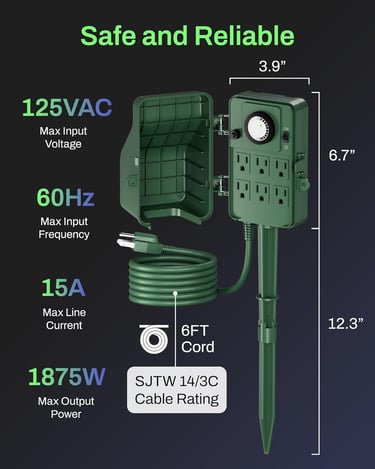
Power stakes combine multiple outdoor outlets into a single weather-resistant distribution point. Many also include built-in timers, photocells, or remote controls.
For medium and large displays, they often provide a cleaner solution than using several individual timers.
What Is a Power Stake?
A power stake is essentially a weather-resistant outdoor power hub.
Most models include:
Multiple grounded outlets
Built-in timer functions
Photocell automation
Remote controls
Weather-resistant covers
Heavy-duty extension cords
Rather than plugging six inflatables into six separate outlets, a power stake allows centralized management from one location.
Benefits for Inflatable Displays
Simplified Automation
Instead of managing multiple timers, one power stake can control an entire display zone.
Examples:
Front yard display
Side yard display
Walkway decorations
Halloween scene
Better Outlet Organization
Many homeowners underestimate how quickly outlet space disappears.
A display containing:
Santa inflatable
Snowman inflatable
Reindeer inflatable
Projector
String lights
Path lights
can easily require six or more powered connections.
Power stakes solve this problem elegantly.
Easier Seasonal Setup
One of the biggest advantages is setup speed.
Instead of:
Multiple timers
Multiple splitters
Multiple extension cord runs
you create a centralized power station.
This reduces clutter and makes troubleshooting easier later in the season.
Recommended Power Stake: DEWENWILS Outdoor Power Stake Timer
This is one of the most complete solutions in the approved product list.
Why Buyers Like It
Six grounded outlets
Built-in photocell
Remote control
Daily automation options
100-foot remote range
Best For
Medium and large inflatable displays.
Not Ideal For
Single inflatable setups.
Practical Notes
The ability to combine dusk-to-dawn operation with remote control makes this particularly attractive for homeowners running several inflatables.
Recommended Power Stake: SURAIELEC Outdoor Power Stake Timer
Strong combination of automation, weather resistance, and outlet capacity.
Why Buyers Like It
Six outlets
Photocell automation
Remote operation
Overload protection
Best For
Homeowners expanding beyond basic timer setups.
Not Ideal For
Very small displays.
Practical Notes
The integrated overload protection provides an additional safety layer for larger decorating projects.
Recommended Power Stake: Tiffcofio Outdoor Power Stake Timer
Why We Selected It
Offers extensive timer flexibility and modern remote-control features.
Why Buyers Like It
Multiple timer modes
Dusk-to-dawn operation
Strong wireless range
Daily repeat schedules
Best For
Users seeking maximum automation flexibility.
Not Ideal For
Those wanting the simplest possible solution.
Practical Notes
A strong option for users transitioning from traditional timers to more advanced automation systems.
If your display is beginning to outgrow a single outlet, power stakes often provide the easiest upgrade path.
For larger setups, also read How to Power Multiple Outdoor Inflatables Safely Without Overloading Your Circuit.
How Many Inflatables Can One Timer Handle?
This is one of the most common questions inflatable owners ask.
The answer is not determined by the timer itself.
It is determined by the electrical load connected to the timer.
Understanding Watts and Amps
Every inflatable blower consumes electricity.
That consumption is typically measured in:
Watts (W)
Amps (A)
Most residential outdoor circuits are:
15 amps
120 volts
A typical safety guideline is to stay below approximately 80% of circuit capacity for continuous loads.
Why Timer Ratings Matter
Most outdoor timers are rated for:
15 amps
1,875 watts
That sounds like a lot.
However, the total connected load matters.
You must include:
Inflatables
String lights
Projectors
Pathway lighting
Any other connected decorations
Example Calculation
Imagine a display containing:
4 medium inflatables
Several LED light strings
A projector
The total electrical load may still fall comfortably below timer limits.
However, every display is different.
This is why actual measurement is valuable.
We'll discuss energy monitoring later in this guide.
The Startup Load Problem
Inflatable blowers require additional power when first starting.
This startup surge usually lasts only briefly, but it can create issues when many decorations activate simultaneously.
Potential results:
Breaker trips
GFCI trips
Timer overloads
Failed startup attempts
This issue becomes more common as displays grow larger.
When to Upgrade Beyond a Single Timer
Consider upgrading when:
Multiple extension cords are involved
More than one decorating zone exists
Breakers trip regularly
Outlet management becomes difficult
Solutions include:
Power stakes
Multiple timer zones
Dedicated circuits
Smart plug systems
Practical Rule
For small displays:
One timer is usually enough.
For medium displays:
A power stake often makes more sense.
For large displays:
Multiple control zones typically provide better reliability.
For advanced planning guidance, see How Many Inflatables Can One Circuit Handle?
Why Inflatables Sometimes Trip Breakers When Timers Turn On
One of the most frustrating decorating problems occurs when everything appears to be working correctly—until the timer activates.
Suddenly:
The breaker trips
The GFCI trips
Some inflatables fail to inflate
The display partially powers up
Many homeowners assume the timer is defective.
Often it is not.
The Real Cause: Startup Surge
Inflatable blowers require extra electricity during startup.
This temporary demand is known as startup surge.
When several inflatables start at the same moment, the combined surge can exceed what a circuit comfortably handles.
Even though normal operation would be fine, the startup event causes problems.
Why Larger Displays Are More Vulnerable
The risk increases when:
Multiple blowers activate simultaneously
Long extension cords are used
Power strips are overloaded
Circuits are already heavily loaded
This is particularly common during Christmas decorating season.
How Power Stakes Can Help
Power stakes improve organization and load distribution.
While they do not eliminate startup surge, they often make it easier to divide displays into manageable zones.
Examples:
Zone 1:
Front yard inflatables
Zone 2:
Roof decorations
Zone 3:
Walkway lighting
Separating loads can improve reliability.
The Role of GFCI Protection
Sometimes the issue is not overload at all.
Water intrusion, damaged cords, or faulty connections may trigger GFCI protection.
This is actually a safety feature working correctly.
Never bypass GFCI protection to stop nuisance trips.
Instead, identify the root cause.
Common Troubleshooting Checklist
Check:
Extension cord condition
Outlet condition
GFCI status
Timer rating
Water intrusion
Excessive load
Many problems can be solved quickly once the true cause is identified.
Helpful Safety Products
DEWENWILS 3 FT Automatic GFCI Extension Cord
Why We Selected It
Adds GFCI protection while supporting outdoor loads.
Why Buyers Like It
Automatic reset
Heavy-duty construction
Triple outlet design
Best For
Outdoor decorating setups.
Not Ideal For
Permanent installations.
Practical Notes
Useful for adding a safety layer to inflatable power systems.
Why We Selected It
Provides outdoor-rated GFCI protection with multiple outlets.
Why Buyers Like It
Heavy-duty construction
Lighted power indicator
Outdoor compatibility
Best For
Seasonal decorating.
Not Ideal For
Users who already have adequate GFCI protection.
Practical Notes
A simple upgrade that improves electrical safety.
For deeper troubleshooting, read Why Your Outdoor Inflatable Keeps Tripping the Breaker (And How to Fix It) and Real-World Outdoor Inflatable Power Problems and How to Fix Them.
Protecting Your Timer From Rain, Snow, and Ice
Many timer failures are not actually timer failures.
They are connection failures.
Water enters plugs, extension cord connections, adapters, or power strips and creates problems that appear to be timer-related.
Protecting connections is often more important than upgrading the timer itself.
Why Outdoor Connections Fail
Outdoor electrical systems face:
Rain
Snow
Ice
Wind-driven moisture
Dirt
Debris
Over time these conditions can affect exposed electrical connections.
The Weakest Point in Most Displays
The most vulnerable areas are usually:
Extension cord connections
Timer-to-cord connections
Power strip connections
Adapter connections
These locations deserve protection.
Why Weatherproof Boxes Matter
Weatherproof connection boxes create a protective enclosure around electrical connections.
Benefits include:
Reduced water intrusion
Better snow protection
Improved cord organization
Cleaner display appearance
For inflatable displays, they are often one of the smartest upgrades available.
Recommended Weatherproof Box: Flemoon Large Outdoor Electrical Box
Large interior capacity accommodates timers, adapters, and power strips.
Why Buyers Like It
Spacious design
IP54 protection
Multiple cord entry points
Best For
Medium and large displays.
Not Ideal For
Simple single-cord connections.
Practical Notes
Particularly useful when combining timers and power strips.
Recommended Weatherproof Box: Hrensaw Small Electrical Connection Box
Compact and affordable.
Why Buyers Like It
Small footprint
Easy installation
Strong weather resistance
Best For
Single timer connections.
Not Ideal For
Large power strips.
Practical Notes
Excellent for protecting individual timer-to-extension-cord connections.
Recommended Weatherproof Box: OUTDSPLY Medium Outdoor Electrical Box
Provides a useful middle ground between compact and oversized boxes.
Why Buyers Like It
Multiple cord ports
Large internal space
Cord management features
Best For
Growing inflatable displays.
Not Ideal For
Very small setups.
Practical Notes
A flexible solution that accommodates many decorating configurations.
The Best Weatherproofing Strategy
Think in layers:
Quality timer
GFCI protection
Weatherproof connection box
Proper extension cords
Safe outlet placement
This layered approach dramatically improves reliability throughout the decorating season.
For a deeper dive, see Best Weatherproof Cord Connection Boxes for Outdoor Decorations and Why Weatherproof Outdoor Electrical Boxes Still Fail in Rain, Snow, and Ice (And How to Fix Them for Good).
Why GFCI Protection Matters for Outdoor Displays
Holiday inflatables operate outdoors in an environment where electricity, moisture, snow, ice, and rain frequently come together.
That combination makes GFCI protection one of the most important safety components in any display.
Yet many decorators focus entirely on timers while overlooking GFCI protection.
What Is a GFCI?
GFCI stands for Ground Fault Circuit Interrupter.
Its purpose is simple:
If electricity begins flowing somewhere it shouldn't, the GFCI rapidly disconnects power.
This helps reduce the risk of:
Electric shock
Ground faults
Damaged equipment
Outdoor electrical hazards
Why Holiday Displays Benefit from GFCI Protection
Outdoor decorating introduces several risks:
Wet extension cords
Damaged plugs
Cracked insulation
Snow accumulation
Water intrusion
Even a well-maintained display can encounter conditions that trigger a ground fault.
A properly functioning GFCI provides an important layer of protection.
Common GFCI Misconceptions
"My GFCI Keeps Tripping So It Must Be Bad"
Not necessarily.
Often the GFCI is identifying:
Water intrusion
Damaged wiring
Faulty equipment
Overloaded connections
The trip is a warning sign rather than the problem itself.
"I Don't Need GFCI Protection Because My Timer Is Waterproof"
A waterproof timer does not eliminate risks elsewhere in the system.
Protection is still valuable because failures often occur at:
Extension cord connections
Power strips
Adapters
Inflatable blower cords
Recommended GFCI Products
DEWENWILS 3 FT Automatic GFCI Extension Cord
Provides a simple way to add GFCI protection to seasonal displays.
Why Buyers Like It
Heavy-duty 12/3 cord
Automatic reset functionality
Triple outlet configuration
Best For
Holiday decorating systems requiring additional protection.
Not Ideal For
Permanent outdoor installations.
Practical Notes
Works particularly well when used upstream of timers and power stakes.
PLUGTUL 3 FT GFCI Extension Cord
Combines GFCI protection with multiple outlet access.
Why Buyers Like It
Three outlet design
LED power indication
Outdoor-rated construction
Best For
Medium-size holiday displays.
Not Ideal For
Installations already protected by dedicated GFCI devices.
Practical Notes
A convenient upgrade for decorators adding additional inflatables.
For a complete discussion of outdoor electrical safety, see The Ultimate Guide to Powering Outdoor Inflatables Safely: Extension Cords, GFCI Protection, Weatherproofing and Load Planning.
Measuring Real Energy Usage and Operating Costs
Many decorators are surprised by how little—or occasionally how much—their displays actually cost to operate.
Rather than guessing, you can measure real-world energy usage.
This is one of the biggest authority gaps in competing timer guides.
Why Energy Measurement Matters
Without measurement:
You don't know actual operating costs.
You can't compare display changes.
You can't identify inefficient equipment.
You can't accurately estimate seasonal expenses.
Measurement removes guesswork.
What Should Be Measured?
Useful metrics include:
Watts
Kilowatt-hours (kWh)
Voltage
Amperage
Runtime
Together these measurements create a complete picture of display performance.
Recommended Energy Monitor: Mecheer Power Meter
Offers extensive measurement capabilities at an affordable price point.
Why Buyers Like It
Multiple measurement modes
Backlit display
Cost tracking capability
Overload warning system
Best For
Homeowners wanting to understand display energy usage.
Not Ideal For
Users who only need basic measurements.
Practical Notes
A useful tool for comparing the energy usage of different inflatable configurations.
Recommended Energy Monitor: P3 Kill A Watt
One of the most recognized energy-monitoring devices available.
Why Buyers Like It
Easy-to-read display
Long-standing reputation
Multiple reporting modes
Best For
Seasonal energy audits.
Not Ideal For
Users wanting advanced app-based reporting.
Practical Notes
Excellent for determining the real operating cost of holiday inflatables.
How Timers Help Reduce Energy Costs
Timers do not make inflatables more efficient.
Instead, they reduce unnecessary runtime.
For example:
Instead of running:
24 hours per day
A timer may limit operation to:
5 PM to 11 PM
Reducing operating hours often creates significant seasonal savings.
The Value of Measuring Before Expanding
Before adding additional decorations:
Measure current usage
Verify circuit capacity
Confirm available headroom
This reduces surprises later in the season.
For more energy-saving strategies, see:
Energy Usage for Outdoor Decorations and Money Saving Tips
How Holiday Decorations Can Skyrocket Your Energy Bill
Save Energy Without Dimming Your Holiday Spirit
How Much Electricity Do Spring Inflatables Use? Real Costs and Easy Ways to Save
Complete Outdoor Inflatable Automation Systems
Most experienced decorators eventually stop thinking about individual timers.
Instead, they build complete automation systems.
The goal becomes:
Reliability
Safety
Convenience
Energy efficiency
The Basic Automation System
Suitable for:
One inflatable
Small displays
System:
Outlet → Timer → Inflatable
The Intermediate Automation System
Suitable for:
Multiple inflatables
Mixed decorations
System:
Outlet → GFCI → Timer → Weatherproof Box → Decorations
Benefits:
Increased safety
Better weather protection
Cleaner installation
The Advanced Automation System
Suitable for:
Large displays
Multi-zone layouts
System:
Outlet → GFCI → Power Stake → Weatherproof Box → Multiple Decorations
Benefits:
Centralized control
Better organization
Easier troubleshooting
The Smart Automation System
Suitable for:
Smart-home users
System:
Outlet → Smart Plug → Power Distribution → Decorations
Recommended Products:
Benefits:
Remote control
Voice control
Scheduling flexibility
The Complete Display Management System
Suitable for:
Serious holiday enthusiasts
System:
GFCI Protection
→ Power Stake
→ Weatherproof Box
→ Smart Control
→ Energy Monitoring
Recommended Components:
This approach creates a safer, more reliable, and easier-to-manage display.
For deeper planning guidance, see:
The Complete Guide to Energy, Power, and Smart Tech for Holiday Inflatables
Common Outdoor Timer Problems and Quick Fixes
Even quality timers occasionally encounter problems.
Fortunately, most issues are easy to diagnose.
Problem: Timer Doesn't Turn On
Possible Causes:
Incorrect programming
Tripped GFCI
Dead outlet
Faulty extension cord
Quick Fix:
Verify power at the source before replacing the timer.
Problem: Timer Turns On but Inflatable Doesn't Inflate
Possible Causes:
Blower failure
Loose connection
Damaged extension cord
Quick Fix:
Test the inflatable directly from the outlet.
Problem: Smart Plug Loses Connection
Possible Causes:
Weak Wi-Fi signal
Router changes
Network interruptions
Quick Fix:
Move the plug closer to Wi-Fi coverage or add signal support.
Problem: Timer Works Intermittently
Possible Causes:
Moisture
Damaged outlet
Loose connection
Quick Fix:
Inspect all outdoor connections and verify weatherproof protection.
Problem: GFCI Keeps Tripping
Possible Causes:
Water intrusion
Damaged equipment
Ground fault
Quick Fix:
Disconnect components one at a time until the source is identified.
Problem: Breaker Trips When Timer Activates
Possible Causes:
Startup surge
Excessive electrical load
Quick Fix:
Divide the display into multiple zones.
For more troubleshooting help, see:
Outdoor Holiday Power Troubleshooting Guide: Why Decorations Fail and How to Fix Them
Real-World Outdoor Inflatable Power Problems and How to Fix Them
Key Takeaways
The best timer depends on display size, not just product features.
Mechanical timers remain excellent for simple displays.
Smart plugs provide the greatest scheduling flexibility.
Power stakes become valuable as displays expand.
GFCI protection should be considered essential for outdoor decorating.
Weatherproof connection boxes help prevent many common failures.
Energy monitors remove guesswork from operating costs.
Large displays benefit from multiple automation zones.
Proper load planning improves reliability and safety.
Complete automation systems outperform isolated timer solutions.
Mini Conclusion
The best outdoor timer for holiday inflatables is not necessarily the most expensive model or the one with the longest feature list.
The right choice depends on your display size, automation goals, and power requirements.
For smaller setups, a mechanical or photocell timer may be all you need. As displays expand, power stakes, smart plugs, weatherproof connection boxes, GFCI protection, and energy monitoring devices become increasingly valuable.
When combined into a complete automation system, these tools help create displays that are easier to manage, safer to operate, and more efficient throughout the holiday season.
FAQ
What is the best outdoor timer for holiday inflatables?
For simple displays, mechanical timers such as the BN-LINK Mechanical Timer are reliable and easy to use. Larger displays often benefit from power stakes or smart plugs.
Is a smart plug better than a timer?
Smart plugs offer more flexibility and remote control. Traditional timers often provide greater simplicity and reliability.
How many inflatables can run on one timer?
The answer depends on total electrical load, not the timer alone. Most outdoor timers are rated for up to 15 amps and 1,875 watts.
Can outdoor timers stay outside all winter?
Most outdoor-rated timers are designed for seasonal weather exposure, but protecting connections with weatherproof boxes improves longevity and reliability.
Do timers save electricity?
Timers reduce unnecessary runtime, which lowers overall energy consumption.
What causes outdoor timers to fail?
Common causes include water intrusion, damaged outlets, faulty extension cords, improper programming, and overloaded circuits.
Do I need a weatherproof box?
For many inflatable displays, weatherproof boxes provide valuable protection for timer and extension-cord connections.
Should I use GFCI protection with inflatables?
Yes. GFCI protection adds an important layer of electrical safety for outdoor decorations.
Can smart plugs handle inflatable blowers?
Many outdoor-rated smart plugs support inflatable blowers, provided electrical ratings are not exceeded.
How do I measure inflatable energy usage?
Energy monitors such as the Mecheer Power Meter and P3 Kill A Watt can measure real-world electrical consumption.
Related Articles
The Complete Guide to Energy, Power, and Smart Tech for Holiday Inflatables
Discover how smart plugs, timers, energy monitors, and automation systems work together to create a safer and more efficient display.
How to Power Multiple Outdoor Inflatables Safely Without Overloading Your Circuit
Learn practical strategies for expanding your display without creating overload problems or nuisance breaker trips.
Best Weatherproof Cord Connection Boxes for Outdoor Decorations
Compare weatherproof connection box options and learn how to protect vulnerable outdoor electrical connections.
Why Your Outdoor Inflatable Keeps Tripping the Breaker (And How to Fix It)
Troubleshoot one of the most common problems inflatable owners encounter during the decorating season.
How Many Inflatables Can One Circuit Handle?
Understand circuit capacity, amperage limits, and safe display planning techniques.