
Bounce House Blower Troubleshooting (2026 Fix Guide for Motor Issues)
Learn how to fix common bounce house blower problems including power failures, weak airflow, overheating, and motor issues. Step-by-step troubleshooting guide for homeowners.
Frank “Frosty” Adminei
5/22/20263 min read
Bounce House Blower Troubleshooting (2026 Guide for Fast Motor Fixes
INTRODUCTION
When a bounce house suddenly stops inflating or the blower motor weakens, the entire setup can fail within minutes. Most issues are not caused by permanent damage but by electrical faults, airflow blockages, overheating, or simple connection problems. This guide to Bounce House Blower Troubleshooting breaks down the most common causes and shows you how to diagnose and fix them step by step.
Whether your blower won’t turn on at all or it’s running but not inflating properly, understanding how the system works will help you restore airflow quickly and safely without replacing equipment unnecessarily.
Quick Answer
Most bounce house blower issues come down to five causes:
• No power supply (outlet, breaker, or cord failure)
• Clogged or blocked air intake
• Overheating safety shutdown
• Loose hose connection or air leak
• Failing motor capacitor or worn fan motor
Quick fix order:
Check power source and breaker
Inspect extension cord and outlet
Clear intake vents
Reset and cool blower
Inspect hose seal and motor function
Most issues labeled “bounce house blower not working” are electrical or airflow-related—not full motor failure.
How Bounce House Blowers Work
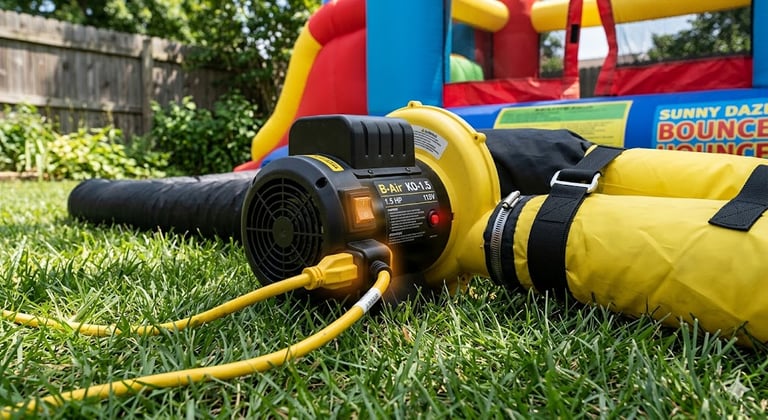
A bounce house blower is a continuous-air fan system that maintains pressure by constantly pushing air into the inflatable. Most residential units operate between 0.5–1.5 HP and require unobstructed airflow to function properly. Brands like Airhead and Blast Zone design blowers with thermal protection to prevent overheating during extended use.
No Power or Blower Won’t Turn On
If your unit shows no signs of power, start with the electrical supply:
• Confirm outlet is working (test with another device)
• Reset GFCI outlets (common in outdoor setups)
• Inspect extension cord for cuts or overload rating
• Check circuit breaker
A frequent cause of “bounce house blower not working” is an under-rated extension cord. Use a heavy-duty outdoor-rated cord only.
Weak Airflow Problems
If the blower runs but the bounce house does not fully inflate:
• Check air intake for debris or leaves
• Ensure hose is tightly secured
• Look for tears in inflatable seams
• Confirm blower size matches inflatable requirements
Low airflow is often mistaken for motor failure, but in most cases it is a restriction issue.
Overheating Shutdowns
Most modern inflatable blowers include thermal cutoff switches. If the unit stops after 10–30 minutes:
• Let it cool for 15–30 minutes
• Move blower to shaded area
• Ensure intake vents are not blocked
• Avoid stacking objects near motor housing
Repeated overheating may indicate restricted airflow or aging motor components.
Strange Noises or Vibration Issues
Grinding, rattling, or high-pitched noise usually means:
• Debris in fan housing
• Loose internal blade
• Worn bearings
• Motor imbalance
Turn off immediately and inspect before further use to avoid permanent damage.
Hose and Air Leak Problems
Even a powerful blower cannot maintain pressure if air escapes faster than it enters.
Check:
• Hose connection tightness
• Velcro or zipper seals
• Small punctures in seams
• Ground friction damage underneath inflatable
Leaks often mimic blower failure but are actually structural issues.
Electrical and Cord Troubleshooting
Electrical issues are the most overlooked cause of failure:
• Use 12–14 gauge outdoor extension cords only
• Avoid daisy-chaining cords
• Keep connections dry and elevated
• Never run blower through overloaded power strips
Poor power delivery leads to inconsistent motor speed and overheating risk.
When to Replace the Blower
Replacement may be necessary if:
• Motor fails to start after verified power supply
• Burning smell persists after cooling
• Fan blades are damaged or warped
• Unit repeatedly overheats under normal load
High-quality replacement options include models from VEVOR and heavy-duty residential units designed for long runtime.
Maintenance Tips
To extend blower life:
• Clean intake vents regularly
• Store indoors when not in use
• Avoid running in heavy rain
• Inspect cords before each use
• Keep airflow path clear at all times
Preventive maintenance reduces most “electric inflatable blower troubleshooting” issues before they start.

CONCLUSION
Most bounce house blower issues are simple airflow or electrical problems rather than permanent motor failure. By checking power supply, airflow path, and hose integrity in order, you can resolve the majority of issues quickly without replacing equipment.
For recurring problems, upgrading to a properly sized blower and maintaining clean airflow conditions will significantly improve reliability for future setups.
Related Articles
• Are Bounce Houses Safe? (2026 Parent Guide) — Safety overview before setup and operation
• Bounce House Setup Mistakes to Avoid (2026) — Prevent blower strain from poor installation
• Best Bounce House Blowers (2026): CFM, HP & Noise Levels — Choosing correct motor size
• Power, Extension Cords & Blower Guide (2026) — Electrical safety and compatibility
• Bounce House Storage Guide (2026): Folding, Drying & Long-Term Care — Prevent motor and fabric damage
• Bounce House Repair, Cleaning & Mold Prevention (2026 Master Guide) — Long-term maintenance system
This article may contain general product references. Always verify compatibility and safety requirements before use. Some recommendations may include commercially available equipment from third-party manufacturers.