
Home > Setup, Safety, and Repairs > Power and Extension Cords > How Much Electricity Does My Entire Holiday Display Use?
How Much Electricity Does My Entire Holiday Display Use?
Learn how to calculate, estimate, and measure your entire holiday display's electricity usage. Includes real-world examples, cost calculations, and tips for safely expanding your outdoor decorations.
By Frank "Frosty" Adminei
7/18/202610 min read

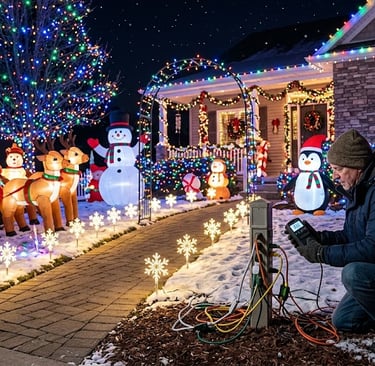
Table of Contents
Introduction
One of the most common questions holiday decorators ask isn't about extension cords or inflatables—it's:
"How much electricity is my entire display actually using?"
Whether you're setting up a few Halloween inflatables, an elaborate Christmas light display, patriotic decorations for Independence Day, or colorful Easter yard décor, understanding your total electricity usage helps you make smarter decorating decisions.
It can help you:
estimate your seasonal electric bill
determine whether you have room to expand your display
compare older decorations with newer, more efficient models
identify decorations that consume more electricity than expected
verify that your actual power usage matches your estimates
Fortunately, calculating your display's electricity usage isn't difficult once you understand a few basic numbers. Better yet, inexpensive electricity monitors let you verify your estimates using real measurements instead of guesswork.
This guide walks through the entire process—from building a simple equipment list to calculating operating costs and measuring real-world power usage—so you can enjoy your display with confidence.
Who This Guide Is For
This guide is ideal for anyone who:
decorates for Christmas, Halloween, Easter, Valentine's Day, patriotic holidays, or other seasonal celebrations
owns one or multiple outdoor inflatables
combines inflatables with lights, projectors, spotlights, or animated decorations
wants realistic estimates instead of exaggerated claims
plans to expand an existing display
wants to understand where their electricity dollars are actually going
Whether you're decorating a small front porch or an entire neighborhood attraction, the same calculation process applies.
Why Understanding Your Display's Electricity Usage Matters
Many homeowners focus only on their monthly electric bill.
While cost certainly matters, understanding your display's electricity usage provides several additional benefits.
First, it helps with planning. If you know your current display uses only a fraction of your available electrical capacity, you'll have much greater confidence when adding another inflatable or two.
Second, it helps with budgeting. Even if electricity costs in your area fluctuate, estimating your display's seasonal operating cost helps eliminate surprises.
Third, it helps identify inefficient decorations. Two decorations that look similar may use dramatically different amounts of electricity depending on their age, lighting technology, and blower design.
Finally, understanding your total electricity usage prepares you for larger displays. As your decorating hobby grows, electricity planning becomes just as important as choosing the decorations themselves.
If you're still building the foundation of your outdoor electrical setup, our guide to The Ultimate Guide to Powering Outdoor Inflatables Safely: Extension Cords, GFCI Protection, Weatherproofing and Load Planning explains how electrical planning, extension cords, weather protection, and load management all work together before you begin expanding your display.
Step 1: Make a List of Every Electrical Item in Your Display
The easiest mistake is focusing only on inflatables.
In reality, nearly every outdoor display contains multiple electrical devices that contribute to total electricity usage.
Start by writing down everything that plugs into an outlet.
Typical items include:
Outdoor inflatables
LED string lights
Icicle lights
Net lights
Spotlights
Flood lights
Laser projectors
Animated decorations
Musical decorations
Blow molds with bulbs
Yard signs with lighting
Outdoor Christmas trees
Power adapters
Timers
Smart plugs
Controllers
Synchronized lighting equipment
Even accessories that use very little electricity should be included so your calculations are as accurate as possible.
Completing a worksheet like the below example takes only a few minutes and makes the remaining calculations much easier.
Don't Forget Seasonal Changes
Many decorators reuse extension cords and timers throughout the year while swapping decorations.
For example:
Halloween may feature inflatables and purple spotlights.
Christmas may add roof lights, trees, and animated decorations.
Easter displays are often smaller and use less electricity.
Patriotic displays frequently combine inflatables with flag lighting.
Keeping separate worksheets for each season makes future planning much easier and allows you to compare displays year after year.
Step 2: Find the Wattage of Each Decoration
Once you've listed every electrical device, the next step is determining how much power each one uses.
The easiest place to start is the product label.
Most decorations include a label showing:
Watts (W)
Amps (A)
Volts (V)
If watts are listed, simply record that number.
If only amps are listed, you can estimate watts using this simple formula:
Watts = Volts × Amps
Since most household outlets in the United States supply approximately 120 volts, a decoration drawing 1 amp uses roughly 120 watts.
Where to Find Wattage Information
Depending on the decoration, you may find the electrical rating in several places:
Manufacturer label attached to the decoration
Blower label on inflatable decorations
Power adapter label
Owner's manual
Product specification page
Manufacturer website
If you no longer have the original packaging, most major manufacturers publish electrical specifications online.
Estimated Wattage vs. Actual Wattage
One of the biggest misconceptions is that the label always reflects real-world electricity usage.
In practice, actual power consumption can vary slightly because of:
blower operating conditions
LED driver efficiency
voltage fluctuations
manufacturing tolerances
accessories connected to the same circuit
For small displays, these differences are usually minor. However, as displays become larger, small variations across multiple decorations can add up.
That's one reason many experienced decorators eventually verify their estimates with an electricity usage meter rather than relying solely on published specifications.
Step 3: Calculate Your Total Wattage
Now that you've identified the wattage of each decoration, it's time to determine how much power your entire display requires.
Fortunately, this step is simply addition.
Add the wattage of every electrical device that will be operating at the same time.
Step 4: Estimate Daily, Monthly, and Seasonal Electricity Usage
Knowing your total wattage is helpful.
Knowing what it costs to operate every night is even more useful.
Electric utilities bill electricity using kilowatt-hours (kWh) rather than watts.
The calculation is straightforward:
Convert watts to kilowatts by dividing by 1,000.
Multiply by the number of hours your display runs each night.
Multiply by the number of decorating days.
Multiply by your local electricity rate.
Example
A display uses:
500 watts
Runs:
6 hours per night
For:
30 days
Calculation:
500 ÷ 1,000 = 0.5 kW
0.5 × 6 = 3 kWh per night
3 × 30 = 90 kWh
If electricity costs $0.18 per kWh:
90 × $0.18 = $16.20
For many homeowners, the seasonal operating cost is lower than expected.
Real-World Display Examples
Example 1 – Beginner Front Yard
A homeowner installs:
Two medium inflatables
One LED light string around the porch
Two landscape spotlights
One timer
Estimated total power:
Approximately 180–220 watts
This type of display is inexpensive to operate and leaves significant room for future expansion.
Example 2 – Neighborhood Favorite
This display includes:
Five inflatables
Roofline lights
Bush lights
Lighted pathway stakes
One projector
Two timers
Estimated power:
Approximately 500–700 watts
At this point, electricity cost is still generally reasonable, but circuit planning starts becoming more important.
Example 3 – Large Multi-Holiday Display
This homeowner decorates for multiple holidays using:
Ten or more inflatables
Hundreds of feet of LED lighting
Animated decorations
Multiple spotlights
Decorative trees
Music controller
Several timers
Estimated usage:
Approximately 1,200–1,500 watts
Displays of this size often benefit from dividing loads across multiple circuits rather than trying to power everything from one location.
Estimate vs. Measure — Why Actual Power Usage Can Be Different
Your calculations provide an excellent starting point.
However, experienced decorators often discover that actual electricity usage differs slightly from the numbers printed on product labels.
Reasons include:
Small manufacturing differences
Voltage fluctuations
Blower efficiency
LED driver variation
Simultaneous accessory loads
The easiest way to eliminate guesswork is by using an electricity usage monitor.
Simply plug the monitor into the outlet, plug your decoration into the monitor, and it displays real-time information such as:
Watts
Amps
Voltage
Kilowatt-hours
Operating time
This allows you to compare your estimates with actual measurements and build a much more accurate understanding of your display's energy use over time.
Easy Ways to Reduce Electricity Usage Without Shrinking Your Display
Reducing electricity usage doesn't necessarily mean removing decorations.
Instead, focus on making your display more efficient.
Some of the easiest improvements include:
Use timers so decorations aren't running when no one is outside to enjoy them.
Replace older incandescent light strings with LED versions as they wear out.
Turn displays off later at night if neighborhood traffic drops significantly.
Group decorations with similar schedules together for easier automation.
Review your actual power usage each season so future expansion decisions are based on measured data rather than estimates.
Outdoor smart plugs can also simplify scheduling by allowing you to automate on/off times or control decorations remotely. If you'd like to compare automation options, see Best Smart Plugs for Holiday Inflatables (2026 Buyer's Guide) for a detailed comparison of scheduling features, weather resistance, and smart home compatibility.
Can You Add Another Inflatable?
This is one of the most common questions among holiday decorators—and the answer depends on two different factors that are often confused.
How much electricity your display uses (operating cost)
How much electrical capacity your circuit has (safe operation)
These are related, but they are not the same thing.
For example, you might discover that adding one more inflatable would only increase your monthly electric bill by a few dollars. From a cost perspective, that's perfectly reasonable.
However, if your circuit is already approaching its safe operating limit, adding that same inflatable could overload the circuit or cause nuisance breaker trips.
That's why it's important to use your electricity calculations as one planning tool, while also considering your home's electrical capacity.
If you're wondering whether your existing setup has enough capacity for another decoration, our guide How Many Inflatables Can One Circuit Handle? explains how to estimate circuit loading using real-world examples.
Likewise, if you're planning to grow from a small display to a larger multi-inflatable setup, How to Power Multiple Outdoor Inflatables Safely Without Overloading Your Circuit walks through practical layout strategies, load balancing, and safer power distribution.
Signs You're Ready to Expand
Your display is generally in a good position for expansion if:
You've calculated your current total wattage.
You've measured actual usage with an electricity meter or verified manufacturer ratings.
Your display operates reliably without tripping breakers.
Your electrical layout has room for additional load.
Your extension cords and outdoor connections are appropriately sized and protected.
Planning before purchasing additional decorations almost always leads to a smoother decorating season.
Common Electricity Calculation Mistakes
Even experienced decorators occasionally make incorrect assumptions about electricity usage. Avoiding these common mistakes can improve both your estimates and your display planning.
Mistake #1: Forgetting Smaller Accessories
Many people only total the wattage of their inflatables and lights.
Items such as:
projectors
spotlights
controllers
timers
smart plugs
animated decorations
all contribute to total electricity usage, even if each one individually uses relatively little power.
Mistake #2: Confusing Watts and Amps
Watts measure power consumption.
Amps measure electrical current.
Both are important, but they answer different questions.
Watts help estimate operating cost.
Amps help evaluate electrical loading.
Keeping those concepts separate makes planning much easier.
Mistake #3: Assuming Every Decoration Runs at Full Power Constantly
Most holiday decorations have relatively consistent power consumption, but actual operating conditions can vary slightly.
For example:
Blower motors may draw a little more power during startup.
LED drivers can vary slightly.
Older decorations may not perform exactly like new ones.
These differences are usually small, but measuring actual usage provides the most accurate picture.
Mistake #4: Ignoring Daily Runtime
Many homeowners focus on wattage while overlooking the number of hours the display runs each night.
Reducing runtime from eight hours to six hours often has a larger impact on seasonal electricity costs than replacing a few already-efficient LED decorations.
Mistake #5: Estimating Forever Instead of Measuring
Estimating is an excellent starting point.
However, once your display grows, actual measurements provide much greater confidence when:
budgeting
comparing decorations
troubleshooting unusual electricity usage
deciding whether to expand
Key Takeaways
Calculating your entire holiday display's electricity usage is simpler than many homeowners expect.
Start by creating a complete inventory of every electrical decoration.
Add the wattage of all items that operate simultaneously.
Estimate your seasonal operating cost using runtime and local electricity rates.
Measure actual usage with an electricity meter whenever possible.
Electricity cost and circuit capacity are different planning considerations.
Timers and smart plugs often reduce electricity usage more effectively than replacing already-efficient decorations.
Keeping annual records makes future display expansion much easier.
Mini Conclusion
Modern holiday displays are remarkably energy efficient, especially when they use LED lighting and newer inflatable designs.
By understanding how much electricity your display actually uses—and verifying your estimates with real measurements—you can make informed decisions about operating costs, future expansion, and seasonal planning without relying on guesswork.
Whether you decorate with one inflatable or an entire yard full of seasonal displays, a little planning goes a long way toward creating a display that's both enjoyable and efficient.
Frequently Asked Questions
How much electricity does a holiday inflatable use?
Most modern outdoor inflatables use relatively modest amounts of electricity, with the exact wattage depending on the blower size, lighting, and overall design. Always check the product label or owner's manual for the manufacturer's specifications.
How much electricity does an entire holiday display use?
It depends on the number and type of decorations. A small LED-based display may use only a few hundred watts, while large displays with multiple inflatables, extensive lighting, and animated decorations can exceed 1,000 watts.
Do LED holiday decorations save electricity?
Yes. LED decorations generally use significantly less electricity than older incandescent lighting while also producing less heat and lasting longer.
For a detailed comparison, see LED vs Incandescent Holiday Decoration Costs: What Outdoor Decorators Need to Know.
Are online electricity calculators accurate?
They provide useful estimates when accurate wattage values are entered. However, measuring actual usage with an electricity monitor is the most reliable method.
Is a Kill-A-Watt meter worth buying?
If you regularly decorate for multiple holidays, expand your display each year, or simply enjoy understanding your electricity usage, an electricity usage meter can provide valuable real-world data that estimates alone cannot.
Will running my decorations overnight dramatically increase my electric bill?
For many homeowners using modern LED lights and efficient inflatables, the increase is often smaller than expected. The biggest factor is usually how many hours the display runs each night rather than the decorations themselves.
Do timers really reduce electricity costs?
Yes. Because timers automatically reduce operating hours, they can lower seasonal electricity usage without requiring you to remember to switch decorations on and off manually.
Can I add another inflatable if my electricity bill is still low?
Possibly—but your electric bill isn't the only consideration. You should also verify that your electrical circuit has sufficient capacity before expanding your display.
Related Articles
How Many Inflatables Can One Circuit Handle?
Learn how electrical capacity—not just operating cost—determines how many inflatables you can safely power from a circuit.
How to Power Multiple Outdoor Inflatables Safely Without Overloading Your Circuit
Discover practical strategies for distributing electrical loads as your display grows.
LED vs Incandescent Holiday Decoration Costs: What Outdoor Decorators Need to Know
Compare lighting technologies and see how they affect seasonal operating costs and energy efficiency.
Best Smart Plugs for Holiday Inflatables (2026 Buyer's Guide)
Compare smart plugs that simplify scheduling, automate run times, and help reduce unnecessary electricity usage.
Explore the complete foundation for designing a safe, reliable, and expandable outdoor holiday display.
InflatableHoliday.com
Practical decorating ideas, buying guides, and setup and maintenance advice for outdoor holiday inflatables throughout the year.
Affiliate Disclosure
As an Amazon Associate I earn from qualifying purchases. Some links on this page are affiliate links — if you buy through them, InflatableHoliday may earn a commission at no extra cost to you. Prices and availability change, so the price you see on Amazon is the one that counts.
© 2026 InflatableHoliday.com