
Yard Size & Type Calculator (2026 Guide)
Learn how to measure your yard for inflatable water slides with this 2026 yard size and type calculator. Includes step by step measurement instructions, slope checks, surface identification, and safety clearance rules.
By Frank “Frosty” Adminei
4/20/20269 min read
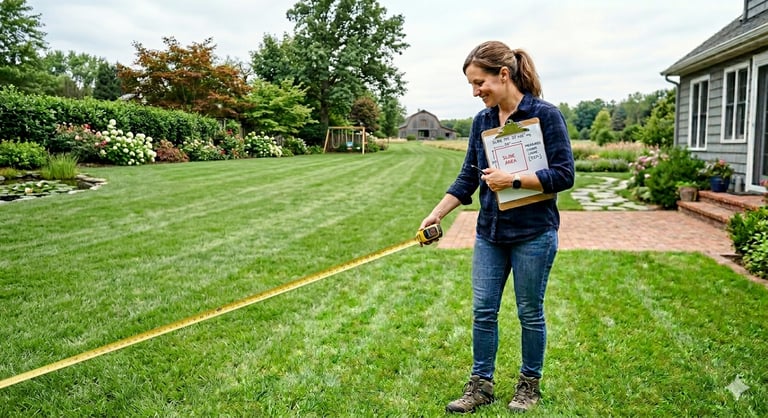
INTRO
If you’ve ever wondered, “Will this inflatable actually fit in my yard?”—you’re not alone. I’ve watched more neighbors eyeball their backyard, shrug confidently, and then discover their new inflatable is roughly the size of a small aircraft carrier. Measuring your yard isn’t glamorous, but it’s the difference between a perfect backyard setup and a return label.
This guide gives you a simple, Frosty‑approved system for figuring out exactly how much usable space you have, what type of yard you’re working with, and whether your ground surface or slope will cause problems. No guesswork. No surprises. No “well… maybe if we angle it diagonally and move the grill.”
Whether your yard is tiny, narrow, sloped, or shaped like a trapezoid, this calculator will help you understand what fits—and what doesn’t—before you buy anything.
WHO THIS GUIDE IS FOR
Parents who want to avoid buying the wrong inflatable
If you’ve ever bought something that looked “normal‑sized” online and then arrived the size of a parade float, this guide is your new best friend. It pairs perfectly with Best Inflatable Water Slides for Every Backyard Size, Budget & Age Group (2026 Guide).
Beginners who don’t know how to measure their yard
No shame here—most people don’t. I’ll walk you through a simple, tape‑measure‑friendly process that works for any yard shape. And if you’re planning to set up an inflatable soon, you’ll want to bookmark How to Set Up an Inflatable Water Slide (2026 Guide).
Renters and homeowners with unusual yard shapes
Narrow yards, L‑shaped yards, sloped yards, patio‑only yards—this guide helps you identify your yard type and match it to the right category‑level recommendations.
Anyone who wants a safe, frustration‑free setup
Correct yard measurement prevents:
Tripping hazards
Blower placement issues
Hose‑reach problems
Clearance violations
Slope‑related instability
If safety is your priority, you’ll also appreciate the anchoring guidance in Simple Ways to Keep Holiday Inflatables From Blowing Away.
WHY THIS TOPIC MATTERS
Most inflatable problems don’t come from the blower, the vinyl, or the water sprayers—they come from the yard. A slide that’s too big won’t inflate properly. A yard that’s too narrow forces awkward angles. A slope that looks “barely noticeable” can turn into a slow‑motion slide migration toward your fence. And if you’ve ever tried to set up an inflatable on a patio without planning for blower placement, you know the pain of extension‑cord gymnastics.
Measuring your yard correctly prevents:
Clearance issues
Tripping hazards
Blower obstructions
Hose‑reach problems
Slope‑related instability
Setup frustration
Safety violations
This guide gives you a simple, repeatable system for calculating usable space, identifying your yard type, and understanding what will actually fit. Pair it with How to Set Up an Inflatable Water Slide (2026 Guide) and Simple Ways to Keep Holiday Inflatables From Blowing Away for a complete backyard‑readiness toolkit.
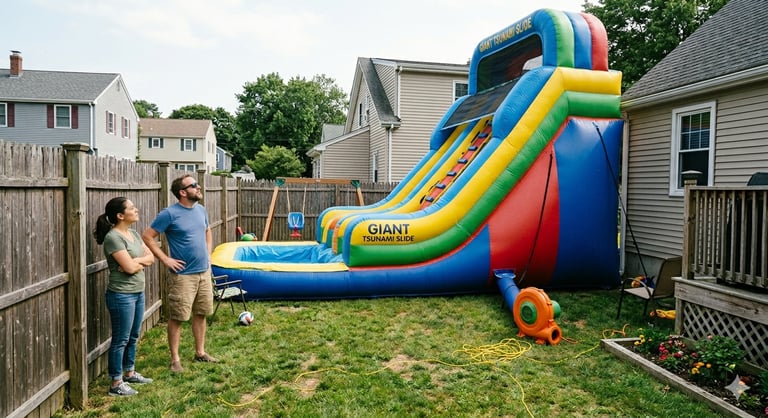
YARD SIZE CALCULATOR (STEP‑BY‑STEP)
This calculator works for any yard shape—rectangular, L‑shaped, narrow, wide, or “my yard looks like a potato.” All you need is a tape measure and a few minutes.
Step 1 — Measure the Length of Your Usable Space
Measure the longest straight line where an inflatable could reasonably sit.
Start at the flattest area
Avoid slopes, dips, and sprinkler heads
Stop at fences, patios, or landscaping
Record this as: Usable Length
If you’re unsure what counts as “usable,” the examples in Best Inflatable Water Slides for Every Backyard Size, Budget & Age Group (2026 Guide) can help.
Step 2 — Measure the Width of Your Usable Space
Measure the widest straight line perpendicular to your length measurement.
Avoid tree roots
Avoid hose bibs
Avoid AC units
Avoid garden beds
Record this as: Usable Width
Step 3 — Subtract Clearance Zones
Inflatables need 3–5 feet of clearance on all sides for:
Safety
Anchoring
Blower airflow
Supervision space
Use this formula:
[ \text{Adjusted Length} = \text{Usable Length} - (Clearance \times 2) ]
[ \text{Adjusted Width} = \text{Usable Width} - (Clearance \times 2) ]
If your yard is tight, use 3 feet.
If your yard is spacious, use 5 feet.
Step 4 — Identify Obstructions
Walk the area and note anything that reduces usable space:
Trees
Poles
Fences
Deck edges
Fire pits
Sprinkler heads
Uneven patches
Patio transitions
Mark these on a simple sketch.
(Yes, even a napkin sketch works—I’ve seen masterpieces.)
Step 5 — Check Hose Reach
Inflatables need a hose connection for water sprayers.
Measure from your hose bib to the planned setup area
Add 3–5 feet for slack
Avoid running hoses across walkways
If you’re planning a party, consider a splitter so you can run sprinklers or fill water balloons without disconnecting the slide.
Step 6 — Check Power Access
Your blower needs a GFCI outlet.
Measure cord reach
Avoid crossing walkways
Avoid creating loops pets can chew
For pet‑safe setups, see How to Protect Your Pets: Outdoor Power Cord Safety Tips.
Step 7 — Calculate Your Final Fit Zone
Your final usable footprint is:
[ \text{Final Fit Zone} = \text{Adjusted Length} \times \text{Adjusted Width} ]
This tells you exactly how much space you have for an inflatable.
YARD TYPE IDENTIFICATION
Once you’ve measured your yard, the next step is figuring out what type of yard you actually have. This matters because different yard types support different inflatable footprints, blower placements, and safety zones.
Below are the most common yard types and how to identify them.
1. Small Yards
You have a small yard if:
Your final fit zone is under ~150 sq ft
Your usable length is under ~15 ft
Your usable width is under ~10–12 ft
Small yards often require:
Shorter inflatables
Lower slide heights
Shallow splash zones
Careful blower placement
For category‑level guidance, see Best Inflatable Water Slides for Small Yards.
2. Medium Yards
You have a medium yard if:
Your final fit zone is 150–300 sq ft
Your usable length is 15–22 ft
Your usable width is 10–16 ft
Medium yards fit most residential inflatables comfortably.
For age‑range matching, see Best Inflatable Water Slides for Every Backyard Size, Budget & Age Group (2026 Guide).
3. Large Yards
You have a large yard if:
Your final fit zone is 300+ sq ft
Your usable length is 22+ ft
Your usable width is 16+ ft
Large yards can support:
Dual‑lane slides
Water parks
Taller inflatables
Wider splash pools
If you’re planning a big setup, review How to Set Up an Inflatable Water Slide (2026 Guide) for safe spacing.
4. Narrow Yards
You have a narrow yard if:
Your usable width is under ~10 ft
Your length is significantly greater than your width
You have fence‑to‑fence constraints
Narrow yards require:
Slim footprints
Straight‑line layouts
Careful blower placement
5. L‑Shaped or Irregular Yards
You have an irregular yard if:
Your yard has multiple sections
Your usable space is broken into zones
You can’t place a rectangle without overlapping obstacles
These yards often require:
Creative angling
Using the longest straight section
Avoiding tight corners
6. Patio‑Only or Hard‑Surface Yards
You have a patio yard if:
Most of your usable space is concrete, pavers, or decking
Grass is limited or nonexistent
Patio setups require:
Ground padding
Weighted anchoring
Careful blower placement
7. Sloped Yards
You have a sloped yard if:
A ball rolls on its own
Your level shows a noticeable tilt
One side of the yard is visibly higher
Sloped yards require special handling (covered below).
SLOPE & SURFACE GUIDANCE
Slope and surface type are the two biggest safety factors most people overlook. Here’s how to evaluate both.
1. Slope Tolerance
Safe Slope Range
A yard is generally safe if:
A ball placed on the ground does not roll
Your level shows minimal tilt
Water does not visibly run downhill
Unsafe Slope Indicators
Your yard may be unsafe if:
A ball rolls on its own
One side of the inflatable sits noticeably lower
The blower tube angles downward
Water pools unevenly
If your yard is sloped, consider:
Rotating the inflatable
Using the flattest section
Choosing a smaller footprint
Using a patio section instead
2. Surface Type Guidance
Grass (Best)
Soft
Easy to anchor
Safe for kids
Ideal for most inflatables
Artificial Turf (Good)
Works well with padding
Avoid high‑heat days
Anchor carefully
Concrete / Patio (Possible)
Requires padding
Requires weighted anchoring
Avoid sharp edges
Sloped or Uneven Ground (Avoid)
Causes instability
Creates unsafe landing angles
Makes anchoring unreliable
If your yard is uneven, consider a smaller inflatable or a different yard zone.
CATEGORY‑LEVEL RECOMMENDATIONS
Now that you know your yard’s size, shape, and surface type, here’s where to go next. These aren’t product modules—just category‑level guides that help you match your yard type to the right inflatable style.
If you have a small yard
See: Best Inflatable Water Slides for Small Yards
If you have a medium or large yard
See: Best Inflatable Water Slides for Every Backyard Size, Budget & Age Group (2026 Guide)
If you’re planning a water‑park‑style setup
See: Best Inflatable Water Slides With Pool (2026 Guide)
If you’re comparing inflatables vs bounce houses
See: Water Slide vs. Bounce House
These guides help you choose the right inflatable after you’ve confirmed your yard can safely support one.
SETUP
Once you’ve identified your yard type and confirmed your fit zone, here’s how to prepare your space for a safe, frustration‑free setup.
1. Clear the Area
Remove:
Toys
Rocks
Sticks
Garden tools
Patio furniture
Sprinkler heads (if removable)
A clean surface prevents punctures and uneven inflation.
2. Mark Your Fit Zone
Use cones, chalk, or garden stakes to outline:
The inflatable footprint
Clearance zones
Blower placement
Hose path
This helps you visualize the setup before committing.
3. Position the Blower
Your blower should:
Sit on flat ground
Have unobstructed airflow
Be within safe cord reach
Avoid walkways
For pet‑safe setups, see How to Protect Your Pets: Outdoor Power Cord Safety Tips.
4. Position the Hose
Your hose should:
Reach the sprayer connection
Avoid crossing walkways
Have slack for movement
Not create loops kids can trip over
If you’re running multiple water sources, consider a splitter.
5. Anchor Before Inflating
Use every anchor point.
This prevents shifting, especially on grass or uneven surfaces.
For anchoring help, see Simple Ways to Keep Holiday Inflatables From Blowing Away.
MAINTENANCE
Even though this guide is about yard measurement, your yard conditions affect long‑term inflatable maintenance. Here’s how to keep your setup safe and consistent.
1. Check Your Ground Surface Regularly
Grass grows, dips form, and sprinkler heads shift.
Before each setup:
Walk the area
Look for new uneven spots
Check for new obstructions
Confirm the slope hasn’t changed after rain
2. Keep the Blower Area Clear
Grass clippings, leaves, and mulch can clog blower intakes.
Clear the area before each use.
3. Monitor Water Flow
If your yard slopes slightly, water may pool on one side.
Adjust hose placement or rotate the inflatable if needed.
4. Protect High‑Traffic Zones
If your yard has:
Hard surfaces
Rough patches
Exposed roots
Use padding or mats to protect the inflatable.
STORAGE
Your yard conditions affect how you store your inflatable. Here’s how to keep things tidy and long‑lasting.
1. Dry the Ground First
If your yard is damp, place a tarp under the inflatable before deflating.
This prevents mud transfer and mold.
2. Fold on a Clean Surface
Use:
A tarp
A patio section
A clean patch of grass
Avoid folding on dirt or mulch.
3. Store Indoors
Inflatables last longer when stored:
In a garage
In a shed
In a basement
Away from extreme heat or cold
For seasonal storage, see How to Store an Inflatable Water Slide (2026 Guide).
FINAL RECOMMENDATIONS
If you take away one thing from this guide, let it be this: your yard determines everything. The size, the shape, the slope, the surface—it all affects what you can safely set up.
Here’s the quick Frosty‑approved summary:
Measure length and width
Subtract clearance
Identify obstructions
Check slope
Confirm surface type
Verify hose and power reach
Match your yard type to the right category‑level guide
Once you’ve done that, choosing the right inflatable becomes easy—and setup becomes a whole lot smoother.
If you’re ready for the next step, explore:
Your yard is unique. This guide helps you use it wisely.
FAQ — Yard Size & Type Calculator (2026 Guide)
1. How do I measure my yard to see if an inflatable will fit?
Measure the usable length and usable width of your flattest area, then subtract 3–5 feet of clearance on all sides. This gives you your Final Fit Zone, which determines what size inflatable your yard can safely support. For a full walkthrough, see the measurement steps in this guide and the setup tips in How to Set Up an Inflatable Water Slide (2026 Guide).
2. How much clearance do I need around an inflatable water slide?
Most inflatables require 3–5 feet of clearance on every side. This ensures safe anchoring, proper airflow for the blower, and clear supervision sightlines. If your yard is tight, use 3 feet; if you have space, use 5 feet. For anchoring help, see Simple Ways to Keep Holiday Inflatables From Blowing Away.
3. How do I know if my yard is too sloped for an inflatable?
Your yard may be too sloped if a ball rolls on its own, water pools unevenly, or the blower tube sits noticeably lower on one side. Inflatables should sit on flat, stable ground.
4. What yard size is considered “small” for inflatables?
A yard is considered small if your Final Fit Zone is under ~150 sq ft, or if your usable length is under 15 ft. Small yards can still support certain inflatables, but you’ll need compact footprints and careful blower placement. For category‑level guidance, see Best Inflatable Water Slides for Small Yards.
5. Can I set up an inflatable on a patio or concrete surface?
Yes—if you use ground padding and weighted anchoring instead of stakes. Patios require extra attention to blower placement and hose routing.
6. How do I check if my yard is wide enough for an inflatable?
Measure your usable width, subtract clearance on both sides, and compare the result to the inflatable’s footprint. If your width is under 10 ft, you likely have a narrow yard, which requires slim, straight‑line inflatables.
7. What ground surfaces are safest for inflatable water slides?
The safest surface is grass, followed by artificial turf with padding. Patios are acceptable with proper protection. Avoid uneven, rocky, or sloped ground. For surface‑specific safety tips, see How to Set Up an Inflatable Water Slide (2026 Guide).