
Best Outdoor Halloween Lights for Inflatables, Yard Displays and Your House
Learn how to light Halloween inflatables, yard displays and your house with RGB spotlights, solar lights, black lights, flame bulbs and string lights.
By Frank "Frosty" Adminei
10/6/202518 min read
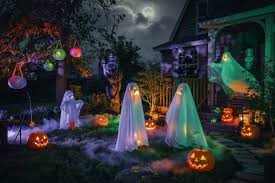
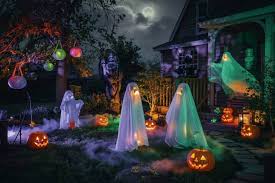
Halloween decorations can look completely different after sunset.
An inflatable that looks enormous during the day may lose half its details at night. A cemetery can disappear into a dark corner of the yard. Five individually illuminated inflatables can look like five unrelated decorations instead of one Halloween scene.
Meanwhile, one bright white porch light can flatten everything you were trying to make spooky.
The solution usually isn't adding as many lights as possible.
It's putting the right light in the right place.
For most residential Halloween displays, think about lighting in three layers:
Background lighting establishes the house, trees, shrubs and surroundings.
Scene lighting highlights inflatables, tombstones, ghosts, props and fog.
Visitor lighting helps people safely identify the walkway, steps and entrance.
Those layers have different jobs and shouldn't necessarily use the same lights.
The goal is simple:
Light the scene, not every object.
Table of Contents
Start Here: What Actually Needs More Light?
Before buying another light, go outside after dark and look at your display from the location where most people will see it.
For many homes, that's the sidewalk or street.
Don't start by looking for places to install lights.
Look for what disappears.
If an inflatable disappears or some of its details are difficult to see, targeted scene lighting may help.
If the inflatables are visible but look disconnected, don't automatically illuminate the inflatables more. Lighting a tree, shrub, section of the house or another background element can visually connect them.
If your decorations look good but the house disappears, architectural lighting can turn the house into part of the scene.
If you have fluorescent webbing, UV-reactive ghosts or similar props, black light may produce the effect you're missing.
If the walkway or stairs disappear, that's different. You have a visitor-lighting problem rather than a theatrical-lighting problem.
And if everything is already bright?
You may not need another light.
Sometimes the best improvement is removing or redirecting harsh illumination so shadows and contrast can return.
The Three Layers of a Halloween Lighting Plan
A good lighting plan doesn't require an enormous budget.
It requires giving each light a job.
Layer 1: Background Lighting
Background lighting establishes the setting.
Think about:
the house
porch
windows
trees
shrubs
fences
garage
other large background structures
Color-changing floods, string lights and permanent smart lighting can work particularly well here.
Layer 2: Scene Lighting
This is where the Halloween action happens.
Think:
inflatables
ghosts
tombstones
skeletons
witches
spider webs
props
fog
Spotlights, RGB floods, solar spotlights and black lights can all serve this layer, depending on what you're illuminating.
Layer 3: Visitor Lighting
Visitor lighting has a completely different job.
It should help people identify:
walkways
stairs
curbs
driveway edges
entrances
changes in elevation
Your Halloween scene can intentionally contain dark areas.
The route trick-or-treaters actually walk should not.
This distinction becomes especially important around inflatable displays because stakes and tether lines may occupy parts of the yard.
A Quick Way to Choose Halloween Lights
If you're trying to decide what kind of light your display actually needs, start with the problem:
A dark inflatable or individual prop: Try an adjustable RGB or RGBW spotlight.
A large section of house, shrubs or several decorations: Use a broader flood or background lighting.
A distant decoration where another cord is inconvenient: Consider a solar RGB spotlight.
Fluorescent webs, skeletons or UV-reactive props: Use a true black light.
Porch lanterns or compatible exterior fixtures: Consider flickering flame-effect bulbs.
Graveyards, witches or other scenes that need freestanding flame atmosphere: Consider solar flickering-flame torches.
Walkways, steps and the visitor route: Treat those separately with dedicated pathway lighting rather than relying on theatrical effects.
How to Light Halloween Inflatables
Most Halloween inflatables already contain internal LEDs.
Start by turning the inflatable on after dark without adding external lighting.
Then identify the problem you're actually trying to solve.
Front Lighting: Improve Visibility
If the front of an inflatable is too dark or certain details disappear, try a spotlight positioned from the general viewing direction.
Avoid placing the fixture directly at eye level.
Angle the beam so it terminates on the inflatable rather than continuing toward pedestrians, drivers or neighboring properties.
You usually don't need to make the entire inflatable dramatically brighter. You're trying to reveal details its internal lighting isn't showing adequately.
Side Lighting: Add Shape
Side lighting can sometimes be more interesting than pointing a flood directly at the front.
Light arriving from an angle creates highlights and shadows across a three-dimensional inflatable.
That can help define:
faces
arms
wings
hats
pumpkins
architectural details
Experiment with placement rather than assuming straight-on illumination is automatically best.
Backlighting: Create Separation
A light positioned behind or somewhat behind an inflatable can help separate it from a dark house, fence or tree line.
This can work particularly well with ghosts, pale-colored inflatables and translucent sections.
Make sure visitors don't look directly into the fixture.
The effect should be visible.
The light itself shouldn't be the focal point.
Remember What Happens When the Blower Turns Off
This is easy to overlook.
A spotlight that appears safely separated from an inflated decoration can end up underneath the fabric when the blower shuts down.
Leave enough clearance around stake lights, floodlights and other fixtures so the deflated fabric cannot simply collapse onto them.
Also keep lighting equipment from interfering with blower intakes, tether lines and anchors.
For a deeper look at setting up tether zones safely, see The Complete Guide to Installing and Securing Holiday Inflatables: Anchors, Wind Protection, Tie-Downs, Weights and Safe Setup.
Don't Give Every Inflatable Its Own Spotlight
If you own six inflatables, you don't automatically need six external lights.
Try illuminating the most important decorations while using background lighting to connect the group.
A colored tree behind several inflatables or a purple wash across the house may accomplish more than another individual spotlight.
Spotlights vs Floodlights: Which Is Better for Halloween?
Both can work.
They solve different problems.
Use a Spotlight When You Want to Target Something
A narrower landscape-style spotlight makes sense for:
one inflatable
a tombstone group
a tree trunk
a skeleton
a particular architectural feature
Stake-mounted lights are especially useful because their position and angle can be adjusted relatively easily.
Use a Floodlight When You Want to Cover an Area
A broader flood makes more sense for:
washing part of the house
illuminating several decorations together
lighting shrubs
creating a colored background
covering a larger cemetery scene
Don't choose between the two based entirely on brightness.
Beam coverage is part of the buying decision.


Color-Changing RGB Lights: The Halloween Workhorse
If you're adding one category of external lighting to an inflatable Halloween display, RGB or RGBW outdoor lighting is one of the most versatile places to start.
One system can become:
Purple for ghosts and graveyards.
Green for witches, monsters and toxic scenes.
Orange for pumpkins and traditional Halloween displays.
Red for a more sinister atmosphere.
Blue for spectral or moonlight effects.
Many color-changing lights can then be reused for Christmas, other holidays or ordinary landscape lighting.
Targeted Plug-In Lighting: SUNVIE RGBW Halloween Spotlights
SUNVIE RGBW Halloween Spotlights are particularly interesting for displays containing several individual decorations.
Instead of one large rectangular flood covering everything, multiple stake-mounted lights can be aimed at separate features.
For example:
one light → large inflatable
one light → tree
one light → cemetery
one light → porch or background prop
That flexibility makes this format particularly well suited to inflatable displays.
Start With One Color
RGB controls make it tempting to activate animated rainbow modes immediately.
Don't.
Start with one static color and look at the display from the street.
Then consider adding a second complementary color.
Only after the scene works with those colors would I experiment with fades or color-changing effects.
Two coordinated colors usually create a more deliberate Halloween scene than every fixture rapidly cycling through every available color.


Solar RGB Spotlights: When Running Another Cord Doesn't Make Sense
Solar lighting solves a genuine Halloween-display problem.
Imagine an inflatable, tree or prop near the far edge of your property.
A plug-in spotlight may require another long extension cord and another outdoor electrical connection.
A solar spotlight can eliminate that run.
Linkind Solar RGB Landscape Spotlights
Linkind Solar RGB Landscape Spotlights are a particularly useful option for these harder-to-wire areas.
Consider solar lighting when:
the location is far from an outlet
you want to minimize cords
the solar panel receives good daytime sunlight
moderate accent lighting is sufficient
easy seasonal installation matters
Plug-in lighting generally makes more sense when:
predictable brightness is important
the location receives poor sunlight
trees or the house shade the panel
the light must operate reliably for several hours every night
you're illuminating the primary focal point
A simple buying rule works well:
Choose plug-in lighting when the effect must work reliably every night. Choose solar when eliminating another cord is more valuable and the panel has a good charging location.
Solar isn't universally better or worse.
It's a location solution.


Black Lights: Fantastic for the Right Decoration and Almost Useless for the Wrong One
Black light doesn't behave like an ordinary purple spotlight.
Ultraviolet light can cause certain fluorescent and UV-reactive materials to glow.
That distinction is important.
Black Light Works Well With:
fluorescent paint
UV-reactive spider webs
fluorescent skeletons
specially designed ghost props
UV-reactive signs
neon-colored reactive props
toxic-waste themes
decorations specifically intended for black-light use
When Black Light Is Usually the Wrong Choice
Black light usually isn't the right solution for:
ordinary dark inflatable fabric
conventional gray tombstones
standard brown or dark props
decorations without UV-reactive material
anything you simply want illuminated purple
If the decoration isn't UV-reactive, use a colored light instead.
If you want a normal inflatable to have a purple glow, set an RGB spotlight to purple.
If you want fluorescent spider webbing to glow dramatically in darkness, that's when black light becomes useful.
Glostars 100W LED UV Black Light
An outdoor flood-style product such as the Glostars 100W LED UV Black Light can cover a larger UV-reactive scene than a small decorative bulb.
That makes it more appropriate for areas containing multiple reactive props.
Homeowners who already have compatible outdoor flood fixtures may also consider black-light bulbs rather than adding another standalone fixture.
In either case, verify the exact product's intended installation and outdoor rating before exposing it to weather.


Flickering Flame-Effect Bulbs: A Simple Porch Upgrade
Not every Halloween lighting improvement requires another extension cord or fixture in the yard.
Replacing an ordinary bulb in a compatible fixture with a flickering flame-effect LED can change the appearance of an entryway in minutes.
Hompavo Upgraded Flame Light Bulbs
The Hompavo Upgraded Flame Light Bulbs, 2 Pack provide a simple option for creating a simulated flame effect in compatible fixtures.
Potential locations include:
porch lanterns
carriage lights
garage sconces
covered entry fixtures
decorative lamps
appropriate window displays
A flame-effect bulb can be particularly convincing when the fixture itself already resembles a lantern.
Instead of a normal white porch light sitting beside your Halloween display, the fixture becomes part of the atmosphere.
Check Your Fixture First
Before buying, verify:
bulb base
bulb dimensions
fixture clearance
intended operating orientation
enclosed-fixture compatibility where applicable
suitability for the intended installation location
A bulb fitting into the socket does not automatically mean it is appropriate for every fixture or location.


Want the Flame Effect Away From the House? Try Solar Flame Torches
Flame-effect bulbs work particularly well when you already have a compatible porch lantern or exterior fixture. But sometimes you want that flickering effect somewhere there isn't a light socket.
That's where solar flickering-flame torches become interesting.
Instead of treating them as general landscape lighting, I would use them as atmospheric lights around a specific Halloween scene. A few carefully placed torches can help define the edge of a graveyard, add warm flickering light around skeletons or witches, illuminate the perimeter of a haunted display area or create a transition between different parts of the yard.
The advantage is placement. Because the lights charge during the day, you can create a flame effect in parts of the yard where running another extension cord would be inconvenient.
Where Flame Torches Work Best
Consider them for:
graveyard boundaries
skeleton and witch scenes
beside decorative fencing
around a haunted display zone
near trees or shrubs
transitions between themed areas
atmospheric lighting beside a visitor route
That last use needs an important distinction.
A flickering flame effect can contribute atmosphere beside a trick-or-treat route, but it shouldn't be responsible for making the walking surface safe and visible. Keep decorative torches outside the walking area and use dedicated visitor lighting where people actually need to see steps, pavement and changes in elevation.
As with other solar lights, check whether the charging location receives enough direct daylight. A heavily shaded part of the yard may produce disappointing nighttime performance.


Halloween String Lights: Use Them to Connect the Scene
String lights are another category where placement matters more than novelty.
Minetom 500 LED Smart Color-Changing Lights
The Minetom 500 LED Smart Color-Changing Lights offer enough length and color flexibility to function as background lighting rather than simply another small decoration.
Possible uses include:
porch railings
shrubs
fences
trees
background landscaping
windows
edges of a display area
Don't Wrap Everything
You don't need to turn every object into a glowing outline.
Try using string lights as the background layer.
For example:
three illuminated inflatables
purple and orange lighting through shrubs behind them
one colored wash on the house
can feel much more intentional than three inflatables surrounded by unrelated novelty lights.
How to Light the Exterior of Your House for Halloween
Your house may be the largest object in the entire display.
Ignoring it can create an odd nighttime effect where brightly illuminated decorations appear to float in front of a black rectangle.
You don't need to illuminate the entire structure.
Choose architectural areas that help frame the display.
Wash Part of the House With Color
RGB floodlights can illuminate:
a garage wall
front gable
porch
chimney
columns
architectural recesses
A broad colored wash creates a backdrop without requiring dozens of individual lights.
Uplight Architectural Features
Lights positioned low and aimed upward can create exaggerated shadows.
Trees and columns become especially dramatic when illuminated from below.
Check the beam direction after dark so the light terminates on the intended surface rather than shining toward neighbors, windows, pedestrians or traffic.
Limit the Color Palette
RGB systems may offer millions of colors.
You don't need to use all of them.
A few simple combinations:
Purple and orange — classic Halloween
Green and purple — witches and monsters
Red and amber — fire or sinister scenes
Blue and purple — ghosts and spectral scenes
Two or three coordinated colors usually create a stronger visual identity than constant rainbow cycling.


Already Have Permanent Smart Outdoor Lights? Use Them
Permanent exterior lighting has become another option for homeowners who want one lighting system for multiple seasons.
Govee Permanent Outdoor Lights Pro
The Govee Permanent Outdoor Lights Pro, 200 ft represents the premium end of this approach.
For someone who already owns permanent smart lighting, Halloween can simply become another lighting scene.
Use the permanent lights as the background layer, then add temporary spotlights, black lights, fog and inflatables in the foreground.
Should You Install Permanent Lights Just for Halloween?
For most homeowners, probably not.
Permanent lighting makes considerably more sense if you also want:
Christmas lighting
other holiday displays
sports or team colors
architectural accent lighting
year-round exterior lighting
Halloween then becomes another use for the system rather than the sole reason for the investment.
If your only problem is one dark inflatable, a targeted spotlight is a much more sensible solution.
Turn Your Windows Into Part of the Halloween Display
Windows are useful Halloween display space.
And because much of the equipment can remain indoors, they open several relatively simple possibilities.
Colored Interior Lighting
A suitable colored light inside a room can make the entire window glow orange, red, purple or green.
Add a silhouette and the effect becomes considerably stronger.
Backlit Silhouettes
A dark witch, monster, ghost or other figure placed between the light and window can create an inexpensive scene visible from outside.
Projection
Animated window scenes can go considerably further.
Once you're projecting digital content, however, projector brightness, placement, projection material and image selection become more important than general Halloween lighting.
For that setup, see Best Halloween Projectors: From Simple Ghost Lights to Animated Window Displays.
Lighting Trees, Shrubs and the Space Between Decorations
Some of the most useful things to illuminate aren't Halloween decorations at all.
A tree can become an enormous Halloween feature with one green or purple uplight.
A hedge can become the background for a cemetery.
A fence can visually define one edge of the scene.
This is also one way to solve the “collection of inflatables” problem.
Instead of:
inflatable → darkness → inflatable → darkness → inflatable
you can create:
lit tree → inflatable group → illuminated cemetery → fog → haunted scene → colored house background
The decorations now occupy one visual environment.
That's something lighting can accomplish that another inflatable often can't.
How to Light Halloween Fog
Fog makes light visible in the air.
That means colored lighting and fog can create effects that neither produces alone.
Try positioning a light:
behind the fog
beside the fog
low to the ground
behind a tombstone group
behind an inflatable scene
Experiment with purple, green, blue and red.
Avoid pointing the light directly toward viewers.
And don't assume more fog produces a better lighting effect. Excessive fog can hide the decorations you're trying to illuminate.
For machine placement, low-lying effects, fog fluid and weather considerations, see How to Use a Fog Machine for a Halloween Display: Inflatables, Placement, Low-Lying Fog and Safety.
Smart Lighting, Timers and Controls
Smart lighting becomes useful when you want more than a static color.
Depending on the system, controls may allow you to:
schedule lights
coordinate colors
save scenes
dim sections
create transitions
change multiple display areas without walking around the yard
But “smart” doesn't automatically mean better.
If you simply want four lights to remain purple every evening, a straightforward control system may be easier.
If you want the house, shrubs and several display zones coordinated together, smart controls become much more useful.
For most residential displays, slow transitions or static colors are also easier to watch than intense rapid flashing.
Keep Theatrical Lighting Separate From Walkway Lighting
A Halloween cemetery may look great almost completely dark.
Your front steps probably won't.
Those are different lighting jobs.
Visitor routes need enough visibility for people to identify:
the walkway
steps
curbs
changes in elevation
driveway edges
the entrance
This is especially important with inflatable displays because stakes and tether lines may occupy parts of the property.
Fog can make those obstacles even harder to see.
Whenever practical, physically separate the walking route from inflatable tether and stake zones.
You don't necessarily need to flood the property with bright white security lighting. Carefully positioned path lighting can preserve the Halloween atmosphere while making the intended route easier to follow.
We'll cover product choices, placement, stairs, decorative pathway lights and cord-free options separately in Best Halloween Walkway Lights and Safe Path Lighting for Trick-or-Treaters.
Outdoor Electrical and Weather Considerations
Every additional plug-in light adds another piece of electrical equipment to the display.
Use equipment appropriate for the location and conditions where you're installing it.
Pay particular attention to:
outdoor ratings
plugs and connections
extension cords
wet locations
cable routing
outlet capacity
timers and controllers
An outdoor-rated fixture also doesn't automatically mean every plug, controller and extension connection attached to it can sit exposed to water.
For electrical problems involving multiple inflatables, lights and accessories, see Outdoor Holiday Power Troubleshooting Guide: Why Decorations Fail and How to Fix Them.
12 Halloween Lighting Mistakes That Can Hurt Your Display
1. Lighting Everything Equally
Your focal point should look more important than the background.
If everything has identical brightness, nothing stands out.
2. Using Too Much White Light
Bright white light can eliminate the shadows and color contrast that make Halloween lighting effective.
Use it intentionally rather than automatically.
3. Aiming Lights at Viewers
The beam should terminate on the object or surface you're illuminating.
Check the display from the sidewalk and street after dark.
4. Putting Lights Too Close to Inflatables
Very close lighting can create harsh hotspots and awkward shadows.
It can also create placement problems when the inflatable deflates.
Give fixtures adequate clearance.
5. Buying a Black Light for a Non-Reactive Decoration
If the material isn't UV-reactive, use an RGB or colored spotlight instead.
Black light isn't simply another name for purple illumination.
6. Using Every RGB Color at Once
A controlled two- or three-color palette usually looks more intentional than constant rainbow cycling.
7. Ignoring the House
Your house can become the backdrop connecting the entire display.
Sometimes one colored wall wash accomplishes more than another lawn decoration.
8. Ignoring the Dark Space Between Inflatables
Lighting trees, shrubs, fog or background structures can visually connect separate decorations.
9. Assuming Solar Works Everywhere
Solar lights need adequate charging conditions.
A heavily shaded location may need plug-in lighting instead.
10. Making the Walking Route Too Dark
Atmosphere shouldn't prevent visitors from identifying the intended path.
11. Adding Lights Without Considering the Electrical Setup
More decorations and lights mean more electrical load and more outdoor connections.
Plan accordingly.
12. Testing the Display Only During the Day
Lighting decisions need to be made at night.
Set everything up, walk to the normal viewing location and look at the display from the visitor's perspective.
Build a Better Halloween Lighting Plan by Budget
You don't need to transform everything at once.
Around $25: Fix One Problem
Choose the most obvious weakness.
That might mean:
solar spotlights on a distant decoration
flame-effect bulbs on the porch
one or two solar flame torches around a graveyard or themed scene
string lights in the background
one targeted black light for UV-reactive props
Don't try to light the entire property with a small budget. Fix the part of the nighttime display that currently disappears, looks disconnected or lacks atmosphere.
Around $50–$100: Create Layers
This is where you can begin combining:
RGB spotlights
background string lighting
porch effects
existing inflatable lighting
Instead of buying several unrelated novelty lights, create a foreground and background.
Around $100–$200: Create Zones
A larger budget can illuminate several areas independently.
For example:
Zone 1: inflatable focal area
Zone 2: cemetery
Zone 3: house/background
Zone 4: trees or shrubs
Each area can use different intensity or color while remaining part of one coordinated palette.
Higher Budget: Smart or Permanent Lighting
If you want app-controlled scenes, coordinated zones or permanent exterior lighting, systems such as Govee Permanent Outdoor Lights Pro become relevant.
But permanent lighting is an optional step-up.
It isn't required for a great Halloween display.
Frequently Asked Questions
What color lights work best for Halloween?
Purple, orange, green, red and blue can all work for different themes. Instead of choosing one universal Halloween color, match the colors to the scene and limit the overall palette to a few coordinated choices.
What is the best way to light a Halloween inflatable?
Turn the inflatable on after dark first and identify what's missing. Use front lighting for visibility, side lighting for shape or backlighting for separation. You may discover that illuminating the background produces a better result than putting another light directly on the inflatable.
Should I use spotlights or floodlights?
Use spotlights for individual objects and floodlights for larger areas. A stake spotlight can target one inflatable or tree, while a flood can wash a house wall or group of decorations.
Are solar lights good for Halloween displays?
They can be useful for remote areas where running another cord is inconvenient, provided the solar panel receives adequate daytime charging. For important focal lighting or heavily shaded locations, plug-in lighting may be more dependable.
Should I use a black light or purple light?
Use black light for fluorescent or UV-reactive materials. If the decoration isn't designed to react to ultraviolet light and you simply want it illuminated purple, use a purple or RGB spotlight instead.
Where should I put Halloween floodlights?
Position them so the beam hits the intended house surface, tree, prop or decoration without shining directly toward visitors, drivers or neighboring properties. Low-angle uplighting can create dramatic shadows.
Can I use regular outdoor landscape lights for Halloween?
Yes. Color-changing outdoor landscape lights can be particularly versatile because they may also be reused for Christmas, other holidays and ordinary landscape lighting.
Are flame-effect bulbs worth using?
They can be an inexpensive way to transform compatible porch lanterns and exterior fixtures. Verify bulb base, dimensions, fixture compatibility and intended installation conditions before purchasing.
How do I make several inflatables look like one display?
Don't automatically add more light to every inflatable. Use background lighting on the house, trees, shrubs or fog to create a common visual environment around them.
How do I light a Halloween walkway without ruining the spooky effect?
Treat visitor lighting separately from theatrical display lighting. Use controlled illumination to make the intended route, steps and potential hazards easier to identify without flooding the entire yard with bright light.
Final Thoughts
The best Halloween lighting plan isn't necessarily the one with the most lights.
It's the one where every light has a reason to be there.
Start by looking at your existing display after dark.
If an inflatable disappears, illuminate it.
If several inflatables look disconnected, illuminate the background or the space between them.
If the house disappears, use it as a colored backdrop.
If fluorescent decorations need to glow, add black light. If they aren't UV-reactive, skip the black light and use colored illumination instead.
If running another cord across the property doesn't make sense, solar spotlights give you another option.
If a porch lantern needs more Halloween character, a flame-effect bulb can change the atmosphere without adding another fixture. And if you want that flickering effect farther into the yard, solar flame torches can bring it to a graveyard or themed scene without another extension-cord run.
And if you already own permanent smart exterior lighting, let the house become the background layer rather than installing another temporary system solely for Halloween.
The guiding principle is simpler than the technology:
Background → scene → visitor route.
Give those three layers their own jobs, and even a modest collection of Halloween inflatables can look much more like a deliberately designed display.
Continue Reading
Best Halloween Projectors: From Simple Ghost Lights to Animated Window Displays
Explore projection options for adding moving ghosts, animated windows and other eye-catching effects alongside your Halloween inflatables and outdoor lighting.
How to Use a Fog Machine for a Halloween Display: Inflatables, Placement, Low-Lying Fog and Safety
Learn how to position and use fog around inflatables and lighting to create a more atmospheric Halloween display while keeping visibility and safety in mind.
Outdoor Holiday Power Troubleshooting Guide: Why Decorations Fail and How to Fix Them
Troubleshoot common power problems that can cause outdoor lights, inflatables and other powered decorations to flicker, shut off or stop working altogether.
The Complete Guide to Installing and Securing Holiday Inflatables: Anchors, Wind Protection, Tie-Downs, Weights and Safe Setup
Learn how to anchor and secure outdoor inflatables so your Halloween display stays upright, properly positioned and better protected when wind and bad weather arrive.
